Building a safer Israel for the next generation.
Acharei HaChagim: Our Children’s Recovery Can’t Wait for Next Year
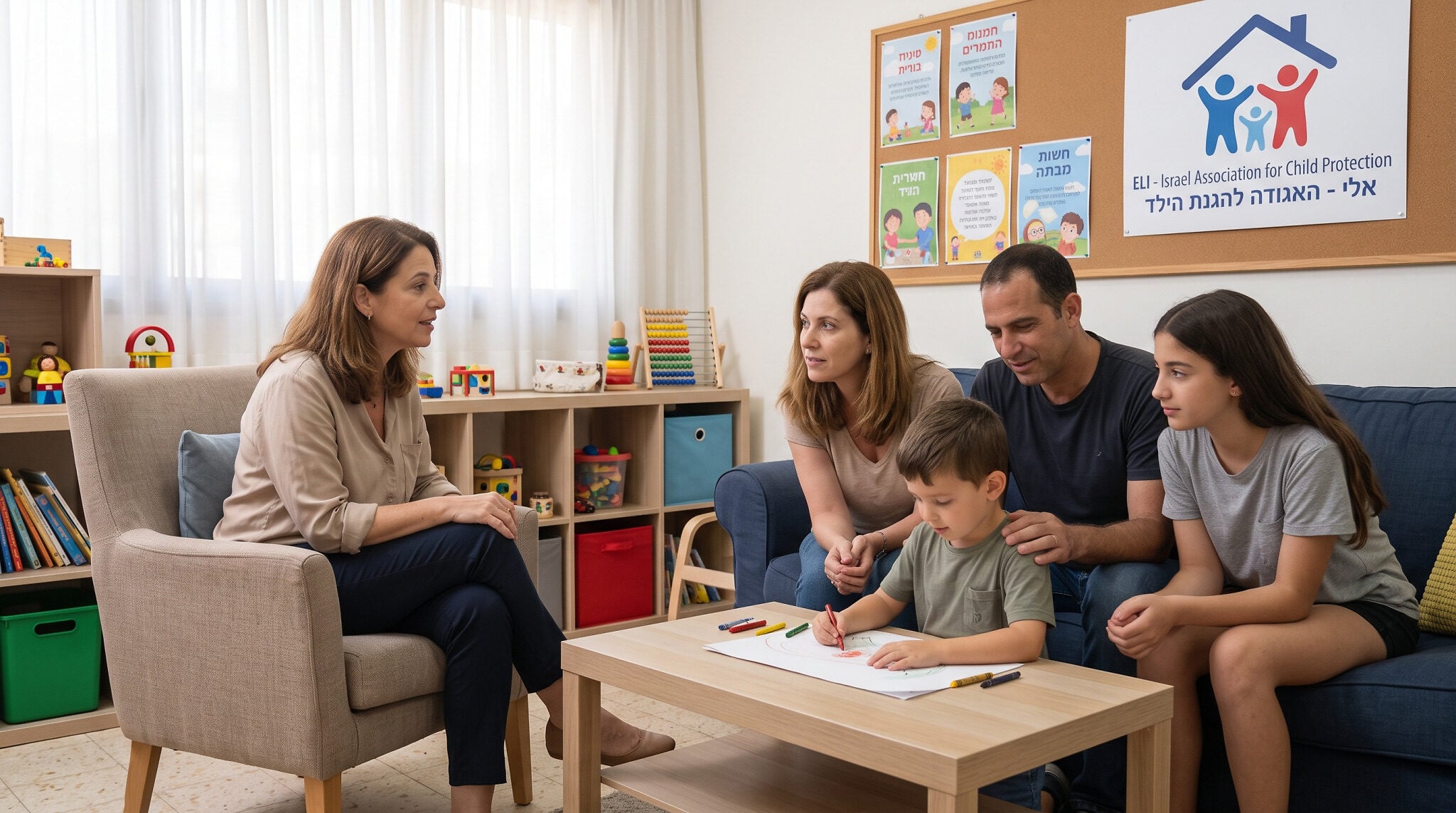
Long-term recovery requires ongoing support: An example of a family engaged in a therapeutic session at ELI - Israel Association for Child Protection.
Every Israeli knows the phrase. Acharei hachagim. After the holidays.
It is the answer to almost every question asked in September. When will the contractor finish the kitchen? Acharei hachagim. When does the new project launch? When will I finally start that diet, call the accountant, book the doctor’s appointment? Acharei hachagim. For a month, the whole country runs on a different clock, and everything that isn’t urgent quietly waits.
Well, the holidays are over. The sukkah is folded and back in storage. The children are back in school. And this year, acharei hachagim lands at a moment we can’t afford to postpone: the start of the fourth year since October 7.
In the weeks and months after that day, Israel did something extraordinary. Therapists volunteered around the clock. Donors here and abroad moved faster than any of us had ever seen. Schools, municipalities and nonprofits like ours built responses overnight. It was emergency mode at its very best, and it saved a great deal.
But emergency mode is built for weeks. Childhood trauma unfolds over years.
The children who were 5 on October 7 are now 8. The ones who were 12 are teenagers. The ones who were 15 are now in uniform, carrying their own experiences of that day into a military service that asks a great deal of them. Each new stage of development gives old pain a new way to come out. A child who seemed fine at 6 may struggle badly at 9, when they finally have the words, the questions and the self-awareness that make a memory heavier, not lighter.
Meanwhile, many of the systems built to support them are still funded and organized as if the crisis has a beginning and an end.
There is another part of this story that is harder to talk about, and at ELI – Israel Association for Child Protection we can’t look away from it. Research around the world consistently shows that prolonged stress raises the risk of neglect and abuse at home. So do economic strain, displacement and a parent who is absent or overwhelmed. Israeli families have lived with all of these for three years: reservist parents called up again and again, families evacuated from their homes, parents who are themselves grieving or traumatized. Most of these families are doing heroic work under impossible conditions. But exhaustion does not make anyone a better parent, and children are the first to feel it when the adults around them are running on empty.
So, now that it is acharei hachagim, here is what I believe we need to stop postponing.
First, meet children in the classroom, in a language they understand. Schools are where children spend most of their waking hours, and where trouble usually shows first. But a lecture about “personal safety” or “emotional resilience” rarely reaches an 8-year-old. A story, a game or a play often does. At ELI, we have learned that edutainment (a play or musical about a sensitive topic) works: material that entertains while it teaches gives children the words to describe what they feel and what is happening to them, and the confidence to tell a trusted adult. When a child can name it, an adult can help. Every school in Israel should have tools like these, along with teachers trained to respond when a child finally speaks up.
Second, build the capacity to match the need. This week I sat down with ELI’s financial reports from the past five years. Since 2021, when I took on this role, the amount of work we do has nearly tripled. I am proud of that, and proud of the team that made it happen. But the number is also a warning. The need isn’t shrinking, and organizations like ours cannot keep stretching the same resources further and further. Growth like this needs to be met with real investment in trained professionals, in infrastructure and in multi-year funding that lets us plan beyond the next crisis. This is where agile philanthropy proves its worth: not only in how quickly money arrives in an emergency, but in staying the course once the headlines have moved on.
Third, go where the people are. Too many families who need help will never walk into a clinic. They live far from services, or they’re juggling a parent on reserve duty, or they’ve been evacuated from their homes, or they’re simply too exhausted to take one more appointment. So we have to bring the help to them. ELI’s mobile therapy rooms do exactly that, bringing a safe, private space (on wheels) for treatment to the communities that need it, rather than waiting for children to find their way to us. When the road to help is shorter, more children make the trip.
We have just spent a week in our sukkot: gentle shelters, open to the sky, that remind us how much we depend on one another. When the week ends, we go back inside, to the homes that hold us all year long.
For three years, so many people have built sukkot for our children, with enormous love, when they were needed most. Now, together, we can build on that: a home with a strong foundation, where children can keep healing for years to come.
The holidays are over. There is no better way to begin the new year.
Related Topics