
AI Security Summit: Reflections and Insights
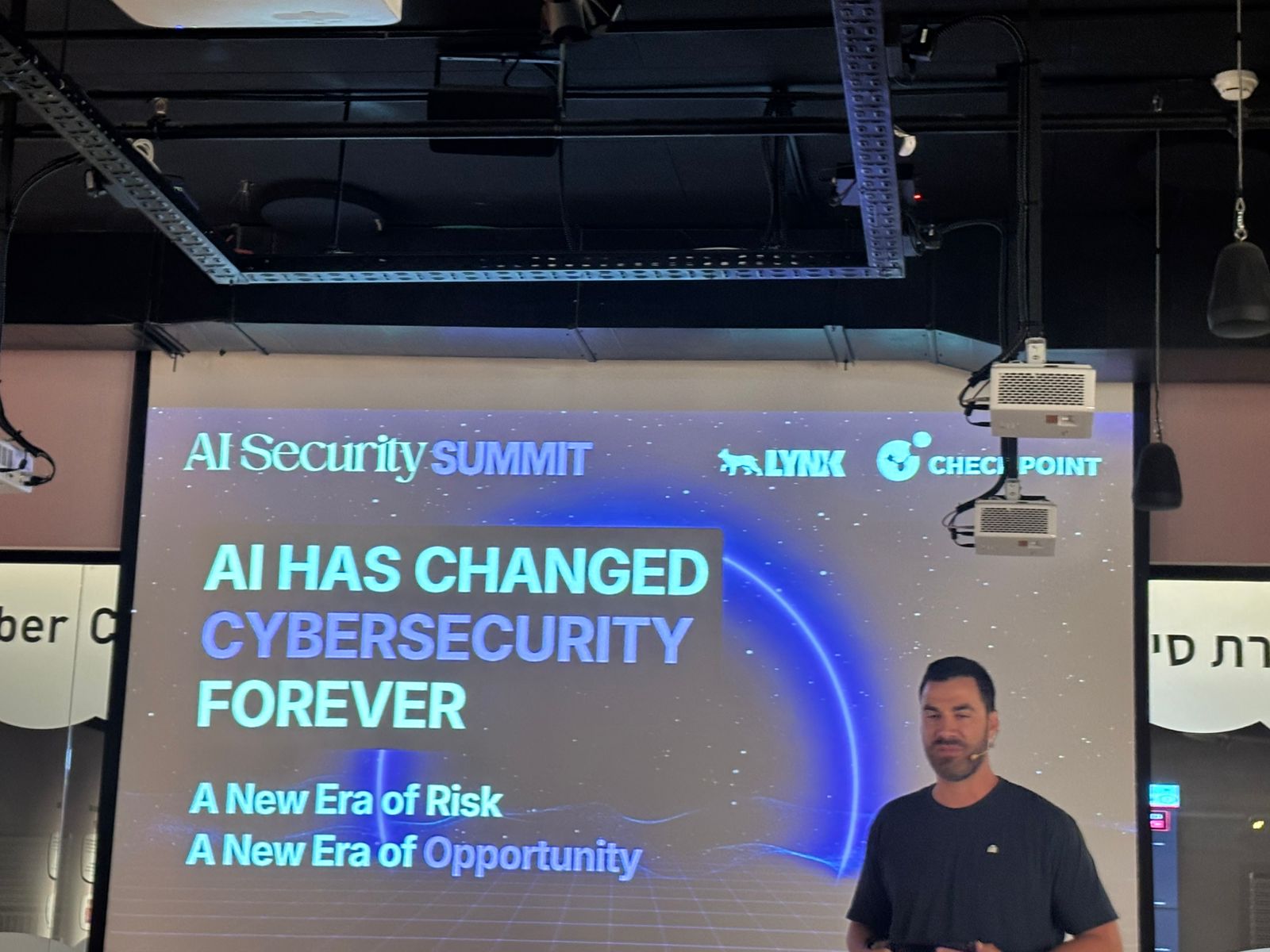
Yesterday, I attended the AI Security Summit, organized by LYNX in collaboration with Check Point Technologies, which brought together founders, CTOs, and cybersecurity leaders to discuss how artificial intelligence is fundamentally reshaping the threat landscape.
The event featured panels with industry figures from companies including Zafran Security, Check Point, NTT Innovation Laboratory Israel, Charm Security, Macaabi, and Aryon Security, among others, exploring the opportunities and risks created by increasingly autonomous systems.
What stood out most was the scale of the challenge. According to figures presented during the summit, 87% of organizations have already experienced AI-driven attacks, while 80% of phishing emails are now generated by AI. Attackers can execute up to 36,000 vulnerability scans per second, with 80–90% of attack steps already automated in recent campaigns. At the same time, AI is also becoming essential for defense, with systems detecting 77% of real software vulnerabilities.
The message was clear: cyber operations are rapidly moving toward complete autonomy, making AI not simply another tool, but a transformative force creating an entirely new era of unparalleled risk for the cybersecurity industry.
I should note that I come to this conversation with a particular vantage point. Over the last two years, I have been writing extensively about AI and its negative consequences for humanity. In every article, I presented first-hand sources to explain how this technology is an all-encompassing negative force with extinction-level consequences. AI is a transparently destructive element that erodes institutions, displaces human agency, and carries the potential for civilizational collapse, as we know it.
The panels the AI Security Summit were among the most candid conversations I’ve encountered in the Israeli tech scene. Speakers did not shy away from the uncomfortable math: the attack surface is growing faster than any defense can be built
The Huskeys´ founder, Itai Gafni framed it bluntly, this is a business problem that has been underperforming for years, and the goal remains as simple and as impossible as filtering good traffic from bad.
Another slide that stayed with me came from Aryon, mapping the agentic (something that behaves with a degree of agency) future in clean corporate typography: humans talking to machines in natural language, machines reasoning and acting autonomously, agents communicating with each other. Traditional controls, the slide admitted, were not built for this. No one said it out loud but the industry is trying to catch up to a Ferrari using a scooter.
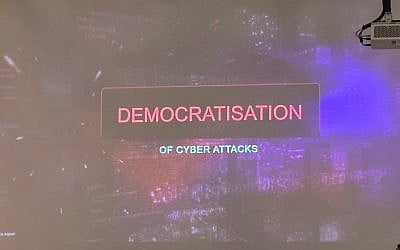
Then there was Check Point’s single-slide gut punch: the democratisation of cyber attacks. That phrase deserves to sit with you for a moment. What AI has done to the threat landscape is not merely accelerate existing dangers. IT has handed sophisticated attack capability to anyone with a laptop and a prompt. The barriers that once made large-scale cyber warfare the domain of nation-states and well-funded criminal organisations have effectively dissolved.
This is what the industry is grappling with, and I credit the panelists for naming it clearly. But naming a problem is not solving it. Every defensive tool presented at the summit runs on the same technology fueling the offense. The industry is not getting ahead of AI; it is running inside it, hoping the same engine powering the attack can somehow outpace itself on defense.
There are no positive sides to AI in this equation: only an accelerating race where the asymmetry has already shifted, permanently, toward those who wish to cause harm.
To benefit from the positive aspects arising from the use of AI (like the increased efficiency across nearly all areas of human activity, particularly in technological, scientific, and medical research, such as enhanced support for people with disabilities, to mention only a few dimensions of this transformative revolution) it is urgent to overcome these cybersecurity risks and to reflect seriously on the many other challenges that this powerful technology brings with it.