
America has no alternative to decisive victory. Why that is and how to win
Dear readers,
The following text builds on the ideas I expressed a few days ago, on July 18, in a text written here, and also on an article I wrote almost two years ago, entitled ‘Why America Stopped Wining Wars.’ At the present moment, with the war against the Iranian regime suspended since approximately the early afternoon of last Friday, 24 July, and with President Trump saying later that same day that he has “not made a decision on major strikes,” I explain why the United States has no alternative to winning the war decisively, why that is the case and how the war can be won. Read on:
America has no alternative to decisive victory. Why that is and how to win
Since winning the Second World War decisively and therefore becoming the world’s most powerful country, the United States has chosen either to wage highly constrained wars, or not to fight at all. These decisions led to stalemates or outright defeats, culminating in the multi-dimensional crisis of the present. Now, the Iranian regime must be forced to capitulate, but this requires the policies of the past to be discarded.
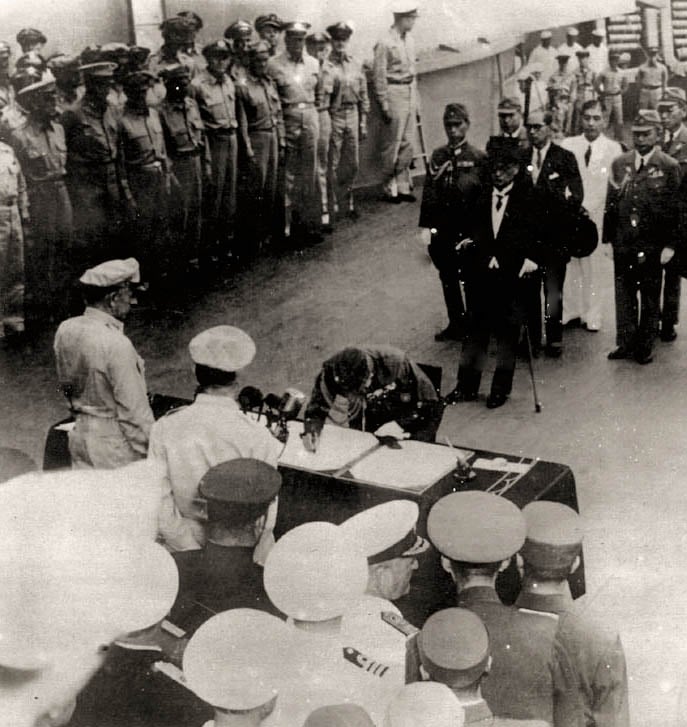
The surrender of the Empire of Japan in Tokyo Bay on September 2, 1945 marked the culmination of America’s campaign to crush the Axis powers. Allied to the British Commonwealth and Empire, and to the Soviet Union, the United States obliterated the armed forces of its enemies and imposed on all of them a permanent and fundamental change in the way they were governed. All three of these countries, Germany, Italy and Japan, became and have since remained America’s friends and allies. Without this decisive outcome, American post-war strength and prosperity would not have been possible.
Even in 1945, the central pillar of this strategic success was not American decision-making. In fact, America’s strategy until Japan’s attack on Pearl Harbor on December 7, 1941 had been woeful. France and Britain had been left to confront Germany unsupported, with catastrophic consequences. France simply collapsed, and surrendered to Adolf Hitler on June 22, 1940. If Britain’s Prime Minister, Winston Churchill, had not forced Britain to fight with the utmost energy, the country would either have made terms with Hitler, or else fought an insipid Phony War, as it had done before Hitler invaded France. Had that happened, Hitler would have been free to crush the USSR without the critical distraction of a two-front war, and Nazi Germany, not the United States, would have become the world’s greatest power.
Churchill’s tragedy was that he saved the world, in the very literal sense of that phrase, but lost his country. After 1945, Britain was not only financially bankrupt, but morally exhausted. It has not played a decisive role in any significant conflict since. In a critically important sense, America has been alone, bereft of a great power ally, ever since. American passivity in the years before Pearl Harbor has cast a very long shadow.
America never really learned the lessons of the pre-war period, and since 1945 has fallen into wars rather than either prevented or initiated them. In Korea, the next big war fought by the United States, America was forced to fight off a Soviet-supported North Korean invasion. The war was nearly lost, twice. First, the North Koreans forced American and South Korean troops to retreat all the way back to the Pusan perimeter in the far south-east of the Korean peninsula. Then, the Allies recovered and nearly liberated the entire peninsula, only to collapse in the face of a Chinese invasion and lose Seoul a second time. The South Korean capital was liberated a second time, but then America chose to fight a limited war to preserve the stalemate along the thirty-eighth parallel, the internal Korean border. Now, Kim Jong-un, the grandson of Kim Il-sung, has intercontinental ballistic missiles (ICBMs) and nuclear warheads. Nobody is paying attention, because there are already too many other crises, but the problem not solved in the 1950s has grown much worse, and is very likely to explode in the future.
The deliberately chosen stalemate in Korea was followed by decisive defeat in Vietnam. Looking soberly at the facts, American involvement was late, again, and forced by events, again. The Ho Chi Minh Trail, sending North Vietnamese supplies and later also ground troops into the South, commenced operations in 1959. At the time of the Tonkin Gulf Resolution which authorized the use of American armed force five years later, the United States was already faced with the choice of either letting the South fall, or fighting a large war.
Already then, America was unwilling to fight, let alone fight decisively. Vietnam became a war of bombing halts and cease-fires for Tet, the Vietnamese new year. America dropped 7.5 million tons of bombs, mostly on South Vietnam, but did not blockade the North Vietnamese port of Haiphong until May 1972. Soon thereafter, the United States signed the January 1973 Paris Peace Accords and abandoned the war to defeat and its South Vietnamese ally to destruction. The shame of that betrayal, and the Cambodian genocide that would soon follow, has far from always been acknowledged, but has pursued America ever since.
The scale of the crisis caused by defeat in Vietnam was tempered by the fact that America had at least fought actively for eight years. Much had happened in that time. Maoism exhausted itself, and Mao Zedong’s Cultural Revolution, initiated in August 1966, exhausted China. The Sino-Soviet split became incapable of being repaired with the outbreak of border fighting over Damansky island in March 1969. The Soviet leadership, including General Secretary Leonid Brezhnev, became increasingly geriatric and incapable of sustaining the regime. By the time of his summit with President Gerald Ford in November 1974, months before South Vietnam fell, Brezhnev was a visibly old and unhealthy man.
The accelerating collapse of the USSR, culminating in the fall of the Berlin Wall on November 9, 1989 and then the fall of the Soviet empire in August 1991 masked America’s own feebleness. Francis Fukuyama ludicrously proclaimed “the end of history” in the summer of 1989, even before the Wall fell. The Soviet Union had stopped functioning and then collapsed, but the United States felt as if it had actively won the Cold War, not simply passively watched its adversary disintegrate.
The post-Cold War delusion of American power and American success was born, helped by an easy victory against Saddam Hussein’s badly trained Iraqi armed forces in the Gulf War of 1991. Bill Clinton became the worst President in American history, because he did absolutely nothing to secure America’s future in a situation when the Soviet Union had imploded, while China was not yet a major power. A golden opportunity, which may not recur for many bloody decades, was thrown into the gutter.
History came back very quickly, and so did the historical failures. After the terrorist attacks of 9/11, America had to hunt al Qaeda and had to fight the Taliban. Following initial success and the rapid fall of Kabul, America let the terrorists slip across the border into Pakistan and enjoy a permanent safe haven there. A naval blockade of Pakistan’s coast and other economic pressure could have changed this, but this was never done. Pakistan was considered America’s ally, indeed it still retains the formal label of Major Non-Nato Ally. For two decades, America fought a war which was unwinnable by definition, because of its own fundamental strategic choices. Then the Taliban invaded Afghanistan from Pakistani territory, and everything America had tried to build for many long years in Afghanistan went up in flames over a few short months in 2021.
The parallel war in Iraq, so often considered a misguided ‘war of choice,’ was in fact an essentially inevitable result of America’s previous strategic failures. Living safely during the post-Cold War peace, not doing anything about Saddam Hussein’s regime in Iraq, was never tenable. Iraq’s great oil reserves, and the consequent mountain of petrodollars available to Saddam, meant he would never stop being a menace. The choice was to leave him in place, and see him or his sadistic sons, Uday and Qusay, eventually turn Iraq into another North Korea, or to get rid of him.
President George W. Bush was right to overthrow Saddam, but he was fundamentally wrong in attempting to turn Iraq, a tribal and sectarian Arab society, into a democracy. He was even more wrong to let Iran send money and weapons to the so-called Special Groups, Iraqi Shia armed gangs which became the basis of the Iraqi Shia militias of the present, without any consequences.
America should have withdrawn to safe bases in pro-American Iraqi Kurdistan, and then hit both the Special Groups and Iran very hard – long before Iran had advanced its nuclear weapons program or built its extensive ballistic missile arsenal. Instead, the war dragged indecisively on, and the term ‘forever war’ was used to describe it. Right now, America is about to finally withdraw all troops from Iraq, an inevitable measure given that the small forces now in the country are vulnerable to attack. This withdrawal, if Iran’s regime will remain undefeated, will be followed by the domination of Iraq, with all its oil, by Iran and those Shia militias that America has failed to deal with. The two-decade stalemate in Iraq could well become yet another American defeat in 2027.
In strategic terms, America’s back is now to the wall. It has not won a single war decisively in over eighty years, while suffering decisive defeats in both Vietnam and Afghanistan. The United States does not remember that at its core, war is very simple. Either you impose your will, and hence your preferred policies, on the enemy, or the enemy imposes his will on you. America failed to impose its will on both North Vietnam and the Taliban, so they imposed their will on America. Wars which America could not have lost militarily were lost politically, and the same pattern is recurring with Iran. The Iranian regime’s military was never efficient, and has now been largely defeated. Yet, America’s restraint in its choice of targets means the regime itself remains functional, and remains willing to impose its will on America.
The current series of strikes on Iran, limited by definition and having as its aim the curtailment of the regime’s attacks on shipping, is the epitome of the wrong choices of past failed wars. Any particular mode of attack chosen by any particular enemy of America is a second-order effect. The first-order problem is the willingness and the ability of the enemy to attack in the first place. The only way to solve the problem is to remove that willingness and that ability, to impose an indomitable American will on the enemy, in this case the Iranian regime. Limited action cannot and will not achieve this. Either America breaks the regime, as it broke Nazi Germany, Fascist Italy and Imperial Japan, or the regime will not stop working to restore its nuclear program and missile arsenal.
The way to breaking the Iranian regime lies wide open. Its air defenses are largely ineffective, its navy and air force are irrelevant. American and Israeli forces can make it impossible for the regime to function by destroying its oil export terminals, its refineries and its transportation infrastructure. Without a source of export earnings, without fuel to run its armed forces and without the ability to move goods around the country, the regime will fall into a state of impotence and of irrelevance.
Of course, this will have a strong impact on the population, which will live in a state of national dysfunction and economic collapse. Yet, if this is not done, the medium-term consequences for the population of Iran will be worse. The regime, which does not hesitate to commit mass murder, will remain. Its weapons programs will be gradually restored, and perhaps not even gradually, if China sees the situation as a key opportunity to take advantage of American failure. The people of Iran will be living in an emboldened tyranny; at a minimum willing to threaten to use nuclear weapons in the future, and perhaps even willing to use those weapons, which would invite a nuclear response. Therefore, it is a false humanitarianism to preserve Iran’s fuel economy and transportation infrastructure. These allow the regime to function, and the regime will continue to become ever more extreme.
As a direct consequence of past stalemates and defeats, and the indecisive nature of the way in which the current war is being prosecuted, a majority of Americans think going to war was the wrong decision. 57% of those polled, including 89% of Democrats, hold this view, according to the July 13 Economist / YouGov Poll. Almost half the population, 46%, thinks the war will last a year or longer. A Fox News poll of July 20 indicates that only 35% of Americans think the opposite, that the war will conclude within less than a year. The war is not being won decisively, and America is sidling towards another political failure in very favorable military circumstances.
Many Americans are adopting an attitude that is suicidal, that America should simply quit the war. According to a July 15 Politico poll, 36% of respondents hold this view, while another 29% think that the United States should only continue to fight if this “does not increase costs in America,” a badly-worded question which implies that rising gasoline prices are the key problem of the war. This is false. The essential issue at stake is whether or not America can force the regime to capitulate.
If it cannot achieve a decisive victory, America is by definition a paper tiger, whose interests can be treated with contempt. All those who now oppose the war, or tepidly support it on the basis that it should be conducted in a manner which superficially limits damage and risks, will live to see the catastrophic consequences of their preferences. If the Iranian regime survives substantially intact, it will rush forward nuclear weapons and ballistic missile production to the extent it is able to do so. Even more importantly; China, Russia, North Korea and every other thuggish government on the planet will plan and then act on the assumption that the United States is too weak and divided to prosecute wars successfully. It will not be a question of whether the roof will fall in, but when and where.
America can simply not afford anything other than a decisive victory in the current war. The federal government borrowed 1.4 trillion dollars in just the first nine months of the 2026 Fiscal Year, more than the 1.15 trillion dollars of defense discretionary spending just passed by the House of Representatives. To restrain budgetary expenditures, including defense spending, America must stop bouncing from one unsuccessful war to another, while adopting the pretense that wars do not matter very much, anyway. They do, and a failure to defeat the Iranian regime decisively would begin to dictate much of America’s future, including its fiscal future.
Not every choice is simple and binary, but the choice concerning the future of the war against Iran is. Either America attacks and destroys targets of decisive significance, and thereby imposes its will on the regime, or the regime will remain functional and bend America to its will.
—
If you found what you read above interesting and substantive, do read more and subscribe to my Substack, The New World Crisis.