
Documenting Hidden Jewish Histories and Legacies
America the Blessing: Rediscovering the Jewish Joy Hidden in Our Small Towns
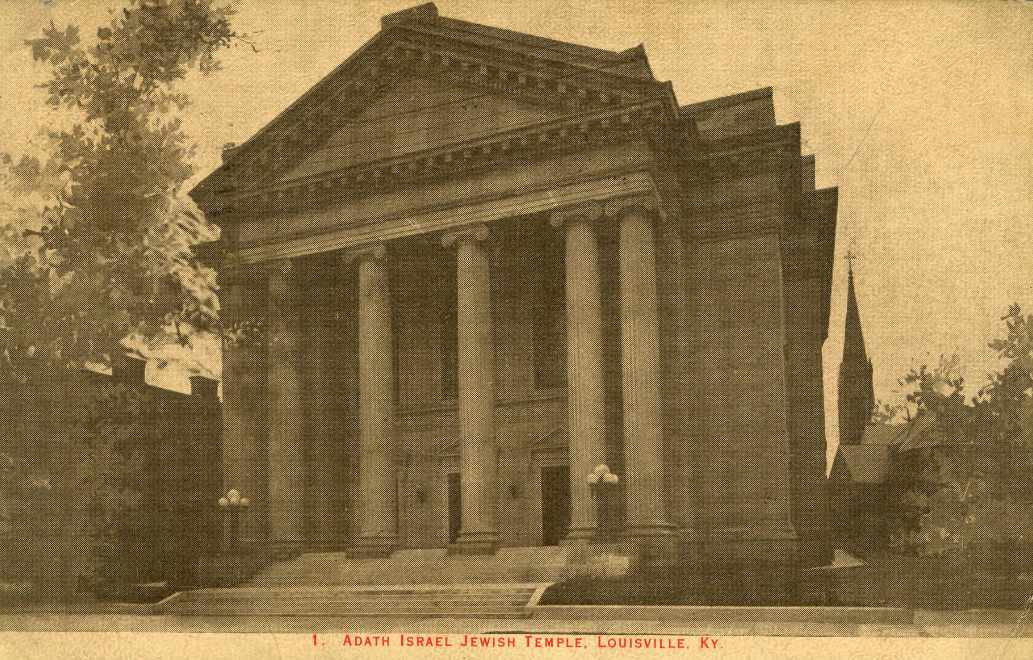
The third home of Adath Israel, dedicated in 1906, seated 1,800 and drew hundreds of Christian guests. A Sunday service that followed welcomed the entire city. Image credit: William A. Rosenthall Judaica Collection – College of Charleston Libraries (public domain).
In one year, the United States will mark 250 years since its founding—a milestone of celebration and reflection. As July 4th approaches, many Americans are already taking stock of what this anniversary means—not only politically, but spiritually and communally. For American Jews, especially those whose roots lie in smaller or now-vanished communities, it’s a moment to ask not only how we arrived here, but how our community’s presence began in many locations with a joyful embrace.
Early American synagogues were not hidden. They were public town treasures. Services drew civic leaders and curious neighbors. Christian townspeople helped fund buildings. And when the dedication services commenced, they came.
On May 30, 1849, a remarkable scene unfolded in Louisville, Kentucky. At the dedication of the state’s first synagogue—built by the members of Adath Israel, a community that continues to exist under the name The Temple-Congregation Adath Israel Brith Sholom—it was reported that the sanctuary filled to its capacity of about one thousand people. What made it extraordinary was not only its importance in the Ohio River Valley’s Jewish history, but that so many non-Jews longed to attend. According to The Occident, a Jewish newspaper published in Philadelphia, the demand for admission tickets was so great that some attempted to bid for them. The congregation declined. Every seat was already spoken for and the building could not simply accommodate more.
This moment of communal pride was also a declaration of belonging. The congregation had invited Rabbi James K. Gutheim to deliver an English address—“the chief object of attraction,” as described by a letter from an attendee to The Occident. Though the service was in Hebrew, the English address became the principal focus. This wasn’t because the congregation lacked understanding of the Hebrew prayers. Rather, it was an affirmation of civic presence—spoken in a language that all could understand. A public act, offered before a crowd that included prominent members of Louisville’s civic life, and nearly unthinkable in most Jewish communities outside the United States at the time.
That legacy continues.
While researching synagogue dedications across the South this past year—for pieces in outlets like The Atlanta Journal-Constitution and Mississippi Free Press—I came across the 1849 Louisville story. Here too, an organized Jewish presence began with public welcome.
This isn’t nostalgia. It’s inheritance. It’s the quiet truth that in towns across America, the echo of Jewish joy still rings—and sometimes, when remembered, that joy returns.
As the United States continues to move through a complex and uncertain season, many are asking what the Jewish future looks like in the next 250 years, or even century. Can the echoes of those synagogue dedications still teach us today, as their sermons once did generations ago? What if part of the American Jewish story is not only to uphold Jewish values, but to share Jewish spiritual life more openly with the world? What if America, with its pluralistic promise, is one of the stages for Isaiah’s vision: a house of prayer for all peoples?
That vision was not abstract. In 1849 Louisville, it was tangible—woven into the civic fabric of a town where neighbors longed to bear witness to a synagogue’s birth. So many came that there was no room to let them all in.
These stories belong to all of us. They are part of what makes religious freedom not just a promise, but a lived possibility.
And sometimes, when we remember that kind of welcome, sparks of holiness can return.
Related Topics
Related Posts