
America’s Rebbitzman’s Jewish Greeting Cheat Sheet
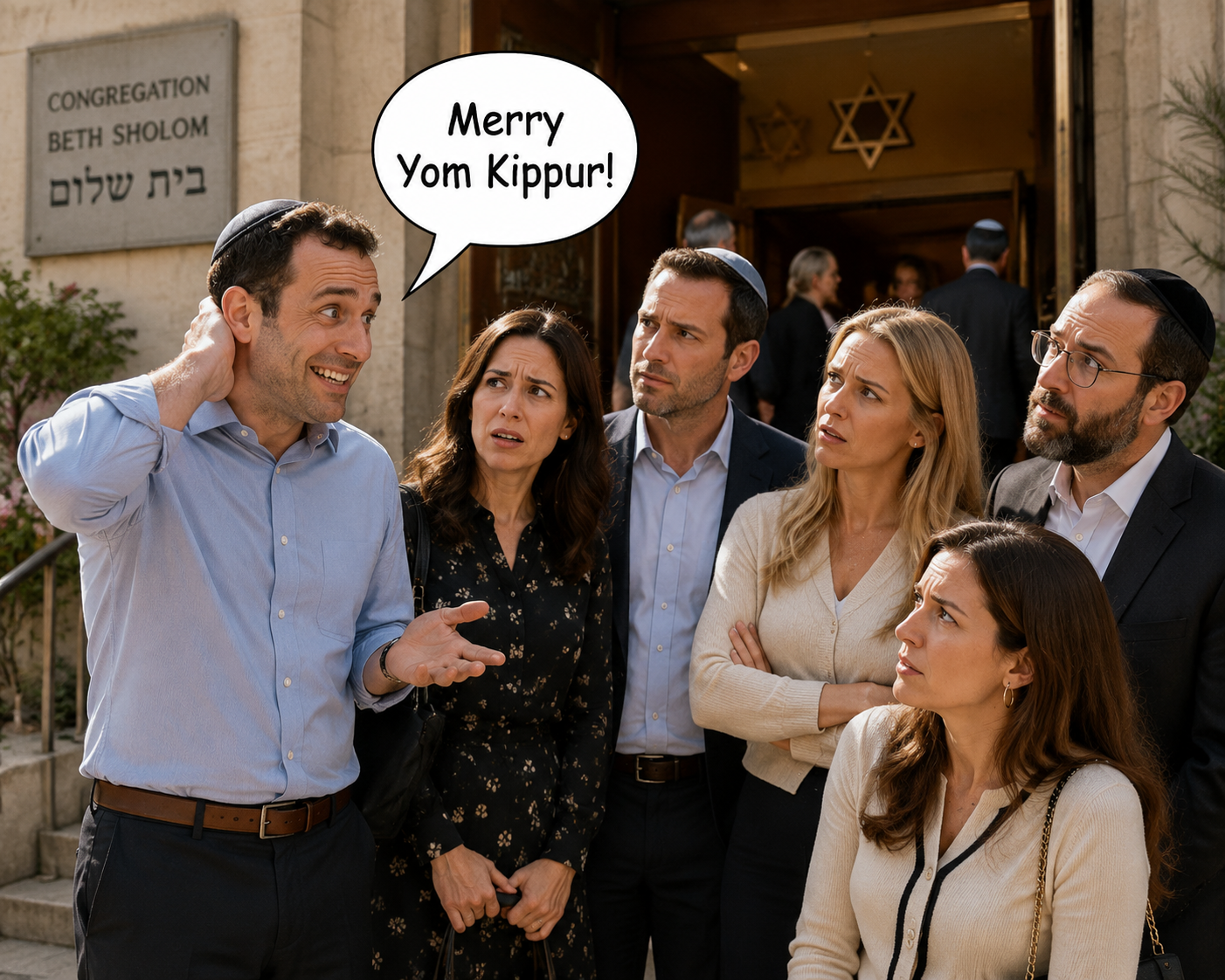
With the High Holy Days fast approaching, many of you are probably facing the same question as you walk through the doors of your Temple, Shul, Synagogue, Schtieble, or rented out Church basement. That question is “what the hell am I supposed to say to these people?”
This is not because you haven’t seen many of them since this time last year, or because you saw their recent X post and are in shock, but rather because there are simply too many ways to greet people in Judaism. This isn’t just a Pesach problem; it’s for every holiday! I’ve counted, and we Jews have 128 different ways to greet each other over the holidays. It is out of control.
Do you know how many ways Christians greet each other on their holidays? Two! They either say “happy” or they say “merry”.
They took the word merry and limited it to a single viable use case. In fact, back in the 1800s, if you were to say the word “merry” and it wasn’t in the context of Christmas, you would be put in the back of a carriage along with uppity children and menopausal women, and sent to the mental Asylum. This is why Christianity spread so widely around the world; it wasn’t because of forced conversions, it was because they eliminated the social anxiety of greeting someone at a religious event. Jewish Greeting Social Anxiety, or JGSA, is a condition plaguing congregations the world over.
I can only imagine how simple and carefree life would be if, regardless of the holiday, I simply had to put the word “happy” in front of its name and knew with confidence I was using the right phrase. Unfortunately, “happy Tisha B’Av” doesn’t quite work.
Now, before you get your tzitzit in a twist, I am not suggesting we toss out the old complicated system of 315 different greetings. That would be crazy, and to be honest, it wouldn’t work.
Can you imagine calling together a Multi-Denominational Congress of Rabbis to come to a global agreement on what we should say to each other on Rosh Hashannah? It would be chaos!
The Orthodox Rabbis would insist we say “Shanah tovah um’tukah, Tizku l’shanim rabot, like Itzak ben Avraham did once when the angel of the lord provided the ram to Abraham on Mount Moria, allowing the Jewish people to continue, Baruch hashem, may such blessing befall your family on such a joyous day, and may Hashem bless you and keep you, Mah tovu ohaleicha ya’akov mishkenoteicha yisrael!”
Their goal is to have the greeting go so long that it becomes a service in and of itself, so that not a moment for prayer goes unwasted. If you have ever been on an El Al flight, it is easy to imagine how this would work.
The Conservative Rabbis would argue that the greeting must be short and fast and stern to both express the joy of the holiday while keeping the auspices of being very serious Jews. They would insist “gut yontif” would not be gut enough and it should be made into “gutyonzeit!”
This way, you not only wish a happy holy day but also fold in the appropriate saying if the person you are speaking with sneezes. After all, services are about to begin and you need to get to your seat!
The Reform Rabbis would be more open to things, but probably insist on the use of the word “howdy.”
This is so that we can be more inclusive with people who like saying howdy a lot.
The Reconstructionist Rabbis will not see this as a problem, since they already just hug people as a response to…well, pretty much everything.
So what is the solution? Simple, know your Jewish greetings with America’s Rebbitzman’s Quick and Easy Jewish Greeting Cheat Sheet!
Rosh Hashahanah: “Shanna Tova,” “gut yontif,” “anyada bueno, dulse, i alegre,” or “Yoni? I thought you died in April!”
Shabbat: “Good Shabbos,” “Gud Shoybas!,” “Shabbat Shalom,” or “Shobado fotyfo”
Sukkot: “Chag Sameach,” “Moadim L’Simcha,” or “Nice Shack, Wanna Shake my Lulav?”
Hannukkah: “The Dreidle Spins at Sundown (followed by a wink),” and “A very good oil unto you!” (with the appropriate response being) “May your sufganiyot only drip a little bit!”
Purim: “Schnaps?” “Schnaps!”
Pesach: “May the maror exit easier than it entered.”
Havdallah: The sun, it fades, and yet I can not help but be overcome by a sense of ennui, for as the Sabbath leaves us, it takes with us that sense of peace, much like we take from it the remembrance of that peace. We carry the burden of the week through the waning of Shabbat, all so that we may see it again in a week’s time. So as I look upon you in this threshold to the house of prayer, I see your joy and your sadness and know that both are good, for that is the struggle of existence.