The views expressed herein are solely mine.
An Iranian Coup Is Coming for the Strait of Hormuz
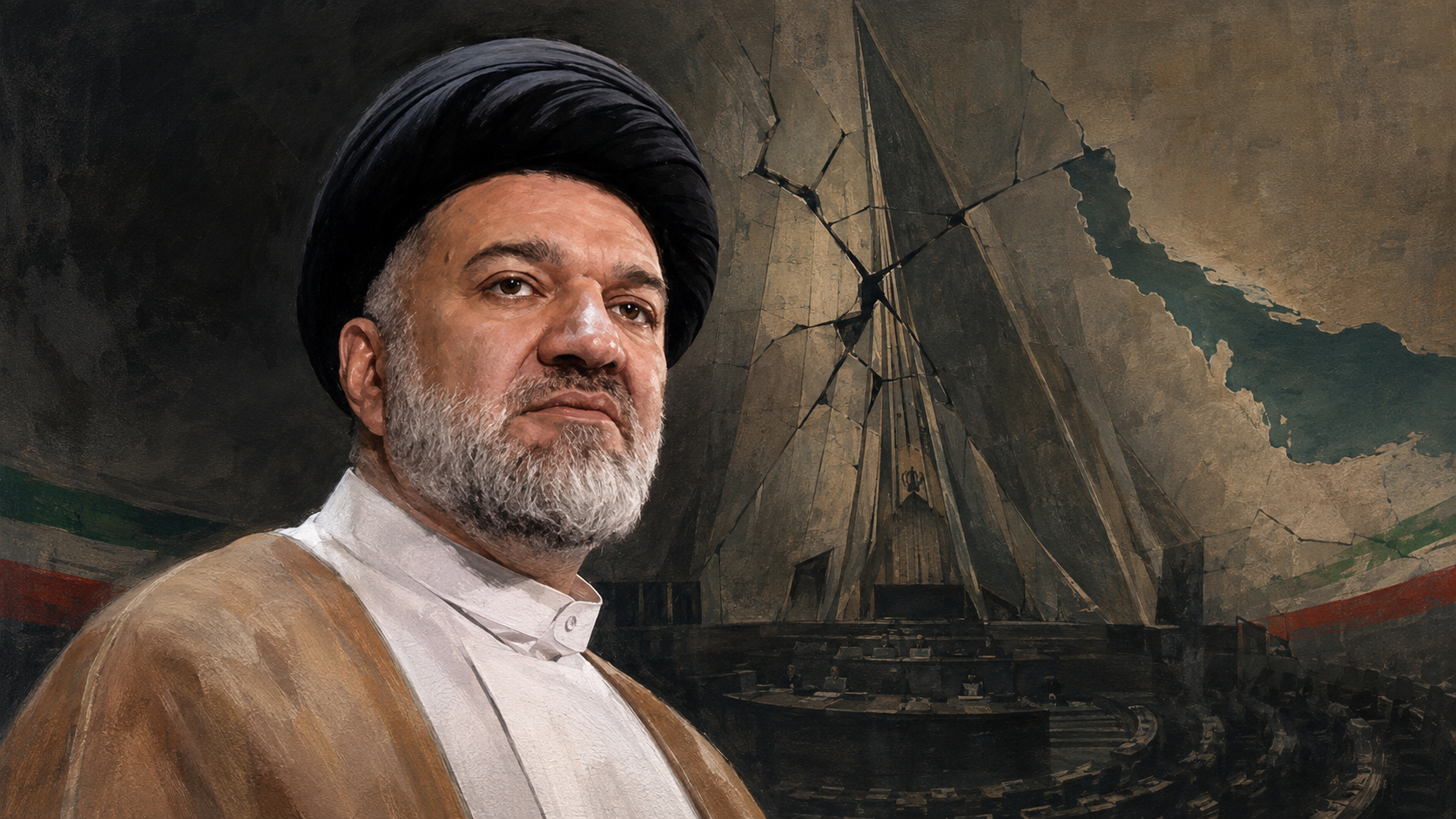
Credits: AI-generated image depicting influential Iranian cleric Mohammad-Bagher Kharazi.
Washington’s most enduring and destructive foreign policy pathology is wishful thinking. For decades, the American foreign policy establishment has pinned its hopes on the mirage of Iranian moderation, treating the Islamic Republic as a conventional state acting on rational interests. While diplomats chase the phantom of “reformist” President Masoud Pezeshkian, an unalloyed totalitarian blueprint is hardening inside Tehran.
Mohammad-Bagher Kharazi, an influential cleric and Khamenei family in-law, recently exposed what Iranian dissidents have long warned: the Islamic Republic’s electoral façade is dead. Kharazi openly admitted that the current system “simply does not work anymore.” His solution is not democracy, but the total elimination of the republic in favor of an absolute, unadulterated Islamic government. This is not mere rhetorical bluster; it is a meticulous doctrine for an internal coup.
By the admission of Kharazi himself, Hezbollah of Iran—his political party— has compiled sixty volumes detailing the vulnerabilities of every state institution. His operational calculus is precise. By ordering each follower to recruit seventeen others, Kharazi aims to deploy 250 disciplined loyalists across 1,000 cities. This disciplined network of 250,000 ideological zealots is engineered to paralyze and surround Tehran’s ministries.
Whether Kharazi can mobilize these exact numbers is secondary to the political impunity he enjoys while articulating this coup doctrine. In a regime that imprisons women for showing hair, Kharazi’s public ridicule of Pezeshkian as a “buffoon” and his open threats to seize ministries have met with absolute silence from the Supreme Leader’s office. This selective enforcement reveals deep elite complicity.
History provides a grim roadmap for this theological fascism. In June 1981, Ayatollah Ruhollah Khomeini systematically dismantled Iran’s first elected president, Abolhassan Bani-Sadr, by deploying Revolutionary Guards to seize presidential buildings, purge rivals, and convert wartime emergency into permanent clerical dictatorship. Kharazi is aspiring to execute the same sequence today. With official inflation running at 62 percent and food inflation skyrocketing past 134 percent, government polling indicates that a staggering 91 percent of the population rejects the regime. Yet, Washington consistently ignores the arithmetic of autocracy: an organized, highly disciplined minority will always overpower a disorganized, starved majority.
This domestic power grab has immediate, catastrophic consequences for global commerce. Driven by Kharazi’s internal putsch, the regime’s national security committee is already advancing legislation to bar American, Israeli, and “hostile” vessels from the Strait of Hormuz—while threatening a twenty percent extortion levy on all cargo values. Tehran’s legislative push is not mere posturing; it is a deliberate attempt to transform a critical international waterway into a radical Islamist tollbooth.
The resulting economic shockwaves were entirely predictable, as Brent crude spiked immediately upon the news. The stakes could not be higher: the Strait of Hormuz normally carries one-fifth of global liquefied natural gas and twenty million barrels of oil daily, but Tehran views this maritime choke point as a geopolitical weapon, not a commercial highway. Ultimately, Kharazi’s domestic consolidation of power and the Iranian parliament’s legislative endorsement of maritime piracy share an identical, dangerous premise: the clerical elite alone believes it dictates rights, both on land and at sea.
American policy has exacerbated this peril through a legacy of diplomatic malpractice. President Donald Trump squandered a historic opening after the February 28 strikes, when spontaneous crowds flooded the streets of Tehran, Karaj, and Isfahan to celebrate Ali Khamenei’s rumored demise. Washington possessed the rare trifecta of military leverage, elite panic, and popular revolt. Instead of sustaining crippling pressure to break the regime, Trump substituted empty boasts, artificial deadlines, and pauses. This strategic hesitation allowed Tehran to recover its coercive capacity, resulting in the execution of dozens of dissidents.
The United States must immediately abandon the fiction that maritime security can be preserved through temporary naval escorts or foolish gamble MOU’s. A harder, absolute Islamic government will not just close Hormuz; it will weaponize global trade even more. Under such circumstances, Tehran will build an ideological licensing system that, by using registries, manifests, and opaque shell companies, will turn every bill of lading into a loyalty certificate for the Supreme Leader.
Washington must stop purchasing temporary access from the world’s primary state sponsor of terrorism. The Obama-Biden-Trump cycle of hesitation carries a global price. The administration must mandate a common vessel-identity standard with Oman, sanction any maritime entity enforcing Tehran’s classifications, and aggressively guarantee passage through international lanes.
If America fails to crush this dangerous ideological customs frontier right now, it will soon find global energy security entirely subject to volatile clerical whim.
Related Topics
Related Posts