This Way Up: Spiritual Means to Psychological Ends
Ancient Chinese (and Jewish) Secret
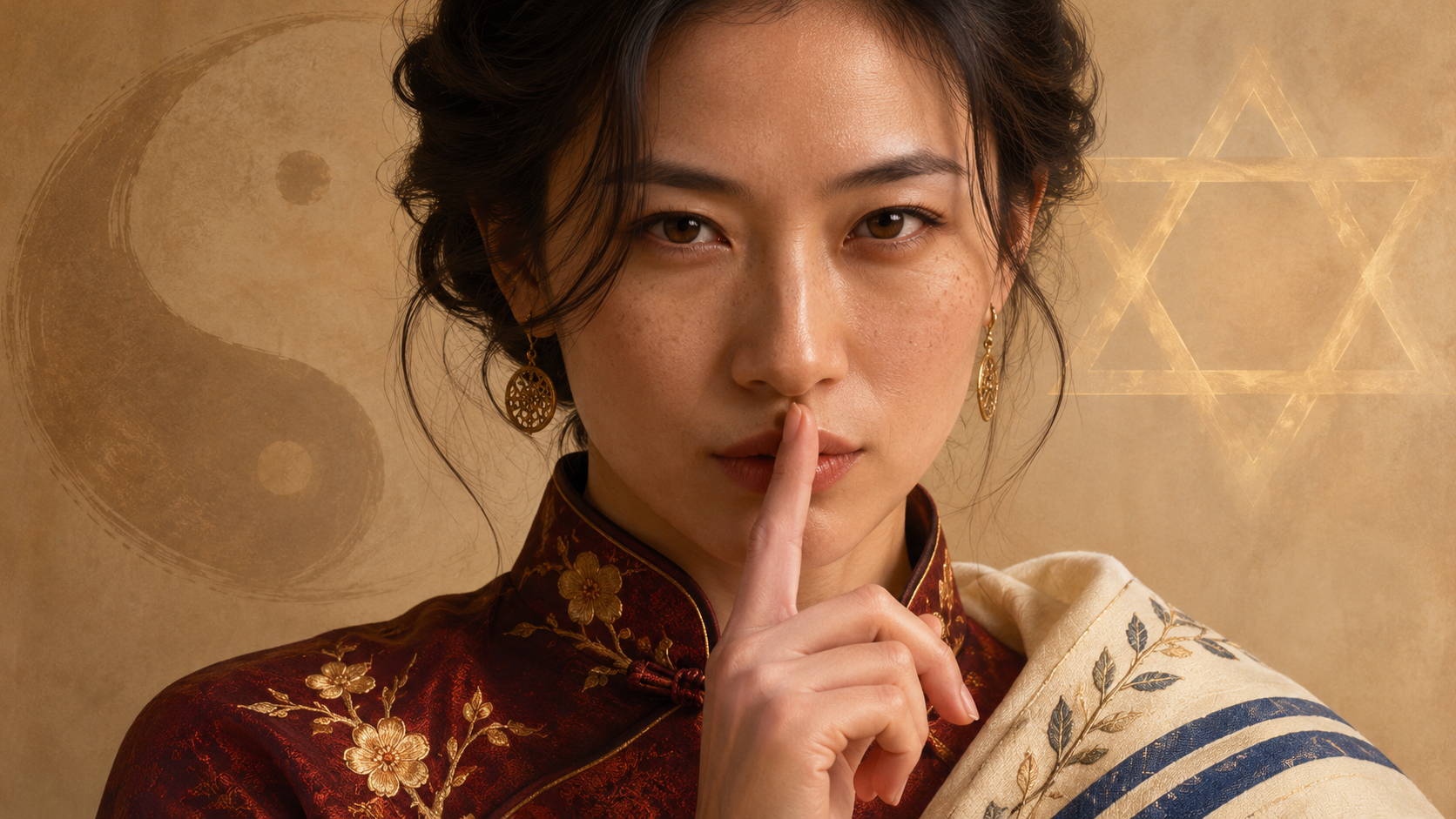
Illustration created with OpenAI's ChatGPT.
Every month or two, I visit the home of an elderly Chinese physician who dispenses a curious assortment of dried roots, leaves, and other botanical ingredients, which I cook into a medicinal decoction.
His home is in a Jewish neighborhood of Toronto, and every time I arrive, I notice something charming. At the edge of his front door, a faint outline in the paint reveals where a mezuzah once hung. The mezuzah is long gone, but its imprint remains. Here I am, a Jewish woman entering the home of a Chinese physician, in what was evidently once a Jewish household.
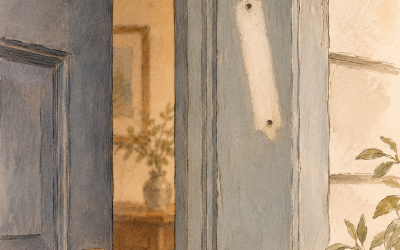
It seems an appropriate symbol for a quiet affinity between two communities.
Over the years, Chinese acquaintances have told me that Chinese people like living in Jewish neighborhoods. And there are other ways our communities find themselves in one another’s orbit.
Several years ago, when I was looking to purchase a car, a friend advised me to visit a dealership in a predominantly Chinese area. His reasoning was that Chinese car owners frequently take particularly good care of their cars. A used car coming off a lease, he suggested, might be an excellent purchase. I followed his advice. He was right.
These encounters may seem incidental, but perhaps they quietly reflect something more substantial. Certainly, the Chinese and Jewish communities have some recognizable similarities. Both have longstanding traditions that emphasize scholarship, education, family, discipline, and achievement. Both have produced remarkable accomplishments, often through sustained effort across generations.
But could there be another connection, one that goes deeper than educational attainment or economic success?
On Friday evenings, in synagogues around the world, Jews sing Lecha Dodi, a hymn welcoming the Sabbath bride. One of its verses contains an extraordinary proposition:
Sof ma’aseh b’machshavah techilah.
“Last in deed, first in thought.”
The traditional understanding is that Shabbat, which appears last in the order of Creation, was foremost in the divine intention. The world was created for the sake of the Sabbath.
Consider what this means. The pinnacle of six days of Creation is actually rest! You probably would not have seen that coming.
We find this sensibility elsewhere in Jewish thought. The messianic vision is not one in which the lamb becomes a predator. It is a vision in which the lion lies, joining the lamb on its own terms.
We find a similar idea in Proverbs: Eshet chayil ateret ba’alah. A woman of valor is the crown of her husband. The crown sits above the head, suggesting a masculine strength that recognizes and honours the sensibility represented by his wife.
And consider the Jewish practice of circumcision, which can be understood, among its many interpretations, as a symbolic limitation placed upon masculine power. Every capacity is to be governed by a measure of restraint.
Judaism certainly venerates courage and strength. At Hanukkah, we celebrate the Maccabees’ battle against a formidable enemy. But consider Purim. When the Jewish people faced the threat of annihilation, Queen Esther called upon them to gather, fast, and pray. She then used carefully orchestrated encounters with the king, relying on timing, relationship, and emotional intelligence rather than physical force to help secure her people’s survival.
Jewish tradition celebrates vigorous action, courage, and the willingness to confront evil. Yet running through it is a profound appreciation for the qualities that Chinese philosophy identifies as yin, associated with the feminine, stillness, receptivity, nourishment and the cultivation of relationships. Its complement, yang, represents activity, dynamism, and outward expression. Neither is complete without the other.
In traditional Chinese medicine, restoring depleted yin is often essential to supporting healthy yang activity. The principle is that vigorous activity depends upon a foundation of nourishment and restoration.
Here, then, is a curious paradox. The Chinese and the Jews are two peoples widely recognized for their yang: their productivity, enterprise, intellectual accomplishments, and determination. Yet, for both peoples, perhaps some of the secret of that achievement lies in their appreciation of yin.
Could yin be the secret sauce? The real mojo behind yang?
Both traditions recognize that visible achievement rests upon less visible foundations. Perhaps this is one reason our communities find something familiar in one another, and why we may have more to offer each other than admiration from a distance.
We live in a time when many of the values our communities have traditionally cultivated are being tested. We have reason to care about education, academic excellence, civility, mutual respect, the cultivation of character, and the opportunity for individuals to advance through effort and accomplishment. We may not agree on every issue, nor should we imagine that two civilizations with histories spanning millennia are interchangeable. But there is considerable common ground.
When people who have developed different ways of seeing the world bring those perspectives together, something new becomes possible. Binocular vision, after all, gives us depth that neither eye can provide alone.
Perhaps it is time to turn our quiet appreciation into something more deliberate: friendship, dialogue, and common purpose. And how might we begin? Through the very principle we have been considering: relationship. Rather than issuing grand pronouncements, we can meet one another, share our stories, and discover the values we hold in common.
Sometimes the potential for connection begins in the smallest and most innocuous of places, like the faded outline of a mezuzah on a Chinese doctor’s doorway. Two civilizations touch at that threshold, opening the door to encounter, listening, and learning.
On Sunday, November 8, 2026, from 10:00 to 11:15 a.m. EST, the Canadian Antisemitism Education Foundation (CAEF) and its partners invite you to When Shanghai Said Yes: A Global Jewish-Chinese Virtual Experience. This free online event will explore the historical and cultural connections between two ancient civilizations, with presentations followed by small-group discussions offering opportunities to meet, exchange perspectives, and build relationships.
All are welcome. Register for the free Zoom event, view the event details, or learn more about the Chinese-Jewish Exchange initiative.
Related Topics