
Angie Nixon’s Path to Winning in 2026 and 2028: Does Israel Hold the Key?
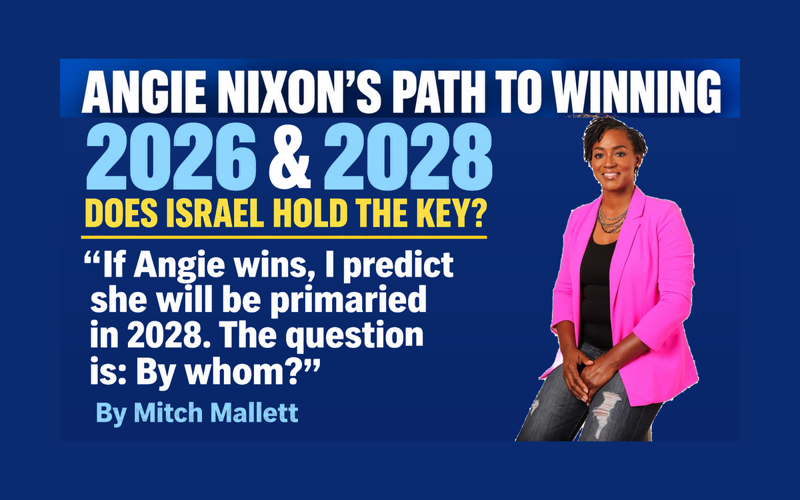
Angie Nixon’s Choice: What Kind of Senator Does She Want to Be?
I’m going to make two bold political predictions.
First, I predict that if Angie Nixon publicly embraces Israel’s right to exist, its right to defend itself, and continued American arms sales to Israel and does so soon, she will win Florida’s November 3 United States Senate election. Without that clarification, I believe her path to victory will be considerably more difficult.
Time is running out. Floridians are already voting.
Second, if Angie wins, I predict she will be primaried in 2028. The question is: By whom?
If she embraces the Democratic Socialists of America’s full anti-Israel agenda, I expect mainstream Democrats to organize a primary challenge.
If she establishes an independent position supporting Israel while continuing to champion the DSA’s progressive domestic priorities, I expect a challenge from within the DSA.
I believe opposition to Israel has become so prominent within the DSA that it threatens to overshadow the organization’s traditional domestic agenda.
That’s a strong assertion. Let me explain why I’ve reached these conclusions.
Why I Have Endorsed Angie Nixon
I have publicly endorsed Angie Nixon, and I stand by that endorsement.
As a lifelong progressive Democrat and Zionist, I support her domestic agenda: healthcare, economic opportunity, civil rights, women’s rights, affordable education, strong labor unions, repeal of right-to-work laws that undermine organized labor, and protecting our democratic institutions.
I also believe Democrats must regain control of the United States Senate to provide a meaningful check on what I consider President Trump’s unconstitutional power grab.
These are the foundations of my endorsement.
My Conversations with Angie Nixon
I met Angie at a political reception in Sarasota earlier this month, where we spoke publicly and briefly in private.
I like her! I believe she has the potential to become a great United States senator.
I explained why Israel and Jewish history matter so deeply to Jewish progressive Democrats like me, and why I see no contradiction between supporting a progressive domestic agenda and supporting the Jewish state.
Since then, I have written about our common ground and the importance of continued dialogue.
I have also received secondhand reports from people closer to her campaign suggesting that Angie has been listening and learning more about Jewish concerns. I cannot independently confirm the extent of those conversations, but I welcome the possibility.
A willingness to listen is important. What comes next matters even more.
An Opportunity Before Election Day
There is something I would welcome hearing from Angie before November 3.
Not a scripted statement designed to satisfy every political faction, but a thoughtful explanation, in her own words, of how her understanding of Israel, Jewish history, and American foreign policy has developed during this campaign.
She could reaffirm Israel’s right to exist and defend itself while maintaining her right to criticize Israeli government policies.
She could express support for continued American arms sales to Israel while distinguishing those sales from the separate question of future American military subsidies.
Supporting Israel’s ability to purchase American military equipment does not necessarily require supporting continued American taxpayer subsidies for those purchases.
She could also explain how she would approach the relationship between the United States and Israel while supporting Palestinian dignity, human rights, and the pursuit of peace.
Supporting Israel does not require supporting Benjamin Netanyahu. I have opposed Netanyahu’s leadership and condemned settler violence while remaining firmly committed to Israel’s existence and security.
Those positions are not contradictory.
Israel is a democratic American ally, and its security matters. So do Palestinian dignity, freedom, and human rights.
I believe there is room for a progressive American foreign policy that recognizes all these principles.
Florida’s Jewish Voters and the Broader Pro-Israel Community
Florida has one of the largest Jewish populations in the United States, with estimates exceeding 750,000 residents.
Historically, Jewish Americans have leaned heavily Democratic. National voting patterns have sometimes placed Democratic support around 70%, although Florida-specific figures differ.
Jewish population estimates are not counts of registered voters, and Florida does not record religious affiliation on voter registration rolls.
Still, the Jewish electorate is an important part of Florida’s political landscape.
Through conversations with Jewish friends throughout the state, fellow Democrats, and discussions in my Facebook group, We Are Progressive, Liberal, Woke and Pro Israel!, which has more than 13,000 members, I have encountered considerable debate about Angie’s candidacy.
My impression is that many Jewish Democrats I’ve encountered remain undecided. Some support her. Others have serious concerns about her positions regarding Israel and American arms sales.
My hunch is that many of these voters are looking for a reason to support Angie, not necessarily a reason to oppose her.
These conversations are not scientific polling. They are personal observations developed through years of political involvement and discussions within Jewish and Democratic communities.
And support for Israel extends well beyond Jewish voters.
There are non-Jewish Zionists, including Christian supporters of Israel, who regard Israel’s security and Jerusalem’s religious heritage as important issues.
The protection of Christian holy sites, freedom of worship, and the preservation of Jerusalem’s religious heritage should concern Jews, Christians, and Muslims alike.
I firmly believe that if Hamas gained control of Jerusalem, even for a matter of weeks, its ancient Christian holy sites would face destruction.
This is not a concern I arrived at recently. It reflects decades of studying the region, its religious history, and the ideologies of extremist movements. I consider the preservation of Jerusalem’s Jewish, Christian, and Muslim holy sites essential.
I’ve also spoken with non-Jewish Democrats who support Israel but remain uncertain about Angie.
I believe the number of voters whose decisions could be affected by Angie’s position on Israel deserves serious attention. My personal estimate is that we could be talking about tens of thousands of voters, perhaps more, among Jewish Democrats and non-Jewish supporters of Israel.
That estimate comes from my conversations and political experience, not scientific polling.
But the distinction matters. I’m not talking about what I believe to be an insignificant number of voters. I’m raising the possibility of an electoral impact large enough to warrant serious consideration.
There is another group worth considering: Republicans who are dissatisfied with President Trump and are reconsidering their traditional party loyalties.
Some may be open to a Democratic candidate while remaining concerned about that candidate’s positions on Israel.
How many such voters exist in Florida, and whether those concerns would influence their decisions, remains uncertain. But they represent another question worth examining when assessing the possible electoral significance of Angie’s foreign-policy positions.
Two Years Is Not a Long Time
Angie has served in the Florida House since 2020. She understands legislative politics, coalition-building, and the pressures elected officials face.
But the United States Senate presents a different challenge.
The winner of this special election will complete the remainder of Marco Rubio’s term, which expires in January 2029.
That means another election in November 2028, with political organizing and a possible primary campaign beginning considerably earlier.
There will be little time to establish a Senate record before the next political contest.
Angie has publicly indicated that she does not agree with every position in the DSA platform.
That distinction deserves attention.
If elected, will she establish her own foreign-policy positions, or will she feel obligated to follow an organization’s platform even where she disagrees?
That is a question worth asking of any elected official.
The Democratic Party Must Learn From 2026
The success of DSA-associated candidates in Democratic primaries has highlighted divisions within the party and dissatisfaction among some voters with established leadership.
I believe mainstream Democratic leaders underestimated the organizing strength of these challengers.
I also predict they will not be caught off guard in the same way in 2028.
After November, Democratic leaders will have an opportunity to examine their successes, failures, messaging, and primary-election strategies.
The party has accomplishments worth defending, including the Affordable Care Act, expanded access to healthcare, infrastructure investment, and important policies advanced during the Clinton, Obama, and Biden administrations.
There is unfinished work, however.
Democrats must communicate a compelling future for younger voters while advancing the progressive priorities that have long been part of the party’s political identity.
They do not need to abandon those principles. They need to articulate them more effectively and demonstrate how their legislative proposals can improve Americans’ lives.
But another question deserves attention.
Why has opposition to Israel become such a prominent part of the DSA’s political identity?
The DSA’s national endorsement requirements include support for the boycott, divestment, and sanctions movement against Israel and explicit anti-Zionist commitments.
I’ve addressed this concern previously in my Times of Israel article, “I Call the DSA Corrupted by the Worldwide Jihadist Movement.”
In that article, I argued that the DSA’s increasingly anti-Israel politics reflect the influence of a broader worldwide jihadist movement. I believe an organization advancing domestic policies many Americans could embrace has allowed opposition to Israel to assume a disproportionate role in its political identity.
That remains my interpretation. The DSA’s published anti-Zionist positions are documented; direct organizational infiltration or control by Islamist extremist groups has not been independently established.
I see a fundamental tension between the DSA’s anti-Zionist requirements and the broad range of domestic policies shared by democratic socialists and mainstream progressive Democrats.
Suppose Angie embraces virtually the entire DSA domestic agenda but establishes an independent position supporting Israel’s existence, security, and continued American arms sales.
If elements within the DSA organize to defeat her primarily over that disagreement, what would it tell us about their priorities?
In my judgment, it would provide powerful evidence that opposition to Israel has become more important to those elements of the organization than their shared domestic agenda.
Opposition to Israeli government policies is legitimate political debate. Opposition to Israel’s very existence raises a different set of questions.
Democrats should be capable of recognizing that distinction.
The Democratic Party and the DSA: A Question of Scale
Consider the difference in organizational scale.
Approximately 45.3 million Americans are registered Democrats in states that record political party affiliation. Florida alone has more than 4 million registered Democrats.
By comparison, the Democratic Socialists of America has approximately 126,000 members nationwide.
These are different measurements, and some DSA members are themselves registered Democrats. Nevertheless, the numbers illustrate the enormous difference in scale between the broader Democratic electorate and the DSA organization.
A relatively small, highly organized group can exert influence far beyond its membership, particularly in low-turnout primaries.
But winning a Democratic primary and winning a statewide general election are two very different political challenges.
The Democratic Party has been a pillar of American politics for nearly 200 years. It has survived wars, economic crises, social upheaval, and enormous political changes.
The DSA’s current political momentum looks more like a passing wave to me. Its influence today is undeniable, but whether that influence will endure is another question entirely.
I expect the Democratic Party to remain a major force in American politics long after today’s ideological disputes have changed.
The 2028 Primary: Which Side Will Challenge Angie?
Let me return to my opening prediction.
If Angie Nixon wins in November, I predict she will be primaried in 2028.
Consider the first scenario.
Angie continues championing her progressive domestic agenda but establishes her independence regarding Israel.
She supports Israel’s right to exist, acknowledges its security needs, supports continued American arms sales, and distinguishes criticism of Netanyahu’s government from opposition to the Jewish state.
My prediction is that elements within the DSA would seek a candidate more closely aligned with its anti-Zionist platform.
Even if Angie were among the strongest advocates for the organization’s domestic agenda, disagreement over Israel could become the basis of a primary challenge.
That would raise a revealing question: Just how central has opposition to Israel become within the DSA?
I also believe mainstream Democrats would have reasons to support an incumbent whose domestic priorities largely align with their own and who maintains an independent foreign-policy position.
Now consider the opposite scenario.
Angie embraces the DSA’s full anti-Israel agenda, including opposition to continued American arms sales and military assistance to Israel.
I predict that mainstream Democrats opposed to those positions would seek an alternative candidate.
Unlike the surprise experienced by some established officeholders in 2026, the Democratic Party has time to study the earlier primaries and prepare for 2028.
Its leaders could adopt some of the same organizing strategies used successfully against established Democratic incumbents.
My broader political forecast is that the prominence of the DSA’s anti-Israel agenda in Democratic primary politics may have reached its high point in this election cycle.
I expect mainstream Democrats to reassess their strategies and become better prepared for future primary contests.
But another force could change the political environment: a growing backlash against extremist violence and antisemitism.
The Backlash I Expect
Look at the violence associated with some pro-Palestinian protests across Europe and the United States, including the recent violence in France. Look at the threat posed by Islamist jihadist terrorism.
Al-Qaeda terrorists flew planes into buildings on September 11. Contrast that terrorism with peaceful Israel Day parades, where Jewish communities celebrate Israel and their heritage.
Violence, intimidation, and antisemitism are not legitimate forms of political expression.
I believe a public backlash against violent extremism and antisemitism has already begun. I predict it will grow, and that the anti-Israel movement’s political momentum has peaked.
By 2028, that backlash could reshape the debate within the Democratic Party and perhaps even influence the DSA’s positions on Israel.
I’m not predicting that the DSA will abandon its anti-Israel positions. But I believe that possibility deserves consideration.
If the organization changes, the circumstances surrounding a potential 2028 primary challenge could change as well.
Whatever happens, Angie’s own principles and judgment should remain central.
What Kind of Senator Will Angie Be?
The immediate election comes first.
Recent October polling has shown Republican incumbent Ashley Moody leading Angie Nixon. One University of North Florida survey reported Moody ahead 49% to 45%, while another poll placed Moody ahead 48% to 40%.
Those findings illustrate the electoral challenge facing Angie. They do not tell us how many voters would change their decisions if she clarified her position on Israel.
My prediction is based on my political experience and conversations with Democrats, not on polling measuring that specific question.
I believe many Jewish Democrats and non-Jewish supporters of Israel have concerns that deserve a serious response.
I also believe Angie has an opportunity to demonstrate that progressive domestic principles and support for Israel’s existence and security can coexist.
Her decisions about Israel should reflect her own convictions, not merely political calculations.
And her record, if elected, would ultimately matter more than any campaign statement.
My two predictions are on the record.
First, I predict that if Angie publicly affirms Israel’s right to exist, defend itself, and continue purchasing American arms, she will win this election. Without that clarification, I believe the election becomes considerably more difficult for her.
Second, I predict that if Angie wins, she will face a primary challenge in 2028, with the source of that challenge shaped by her positions on Israel.
These are my predictions, and I recognize that the election results and events of the following two years may prove them right or wrong.
Angie Nixon has an opportunity to establish herself as an independent progressive leader who supports her domestic principles without surrendering her judgment on foreign policy to any organization.
I believe the question of her long-term political identity deserves as much consideration as the immediate contest.
The Democratic Party will continue evolving, the DSA may evolve, and public attitudes toward Israel and the Middle East may change.
Ultimately, Angie’s decisions should be guided by her convictions, her understanding of the issues, and her responsibilities to the people she hopes to represent.
Angie Nixon’s challenge is not simply winning an election. It is deciding what kind of United States Senator she wants to become.
And that is a question only Angie Nixon can answer.
On November 3, you, the voter, will decide whether to give her that opportunity.
I know I’m voting for Angie.