Avigdor Liberman for prime minister?
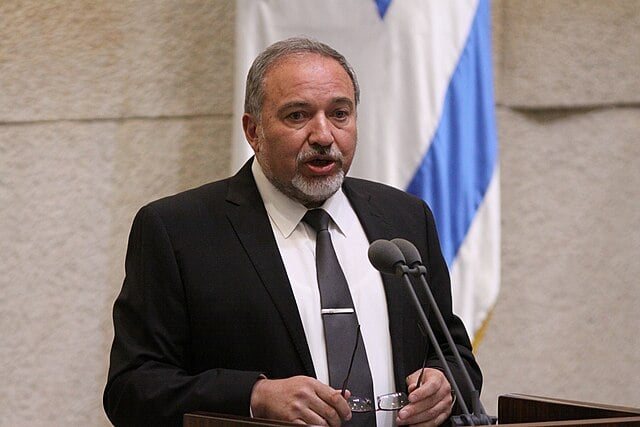
Recently, Avigdor Liberman announced that he is running for prime minister in the next elections.
His party, Yisrael Beytenu, literally “Israel, Our Home” is climbing in the polls. A survey from Maariv showed that it is now the largest opposition party, with a projected 17 seats in the next elections, which would make Liberman prime minister if the poll is correct.
At first glance, he may seem like the perfect candidate for Israel’s next prime minister. The country needs change, and his platform promises it. Like many of his fellow olim, immigrants, from the former Soviet Union (Liberman is from Moldova), Liberman is a committed secularist. He calls for drafting ultra-Orthodox young men into the army, from which they are currently effectively exempted.
This policy seems highly rational at a time when the IDF says that it is short on soldiers, when reservists are becoming increasingly weary and some have begun to not show up for duty. Can they be blamed? Many have been separated from their families and jobs for hundreds of days, and this war is not showing signs of ending.
Meanwhile, over 60,000 young ultra-Orthodox men are exempted from the army every year. This reality is unfortunate and entirely unfair. All citizens must share the burden equally.
On this point, Liberman is right. However, he was Minister of Defense under Prime Minister Netanyahu from 2016 to 2018, and his party was a key member of the coalition governments formed after the 2013 and 2015 elections. The 2015 coalition included ultra-Orthodox parties, and an ultra-Orthodox draft was not instituted despite Liberman’s presence in the government.
Furthermore, public transportation remains largely unavailable on Shabbat, and civil marriage remains impossible, despite Liberman’s views on these issues. The same accusations can be leveled against Yair Lapid, also a committed secularist and the leader of the Yesh Atid party, which was a member of Netanyahu’s government from 2013 to 2015, at a time when no ultra-Orthodox parties were in the government.
Liberman is also a noted personal friend of the leader of the ultra-Orthodox Sephardic-interest party “Shas.”
Liberman and Lapid failed to make any progress on these important issues when they were in government, so how can we trust them with these critical issues after the next elections, currently scheduled for October 2026?
While Prime Minister Benjamin Netanyahu has proven to be an obstacle to advancing secular interests, the clear obstacles are the ultra-Orthodox parties, which seek to dictate how secular Israelis should live their lives, while simultaneously using their political leverage to prevent their voters from equitably sharing the burden of Israeli society during this difficult war by serving in the military. In addition, they continue to secure incredibly high levels of funding for their yeshivas, over $350 million this year.
Essentially, they are taking the taxpayers’ money, telling them how to live their lives, and refusing to defend them or their country. This is plainly a critical issue. While Liberman certainly talks the talk, will he walk the walk?
Many supporters note Liberman’s withdrawal from the coalition government in November 2018, after a ceasefire with Hamas that facilitated the shipment of literal suitcases of cash from Qatar. These cash transfers were referred to by former IDF Chief of Staff Benny Gantz as “protection money.” Clearly, Israel was not protected.
Again, Liberman was right to disagree with this decision, which eventually helped enable Hamas to commit its gruesome attack on October 7, 2023. However, Avigdor Liberman’s withdrawal from the coalition precipitated the collapse of the government, leading to a protracted political crisis.
Five elections were held from 2019 to 2022 before Israel elected a stable, albeit highly problematic government in exasperation. A large part of why these subsequent elections failed to yield a functioning and stable government is because Avigdor Liberman refused to sit with Arab parties, instead demanding a highly unlikely unity government.

This unreasonable and racist demand was a major factor in contributing to Israel’s political chaos. Eventually, irritated with the political crisis, many of Israel’s voters realized that the only path back to political stability was a Netanyahu-led government — or so they thought.
Many Likud and coalition voters did not realize that the first agenda item of the new government would be a dangerous and anti-democratic judicial overhaul plan. The protests and division that ensued in the wake of this government maneuver exhibited a weak and divided nation to our enemies, furthering the damage caused by the political crisis.

It was in this divided and chaotic context that Hamas attacked the country on October 7, 2023, kicking us while we were down. Thus, it can be said that Avigdor Liberman was a significant contributor to the chaos that undermined the fundamental underpinnings of Israeli society leading up to the attacks.
Furthermore, Liberman has shown the same corrupt and anti-democratic tendencies of which many accuse Prime Minister Netanyahu. Like the Likud for Netanyahu, Yisrael Beytenu is essentially a political vessel for Liberman, who has been the party’s leader since its founding in 1999, not a “national movement” as it describes itself. Liberman and his party have faced numerous corruption allegations, and he narrowly dodged indictments and convictions in two separate cases.
This should not be surprising. Given his background in the former Soviet Union, Liberman has a unique familiarity with leaders who display autocratic tendencies. He has historically been an ally of Russian President Vladimir Putin, who, coincidentally, has also served in his role since 1999 (with the exception of a four-year stint as prime minister, in which he maintained a high level of influence.)
This leads me to the most serious criticism of Liberman. His tendency for far-right and racist statements, his status as a settler, his corruption, and his cozy relationship with Russian President Putin, largely ostracized by the West since his full-scale invasion of Ukraine, are all serious liabilities for his relationship with Israel’s allies in the United States, the European Union, and other Western countries.
These foibles could further weaken Israel’s global standing, already at an all-time low amid the war in Gaza, should he be elected prime minister.
Furthermore, Liberman’s history of racist and dogmatic statements could pose serious diplomatic problems. He has called for mandatory loyalty tests for Arab citizens of Israel. He has also advocated the transfer of Arab areas of Israel along the Green Line, which have been shown to overwhelmingly support remaining part of the State of Israel, to a Palestinian state in a two-state solution. During the 2014 Gaza War, he supported a boycott of Arab-owned businesses.
At a time when Israel’s image in the Arab world is severely blackened, but there are genuine chances for normalization with Saudi Arabia, and even with Syria and Lebanon, careful leadership is necessary to secure Israel’s essential security interests, while simultaneously appealing to Arab countries, including existing allies like the United Arab Emirates, Bahrain, and even (allegedly) Saudi Arabia.
A dogmatic figure with an anti-Arab racist past is certainly not the type of leader who is well-poised to make these historic and necessary agreements.
Israel needs change from the current coalition, but Avigdor Liberman, who often reflects its worst elements, is not the leader who can deliver it. He is liable to burn bridges with our allies, and he has not been able to deliver real victories for his ideological base while holding office in the past.