
'A Brief History of Antisemitism' out in 2026
Bad Hasbara #23: Be Quiet! You Don’t Live Here
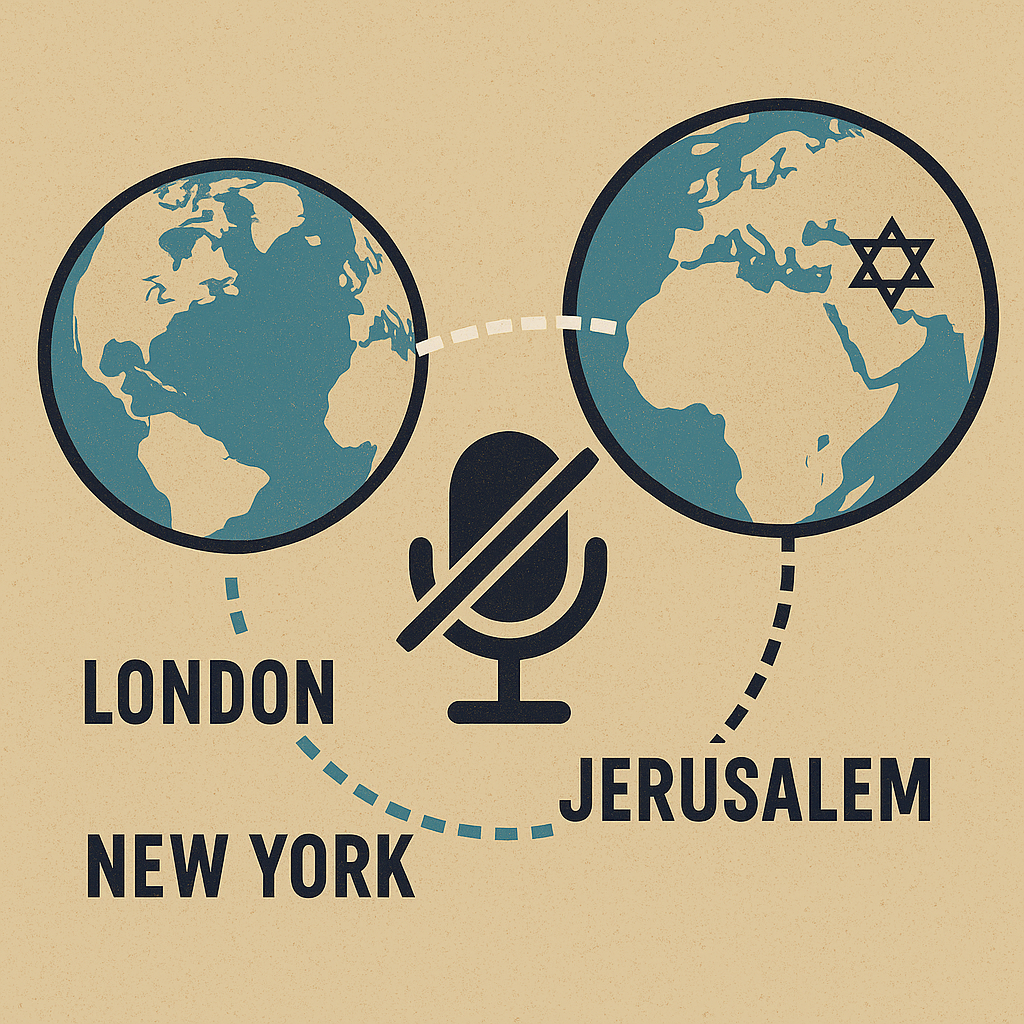
Diaspora muted
A familiar line surfaces whenever Diaspora Jews speak critically about Israel: “If you don’t live here, you don’t have the right to say anything.”
Sometimes it’s barked out defensively, sometimes gently implied, sometimes wrapped in guilt: “You’re safe in New York or London — what gives you the right to judge when we face the dangers?”
I understand where this comes from. Life in Israel is lived under conditions of threat most Diaspora Jews will never fully experience. People send their children to the army, live with the fear of rockets, and navigate dilemmas that are existential in ways outsiders can barely imagine. The frustration at hearing lectures from afar is real.
But the argument doesn’t work. It’s not a principle; it’s a silencing tactic. And it collapses the moment you test it.
Dismissing someone’s view because of their location is not a rebuttal. In logic it’s an ad hominem circumstantial fallacy: the speaker’s address becomes the focus, not the truth of their claim.
No one says you must live in Washington to oppose Trump, in Moscow to criticize Putin, in Gaza to condemn Hamas, or in Kabul to criticize the Taliban. The idea that only Israelis can comment on Israel is not a principle. It’s used selectively to shut down critics.
It’s often said that only Israelis live with the consequences of Israel’s choices. But that’s simply not true.
Every war, every military escalation, every government policy that captures headlines is followed by a spike in antisemitism worldwide. Synagogues in Paris or Toronto are defaced, Jewish students in London or New York are harassed, Jews are pressured to explain decisions they had no part in making. Diaspora Jews did not cast ballots in Israeli elections, but they live with the social and physical fallout.
If you’re affected, you have a stake. And if you have a stake, you have a right — even a responsibility — to speak.
Some argue that Diaspora Jews cannot grasp the reality of Israel’s enemies because they do not live next to Hamas or Hezbollah. It is true that life outside Israel is not lived under rockets. But many Diaspora Jews have family serving in the IDF, friends in border towns, relatives who have experienced war. Distance does not erase connection. And proximity is not the only source of insight. Those who live outside sometimes see dynamics more clearly, precisely because they are not consumed by the daily grind of survival.
There is also a strong counter-argument: sometimes Diaspora Jews may see the situation more clearly precisely because they are not clouded by immediate pain and trauma, or by the pressures of national solidarity. Israeli media is generally supportive of the IDF and, to a significant degree, the government. With a conscription army, nearly every Israeli has close friends or family serving, which makes critical distance emotionally difficult. Outside Israel, Jews are freer to evaluate alternative sources: non-Israeli reporting, critical voices from left-wing Israelis (who inside Israel are often dismissed as extremists), and perspectives from beyond the national echo chamber. Distance does not necessarily mean detachment — it can mean freedom to see what those inside cannot.
Another claim is that public Diaspora criticism amounts to “airing dirty laundry” and fuels antisemitism. But antisemitism doesn’t need Jewish critics — it manufactures its own excuses. Jews have been hated for millennia, long before Israel existed.
The uncomfortable truth is that the “dirty laundry” is not the criticism itself. It’s the behavior that gives rise to it. When Jews call Israel to moral account, they don’t weaken the Jewish position globally. They strengthen it, by showing that Jewish identity is bound up with principle rather than blind loyalty.
Another variation: if you want to influence Israel, move there. Otherwise, stay out of it.
That’s not an argument — it’s gatekeeping. It’s also a kind of purity test: only “true Jews,” meaning those who live in Israel, get to speak. But Jewish life has never worked that way. For two millennia, Judaism developed outside the Land of Israel, in countless Diaspora contexts. Jewish identity is not reducible to Israeli citizenship.
And again: we do not say you must live in Moscow to oppose Putin, or only South Africans in Pretoria could legitimately speak against apartheid. Why then, uniquely, should Israel be shielded from the same scrutiny?
There is also a simple historical fact: Israel was never a purely local project. Its existence and prosperity have always depended on the Diaspora. From the late nineteenth century onwards, Jews outside Palestine shaped events as much as those within it. The Zionist Congresses were held in Basel, London, and across Europe long before the State of Israel existed. Warsaw intellectuals, London lawyers, and New York philanthropists were as decisive as pioneers in Tel Aviv or Jerusalem. Diaspora Jews provided money, political lobbying, intellectual energy, and diplomatic leverage. They weren’t spectators cheering from the stands. They were builders in their own right.
That hasn’t changed. Diaspora communities today still contribute billions in philanthropy, wield influence in foreign capitals, and provide cultural and intellectual capital that nourishes Israeli society. You don’t need to be a Zionist to acknowledge this reality. It’s simply a matter of fact: Israel has been profoundly shaped by the Jewish world beyond its borders, and continues to be.
That means Diaspora Jews are not only affected by Israel’s choices, but have helped create the conditions in which those choices are made. That is “skin in the game,” whether one embraces it gladly or ambivalently. To be told now to “keep quiet” is not only dismissive but ahistorical.
What’s striking is that this silencing argument is not only made by Israelis but often by Diaspora Jews themselves, particularly those on the right. It lets them dismiss progressive Jewish voices without dealing with substance: if you live in London or New York, you’re naïve, detached, or disloyal.
But here’s the hypocrisy: right-wing Diaspora Jews also don’t live in Israel. They, too, sit abroad while lobbying, donating, or campaigning. Yet somehow their alignment with Israel’s current direction exempts them from the very standard they impose on others.
It reveals what’s really at work: not a consistent principle but a tool of convenience, wielded to silence some voices while amplifying others.
Even for those who are not ardent Zionists, or who see themselves as post- or non-Zionist, Israel still matters. Its policies shape global perceptions of Judaism. Its actions reverberate in the safety of Jewish communities abroad. Its trajectory will influence the character of Jewish identity for generations.
You don’t need to believe in Israel as the pinnacle of Jewish life to recognize that what happens there affects you. And if it affects you, you have a right to say something.
The insistence that Diaspora Jews “stay out of it” makes our global conversation smaller, narrower, and more brittle. Judaism has always thrived on argument — across borders, languages, and wildly different lived experiences. To cut Diaspora Jews out of debates about Israel is to cut away half of Jewish vitality.
Another common claim is that when Israel is under attack, criticism from abroad amounts to betrayal. The demand is for unconditional solidarity — anything less is seen as standing with the enemy. But this is a false choice. Criticism offered in the midst of conflict does not mean siding with Israel’s enemies; it means refusing to let crisis suspend moral responsibility. Wartime is when values are tested most severely. To fall silent then is not loyalty, it is abdication. Real solidarity is not about clapping from the sidelines no matter what happens; it is about holding a friend, a family member, or a people to their best selves, especially in their most difficult hours.
And in truth, the claim that criticism during wartime is betrayal only makes sense if you assume the war is being fought both strategically and morally well. If Israel’s leaders are pursuing a disastrous course — tactically, diplomatically, or ethically — then unquestioning loyalty helps no one. A government’s mistakes do not become less dangerous under rocket fire; they become more dangerous. The choice is not between silence and siding with enemies. It is between blind endorsement and the harder task of speaking out when silence could enable real harm.
Fundamentally, Diaspora criticism is not detachment, it’s care. It may be frustrating to Israelis, uncomfortable to other Jews, easily misused by antisemites. But it is also necessary, because silence would be worse.
Israel doesn’t belong only to those who live within its borders, nor does Judaism. Our lives are bound up with one another. When Diaspora Jews speak about Israel, they are not trespassing on foreign ground. They are engaging, however imperfectly, in the same shared Jewish story.
The line “you don’t live here, so be quiet” is not an argument. It’s an attempt to end an argument. And Judaism, if it has taught us anything, is that arguments are precisely what keep us alive.
Related Topics
Related Posts