Teacher. Listener. Builder of sacred spaces.
BaMidbar: Mapping Our Relationship
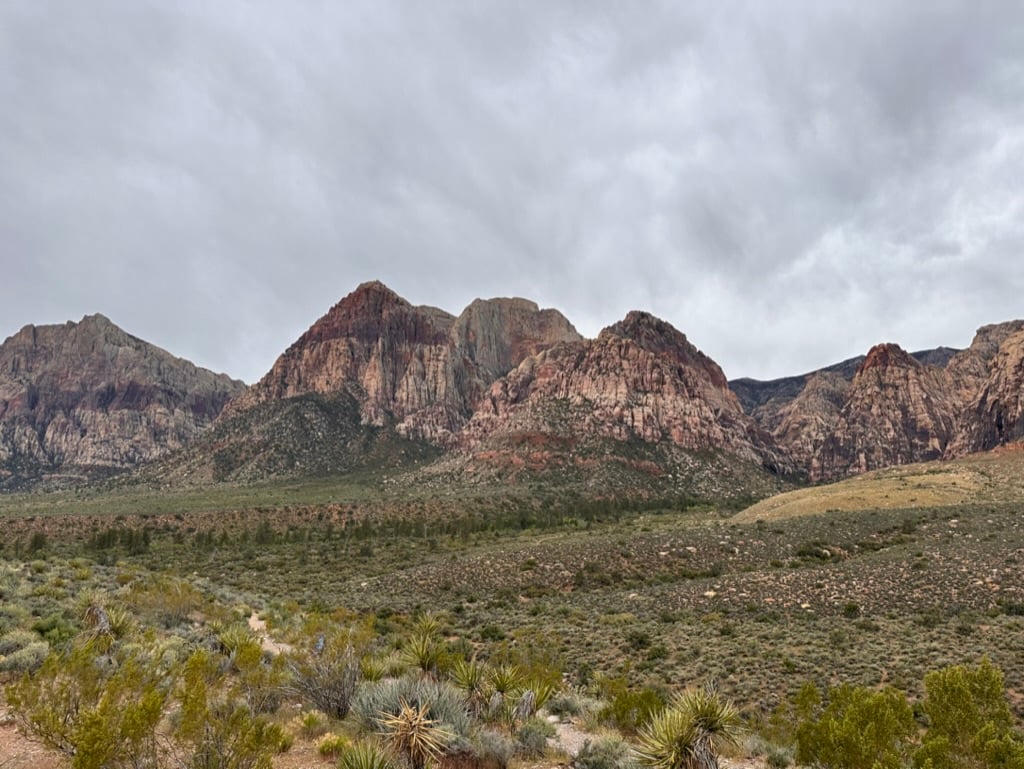
Red Rock Canyon, April 26, 2024. Photo by Rabbi Shanee B. Michaelson
There are relationships built out of similarity, and relationships built out of translation. Ours has always felt like the second kind. My husband and I came from neighboring worlds that somehow still needed interpretation.
We both grew up in Los Angeles, but even that sentence means something different for each of us.
His Los Angeles was bounded by Los Angeles County—neighborhoods and freeways and routines that formed a contained map of home, mostly on the Westside. Mine was more sprawling. My version stretched from the San Fernando Valley southward all the way to San Diego. It was less a single city than an entire corridor of movement and family and identity.
To me, Southern California was never divided into separate regions. The drive south was not a transition into somewhere else; it was a continuation. Geography there was not municipal but relational—measured by who lived where, where holidays happened, where grief and celebration gathered.
My mental map of home included hours of freeway, familiar exits, long drives with anticipation already attached to them. San Diego was not a vacation destination. It was part of the same emotional climate as Los Angeles.
For Chaim, San Diego barely existed in his story at all.
There is something disorienting about discovering that a place so central to your identity can be almost absent from someone else’s. The streets, the beaches, the particular landmarks— all of it lived in me as memory, while for him it was mostly blank space. And in reverse, Oregon belonged to him long before it belonged to me.
When I moved to Oregon, I entered a world already shaped by his history. He had lived here for nearly twenty years. The roads were familiar to him in a way that had nothing to do with navigation. Towns carried memory. Weather systems had meaning. The various mountains had personalities. I was stepping into a landscape where I had no prior language.
If I am honest, there are still days when Oregon does not fully feel like mine. I miss Southern California with a physical kind of longing—the dry warmth in the air, the gold of late afternoon light, the sense that life spills outward onto sidewalks and patios and freeways. I miss knowing where I am without having to learn it.
In Oregon, I sometimes feel translated. The landscape is beautiful, but not yet fluent in me. The rain can feel less poetic than isolating. I find myself longing for the expansiveness of the Southland—for the familiar drive south toward family, for the ease of a place that knew me long before I became a rabbi or a wife.
And still, I am learning it. The dramatic green, the way mist settles into trees, the slow unfolding of gray mornings, and even the bridges traversing over creeks and rivers. What once felt foreign begins, gradually, to feel familiar.
Sometimes I think my newness restores something to my husband, too. Being with someone from elsewhere means remembering that your world is not inevitable. It can still be seen for the first time.
Perhaps this is what BaMidbar teaches.
In the wilderness, the Israelites are always between places—no longer where they were, not yet where they are going. BaMidbar begins with a census and a map. The tribes are arranged around the Mishkan, each in its place, each banner facing a different direction. Even in motion, there is structure. And even in uncertainty, there is orientation.
The wilderness is not empty. It is organized around presence.
Holiness in BaMidbar does not belong to a fixed location. The Mishkan is dismantled, carried, and rebuilt wherever the people travel. Sacred space moves with them. Home is not only where they stand—it is what they carry together.
I think close relationships create something similar.
In Jewish mystical language, each person carries scattered sparks of holiness, nitzozot, through the world and paradoxically also gathers them. Relationships are part of the work of gathering—one person bringing one geography of memory, the other bringing another, until something shared begins to form. There’s a Hasidic idea that when you feel mysteriously drawn to a place or person, it may be because “your sparks are there.”
My husband is learning my Southern California—not the postcard version, but the lived one, measured in family and return and the way San Diego and Los Angeles are braided together in my history. And I am learning his Oregon: the steadiness of rain, the quiet logic of distance, the way a place becomes familiar through endurance.
Even our engagement took place in a landscape of in-between. Red Rock Canyon, just outside Las Vegas—desert stone, open sky, a place suspended between movement and permanence. It feels right in retrospect. We were already practicing how to stand inside each other’s geographies without needing them to match.
Israel, too, was part of this layering. I had lived there before we married; he had not. On our honeymoon, I watched him encounter a place that already held pieces of my life. But what mattered most was not explanation. It was introduction: here is a world that shaped me—come meet it.
We were married in San Diego, in a synagogue that has stood for a century. I remember thinking about how many lives had already passed through those walls. Standing there beneath the chuppah, we were not only creating something new; we were entering a continuity much older than ourselves.
And perhaps that is another lesson Judaism teaches about geography: holiness does not emerge only from the place itself, but from repeated acts of gathering. A synagogue becomes sacred because Jews keep returning to it. A marriage becomes sacred in much the same way — through the steady act of showing up, again and again, carrying your histories into a shared space until, over time, it begins to feel like home.
And maybe that is what I understand differently now, living in Oregon.
It is not that a place becomes mine by time alone. It becomes mine through repetition—walking through the neighborhood Costco and Fred Meyer, rainy drives to the JCC, and ordinary routes that begin, slowly, to hold memory. A landscape becomes shared when it is lived in together.
Oregon is becoming mine too. Not because it replaces what came before, but because it begins to hold it alongside something new.
And maybe that is what marriage is: the slow creation of a shared map out of places that once existed separately. Two people carrying their histories like tribes in the wilderness, learning over time how to pitch their tent beneath the same sky.
Related Topics
Related Posts