The views expressed herein are solely mine.
Belize Slams Israel, Ignores Hezbollah in Corozal
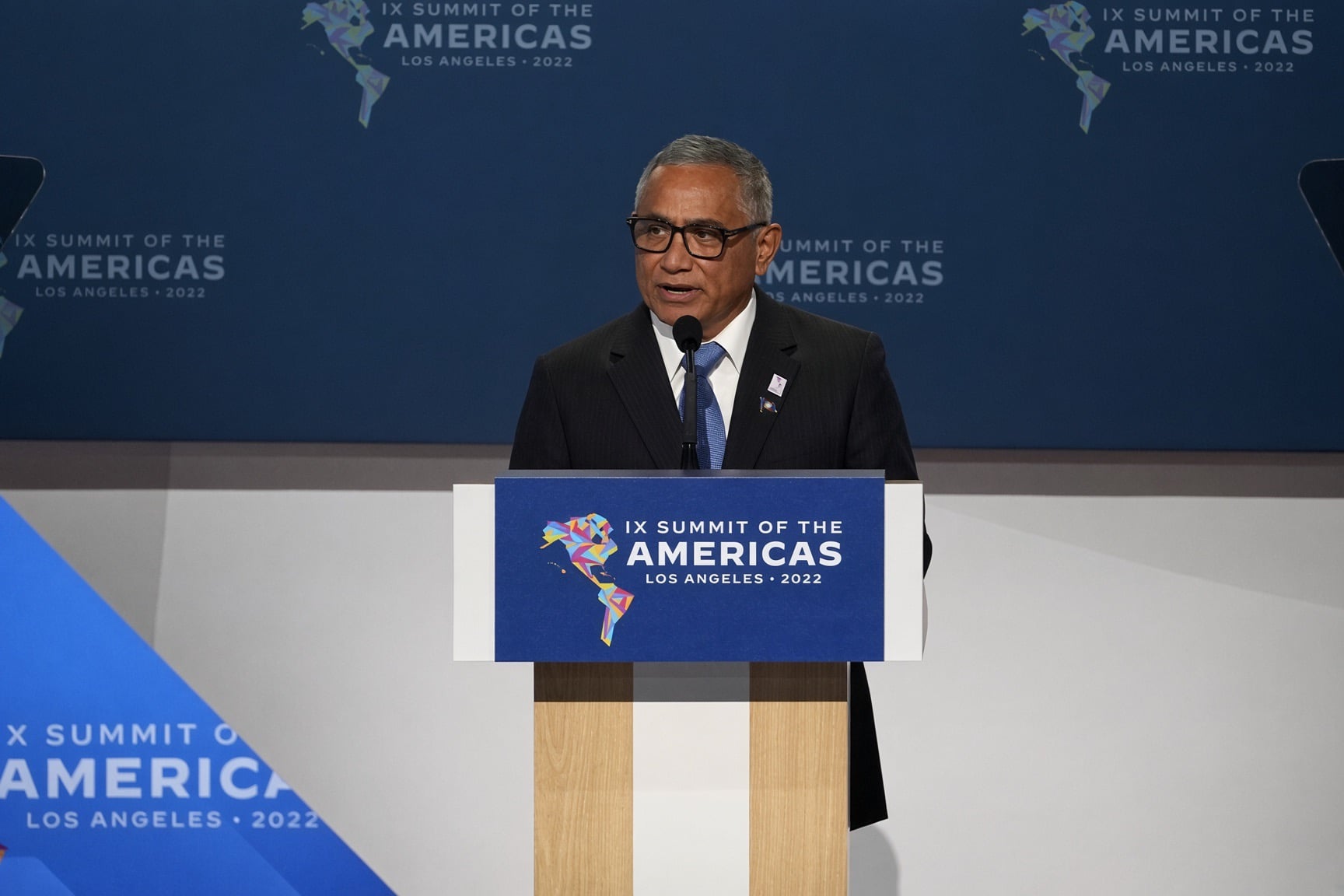
Belize Prime Minister Johnny Briceno speaks during the opening plenary session at the Summit of the Americas Thursday, June 9, 2022, in Los Angeles. (AP Photo/Marcio Jose Sanchez).
Argentine investigators tracing the commercial fronts behind the 1994 AMIA bombing that killed 85 people later mapped a set of Lebanese import-export companies that had already penetrated Central American free zones by the late 1980s. Established primarily by diaspora traders fleeing the Lebanese civil war, these firms systematically routed charcoal, textiles, and bulk cash through lightly supervised ports and free-trade areas. By the time Hezbollah’s Business Affairs Component formalized its Latin American revenue operations, these exact networks offered ready-made cover. Belize’s Corozal Free Zone, sitting flush on the Mexican border and operating entirely in English, quietly emerged as one of the network’s most secure nodes.
The operational reality of this corridor became undeniable in 2013, when Salvadoran authorities intercepted a truck originating from Corozal and discovered roughly 500 kilograms of cocaine concealed in fruit shipments. Subsequent U.S. Treasury designations identified Samer Akil Rada—a Hezbollah member, brother of AMIA-linked operative Amer Akil Rada, and a former executive on the Corozal Free Zone board—as the logistics head leading the operation. Though Rada fled Belize following local interrogation, his network adapted, later shifting its financial gravity into Venezuelan cryptocurrency vehicles. Today, Western threat assessments routinely rank Corozal alongside Panama’s Colón, Venezuela’s Margarita Island, and Colombia’s Maicao as a premier high-risk zone for trade-based money laundering.
Against this backdrop of deep illicit entrenchment, Belize abruptly severed diplomatic ties with Israel on November 14, 2023, withdrawing its agrément for the ambassador-designate and freezing all honorary consulates. This diplomatic rupture directly penalized Israel’s military campaign against Hamas, a move aligning with Belmopan’s 2011 recognition of Palestine and culminating in its later petition to join South Africa’s genocide case against Israel at the International Court of Justice. Yet, this ideological posturing reveals a stark hypocrisy: while Belize rejects the Middle East’s premier Western nation, it has maintained uninterrupted ties with democratic Taiwan since 1989, even as Foreign Minister Francis Fonseca faces intense, ongoing Chinese pressure to abandon Taipei. Furthermore, the country’s domestic demographics offer no logical anchor for this anti-Israel pivot, given that Belize’s Muslim population remains under 0.2 percent and its Jewish community numbers fewer than fifty individuals.
Ultimately, Hezbollah’s affinity for free zones is driven by operational utility, not symbolic alignment. Lax customs enforcement, cash-heavy transactions, entrenched political patronage, and the native use of English drastically reduce friction for networks already laundering capital through Lebanon, Panamá, Venezuela, and Colombia. By severing ties with Israel, Belize foolishly eliminated the primary intelligence channel capable of tracking these hostile financial flows. This security deficit arrives at a dangerous moment, as Mexican cartels aggressively probe Belize’s northern border. This crisis has already forced recent Coast Guard seizures and triggered the government’s emergency “Northern Fortress” security deployment.
Consequently, countering this expanding blind spot does not require a public diplomatic reversal; rather, it demands three narrow, non-public countermeasures to systematically raise the cost of doing business in the corridor.
First, the State of Israel and the United States must present Belize with a classified container-risk “digital twin” system for Corozal, co-developed alongside Taiwanese technology partners currently on the ground. This joint architecture would automatically flag dual-use cargo and anomalous beneficial-ownership structures tied to Lebanese diaspora shell companies. To avoid diplomatic blowback, funding can be routed discreetly through established Taiwanese assistance channels, bypassing any need for a formal restoration of Israeli-Belizean ties.
Simultaneously, the U.S. Treasury and Southern Command should establish a restricted, English-speaking free-zone anomaly cell fueled by technical data from Israeli financial-intelligence specialists. Focusing exclusively on Corozal and the Western Free Zone at Benque, this cell would operate through existing Egmont Group and FATF mechanisms. This creates a win-win scenario where Belize receives the targeted tools it desperately needs to push back against Mexican cartels, while Israel regains critical visibility over a node funding Hezbollah’s global operations.
Finally, the Jewish state should launch a private-sector agricultural-water pilot program in the northern districts immediately bordering Corozal. Because Israeli drip-irrigation and salinity-management systems are uniquely suited for these tropical microclimates, a trilateral partnership leveraging Taiwan’s established development network in Belize could execute the initiative seamlessly. Staffed by mixed civilian technical teams, the project would secure a permanent stabilizing footprint along the border, denying illicit actors an unmonitored vacuum while building a local commercial constituency incentivized to oppose free-zone lawlessness.
Jerusalem and Washington must start treating Corozal as a critical logistical node rather than a venue for symbolic grievance. Hezbollah has already proven it can survive the collapse of its own Lebanese banking infrastructure; closing this English-speaking Central American sanctuary is the only way to break its illicit lifeline, neutralize its threat to Israel, and secure the Western Hemisphere.
Related Topics
Related Posts