Strategist and Diplomat Analyzing Somaliland and Horn Affairs
Mogadishu’s diplomatic blunder
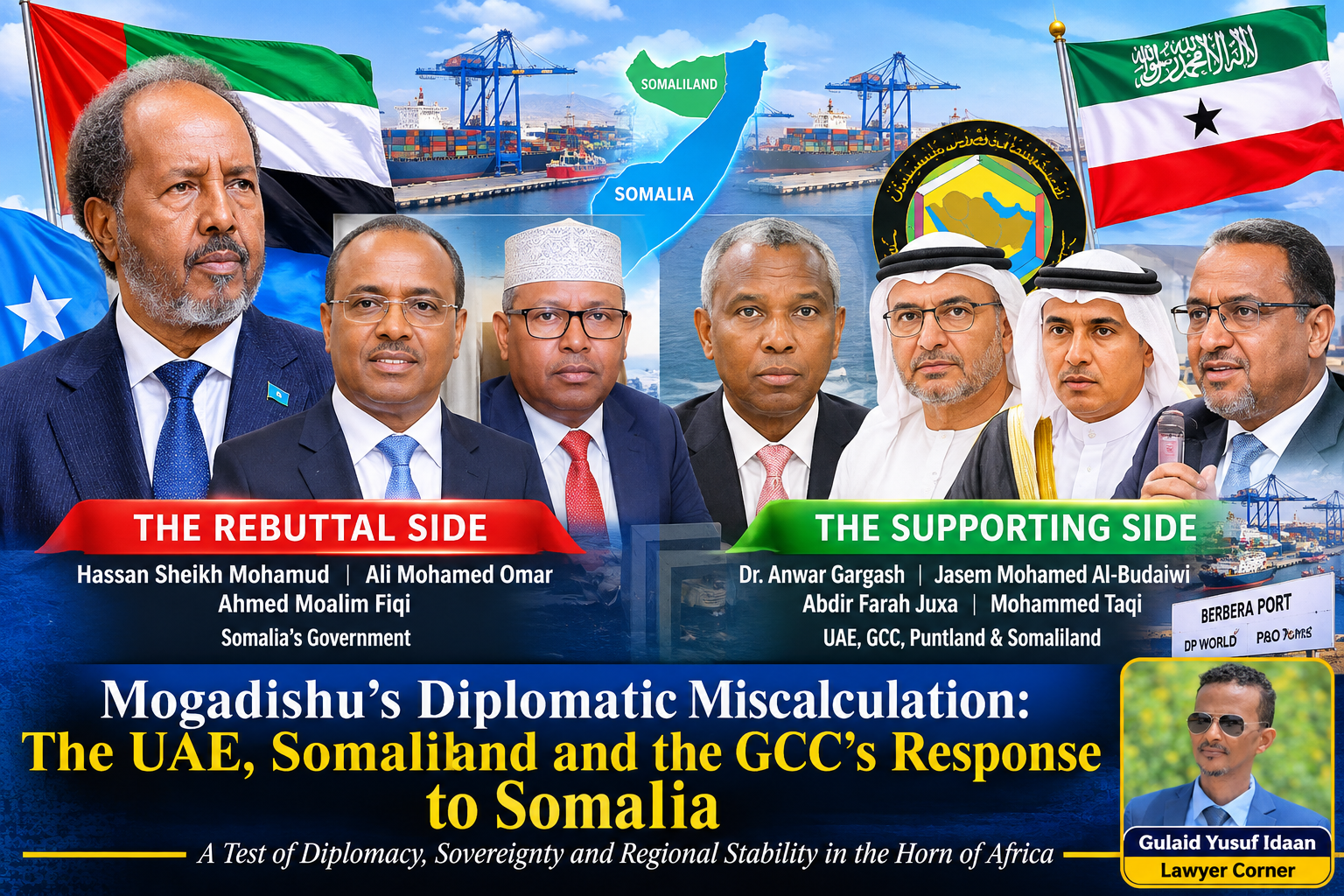
Mogadishu’s Diplomatic Miscalculation: The UAE, Somaliland and the GCC’s Response to Somalia. Diplomacy requires strategy, not hostility.
Introduction: From Bilateral Disagreement to Regional Diplomatic Confrontation
The diplomatic confrontation between Mogadishu and Abu Dhabi has become an important episode in the evolving geopolitics of the Horn of Africa. What initially appeared to be a disagreement over the UAE’s regional activities and economic partnership with Somaliland has developed into a broader dispute involving sovereignty, federal authority, international partnerships, maritime security and the strategic balance across the Red Sea and Gulf of Aden.
The confrontation intensified following accusations by Somali President Hassan Sheikh Mohamud against the UAE. These included allegations of interference in Somalia’s internal affairs, agreements involving strategic ports outside Mogadishu’s authority, security developments involving Yemen, Israel’s recognition of Somaliland and the alleged promotion of regional instability and proxy conflicts.
Several senior Somali officials subsequently defended the government’s position. They included Ali Mohamed Omar, Minister of State for Foreign Affairs and a member of the Federal Parliament, and Ahmed Moallim Fiqi, Minister of Defence. The UAE’s response was articulated by Dr. Anwar Gargash, Diplomatic Adviser to the UAE President. Criticism also emerged from Abdir Farah Juxa, Minister of Interior in the Puntland government, while Emirati military commentator Mohammed Taqi offered a separate public response.
- President Hassan Sheikh Mohamud: Sovereignty Claims and the Limits of Diplomatic Accusations
President Hassan Sheikh Mohamud’s accusations transformed an existing political disagreement into a wider diplomatic confrontation. The issue is not whether a head of state may challenge another country’s conduct. Governments are entitled to express objections, review bilateral relations and pursue diplomatic remedies. The more important question is whether the accusations are supported by evidence and whether the adopted response serves the country’s long-term interests.
An allegation does not become an established fact simply because it is issued by a head of state. Claims of interference, destabilization or violations of sovereignty require the identification of specific conduct, credible supporting information and an applicable legal basis. Without these elements, public accusations risk becoming instruments of political mobilization rather than effective diplomatic engagement.
2.1 Institutional Authority and External Interference
The Federal Government of Somalia frequently invokes sovereignty, national unity and federal authority when objecting to international engagement with political entities outside Mogadishu’s control. Yet Somalia continues to experience disagreements with federal member states over constitutional powers, political representation, elections, security arrangements and national institutions.
These disputes expose the difference between claims of exclusive national authority and the practical challenges of establishing political consensus. They do not remove Somalia’s right to object to demonstrable external interference. However, they make it necessary to distinguish the Federal Government’s political position from the wider institutional realities of the country.
The UAE has commercial, maritime, economic and strategic interests in the region. States routinely develop international partnerships to advance their national interests, provided their conduct complies with applicable international obligations. Mogadishu is entitled to challenge particular Emirati policies, but it must identify the alleged interference, provide supporting evidence and establish the relevant legal framework.
2.2 Berbera, Bosaso and Kismayo: Different Political and Administrative Realities
The controversy over Berbera, Bosaso and Kismayo exposes an important distinction that Mogadishu’s political narrative risks overlooking: these ports do not share the same political, constitutional or legal status.
Berbera is located in Somaliland, which declared the restoration of its independence in 1991 and maintains that it is a sovereign state rather than a federal member state under Mogadishu’s authority. Somaliland independently administers the port and has concluded agreements concerning its development.
Bosaso is located in Puntland, a federal member state of Somalia. Kismayo is located in Jubaland, also a federal member state whose relationship with Mogadishu is shaped by disagreements within Somalia’s federal system.
2.3 Aidarus al-Zubaidi: Security Allegations and the Requirement of Evidence
The allegation that Berbera was used to transport Yemeni political leader Aidarus al-Zubaidi introduces a sensitive security dimension.
Given Yemen’s conflict and political fragmentation, allegations involving the movement of political or military figures through regional ports carry potential implications for maritime security and the wider regional balance. Their seriousness makes the responsibility to substantiate them particularly important.
2.4 The UAE and Israel’s Recognition of Somaliland
Another dimension concerns attempts to connect the UAE’s relationship with Somaliland to Israel’s recognition of Somaliland.
This argument risks conflating separate economic, strategic and diplomatic developments. The UAE’s relationship with Somaliland must be distinguished from formal recognition decisions made by other states. Abu Dhabi should not be assigned responsibility for another state’s recognition decision without an explicit announcement or reliable evidence establishing such a role.
States make foreign-policy decisions through various considerations, including geography, maritime security, economic interests, strategic partnerships and regional calculations. Emirati economic relations with Somaliland do not, by themselves, demonstrate that the UAE directed or determined another state’s recognition policy.
Interpreting every Emirati relationship through a framework of political conspiracy does not establish causation or diplomatic coordination. It obscures the independent interests influencing regional decisions.
2.5 Allegations of Exporting Instability and Proxy Wars
Accusations that the UAE is exporting chaos or promoting proxy wars concern the wider security architecture of the Horn of Africa, the Red Sea and the Arabian Peninsula.
Such claims must be assessed against credible evidence and established legal standards rather than political rhetoric. Somalia continues to confront major challenges in combating Al-Shabaab, strengthening security institutions, establishing political consensus and managing federal relations.
These difficulties do not deprive Somalia of its right to object to external activities that demonstrably threaten its security. They reinforce the importance of consistent, evidence-based diplomacy. A government cannot automatically interpret every regional development contradicting its preferences as evidence of external interference.
The deeper weakness is the appearance of reactive foreign policy rather than a comprehensive strategy capable of anticipating and managing regional developments. Repeated objections without a coherent diplomatic alternative risk weakening Somalia’s regional position.
2.6 Dr. Anwar Gargash: Relations with Peoples Beyond Political Disputes
Dr. Anwar Gargash, Diplomatic Adviser to the UAE President, responded to Hassan Sheikh Mohamud’s statements by criticising his political approach and warning against turning Somalia’s internal power struggles into regional diplomatic confrontations.
Gargash stated:
“The attack by the outgoing Somali president on the UAE reflects the volatility of his positions and policies, and raises questions about whether he is prioritising his personal calculations over the national interests of his country.”
He further emphasised:
“The UAE stood by Somalia and its people in their darkest circumstances, and we regret that internal disputes over power in Somalia are being drawn into regional polemics that do not serve the interests of its people or their aspirations for security and stability.”
He concluded:
“Our relationship with the Somali people will remain deeper and more firmly rooted than passing political disputes, personal calculations, and political ambitions.”
Gargash’s response distinguishes the Somali people from Mogadishu’s political leadership. It presents the UAE’s relationship with Somali society as broader and more enduring than temporary political disagreements.
The central question for Mogadishu is why changing regional realities repeatedly appear to take it by surprise while its responses remain dominated by political accusations rather than strategic engagement.
- The GCC Response: Regionalization of the Mogadishu–Abu Dhabi Dispute
The diplomatic consequences of Mogadishu’s statements extended beyond the bilateral relationship. The GCC response introduced a wider regional dimension.
The GCC comprises Saudi Arabia, the UAE, Qatar, Kuwait, Bahrain and Oman. Its Secretary-General, Jasem Mohamed Al-Budaiwi, condemned what he described as irresponsible statements and malicious media campaigns targeting the UAE by Somali Federal Government officials.
Al-Budaiwi emphasised the UAE’s contribution to security, stability and dialogue among nations. He referred particularly to the UAE’s hosting of Russian-Ukrainian talks as evidence of its diplomatic engagement and efforts to advance international peace and security.
He argued that the allegations sought to undermine the UAE’s efforts to strengthen regional and international dialogue and cooperation. He reaffirmed the member states’ commitment to security, stability and prosperity, rejected campaigns targeting GCC member states and stressed the Council’s continued role in supporting peace and security.
This intervention is significant because it demonstrates how a bilateral disagreement can acquire wider regional consequences. The controversy is no longer confined to exchanges between Mogadishu and Abu Dhabi; it has generated an institutional response from the GCC.
The statement reflects the position expressed by its Secretary-General in defence of a member state and its diplomatic role. It also highlights institutional solidarity among GCC members when one of them becomes the target of public political campaigns.
The GCC intervention does not settle the underlying allegations or determine the legal questions surrounding Emirati activities. Rather, it demonstrates the diplomatic consequences of allowing bilateral disagreements to expand into wider regional confrontations. Mogadishu must therefore consider the institutional relationships and strategic interests of the partners it chooses to confront.
- Ali Mohamed Omar: National Unity, Federal Authority and Somaliland’s Status
Ali Mohamed Omar, Minister of State for Foreign Affairs and a member of the Federal Parliament, defended Mogadishu’s position following Gargash’s statements.
“Somalia’s national interest is not served by fragmenting the state or dealing with subnational entities outside the authority of the Federal Government. Agreements concerning strategic ports, such as Berbera, Bosaso, and Kismayo, alongside security arrangements and political support that bypass the Federal Government, undermine national unity and encourage the emergence of parallel authorities. This approach has never contributed to strengthening Somalia; it has only deepened its divisions.”
His statement reflects Mogadishu’s position that international engagement with entities outside federal authority undermines national unity. However, it overlooks the fundamental distinction between Berbera and the ports located within Somalia’s federal system.
4.1 Somaliland’s Historical and Political Position
Somaliland gained independence on 26 June 1960 before entering into a union with the former Italian-administered territory on 1 July 1960. Following the collapse of the Somali Republic in 1991, Somaliland declared the restoration of its independence and rebuilt its political, administrative and security institutions.
For more than three decades, it has maintained its own constitution, elections, government and security institutions. Although international recognition remains contested, its historical and political position cannot be dismissed through Mogadishu’s administrative terminology.
The dispute is not simply about distributing powers within an agreed federal system. It concerns the nature of the 1960 union, the historical circumstances that followed and Somaliland’s 1991 declaration restoring independence.
4.2 Berbera, DP World and Regional Economic Connectivity
Through DP World, the UAE has invested in modernising Berbera Port and strengthening its infrastructure, logistics and commercial capacity. Its strategic location on the Gulf of Aden, near the Bab el-Mandeb Strait, gives it importance beyond Somaliland, particularly for Ethiopia and regional markets seeking diversified maritime access.
Berbera’s development offers opportunities for international trade, logistics, transportation, private-sector investment, employment and commercial links between the Horn of Africa and the Arabian Peninsula.
The port is particularly important because Ethiopia, as a landlocked country, has a strategic interest in diversified trade routes and reliable maritime infrastructure. Berbera can therefore contribute to regional connectivity rather than serving only Somaliland’s immediate commercial interests.
4.3 Federalism and the Contradiction in Mogadishu’s Position
Ali Mohamed Omar’s appeal to national unity also raises questions about Somalia’s own federal arrangements. Mogadishu continues to face disagreements with Puntland and Jubaland over constitutional powers, elections, resources and institutional authority. Political and security tensions have also affected relations with Hirshabelle and South West State.
It is therefore contradictory to demand exclusive federal control over Somaliland while struggling to establish consensus within Somalia’s federal system. This does not automatically invalidate Somalia’s diplomatic claims; it demonstrates that national unity requires political legitimacy, constitutional clarity and institutional agreement.
National unity cannot be achieved through political subordination. Nor can Mogadishu automatically extend its federal authority over Somaliland. Repeatedly describing Somaliland as a subnational entity does not resolve its historical, political or legal status.
- Ahmed Moallim Fiqi: Defence Responsibilities and Escalatory Rhetoric
The statements of Ahmed Moallim Fiqi, Somalia’s Defence Minister, raise questions about the relationship between military responsibilities, diplomatic communication and internal security challenges.
Rather than keeping the disagreement with the UAE within established diplomatic channels, Fiqi employed confrontational language, including direct accusations and personal attacks.
Among the statements attributed to him were:
“We have appointed an ambassador who represents sedition and evil.”
He also stated:
“Pack your bags and leave; Somalia is greater than your ambitions, and the dignity of its people is higher than your influence and money. Whoever does not respect our sovereignty has no place for interference on our land.”
A further statement read:
“Your money will not buy our will or break our unity. Stop exploiting the tragedies of peoples, and do not build your prosperity on the ruins of their homelands. The blood of innocent people is not a commodity for trade.”
The question is not whether Fiqi can defend his government’s position, but whether such language is consistent with the responsibilities of the Defence Ministry. National defence requires institutional discipline and strategic coordination, not personal verbal confrontations with foreign governments.
5.1 Somalia’s Security Priorities
Somalia continues to face serious security challenges, including combating Al-Shabaab, securing cities, roads and rural areas, strengthening the armed forces, unifying security command and developing effective defence institutions.
Political and security disagreements persist across the federal system:
- Hirshabelle: Tensions around Beledweyne, including confrontations involving Ma’awisley fighters and security forces affiliated with the regional administration.
- South West State: Political and military disagreements involving forces loyal to former President Abdiaziz Laftagareen, the administration supported by the Federal Government and unrest surrounding Baidoa.
- Puntland: Disagreements with Mogadishu over federalism, constitutional powers and regional autonomy.
- Jubaland: Continuing disputes over elections, administrative autonomy and federal intervention, following previous political and security confrontations.
These challenges demand sustained attention from the Defence Ministry. Fiqi’s primary responsibility is to strengthen military readiness, protect citizens, improve security coordination and develop a coherent national defence strategy.
The legitimate question is why such strong political determination is directed towards confronting the UAE while serious security challenges within Somalia continue to demand urgent attention. Would it not be more appropriate to prioritise securing Beledweyne, Baidoa, vulnerable roads and other areas facing security threats?
A Defence Minister’s effectiveness should be measured by military performance and the protection of citizens, not the intensity of statements against foreign governments. The Ministry of Foreign Affairs should manage bilateral disputes, while the Defence Ministry concentrates on security and military preparedness.
- Abdir Farah Juxa: Internal Political Disagreement and Representation
Criticism of Ahmed Moallim Fiqi was not confined to opposition voices or external political actors. Abdir Farah Juxa, Minister of Interior in the Puntland government, also challenged Fiqi’s rhetoric.
Juxa described Fiqi as:
“This is a donkey.”
He also questioned whether Fiqi possessed legitimate authority to represent Somalia, even in Mogadishu, according to the translated account of his remarks.
- Mohammed Taqi: Emirati Commentary and Humanitarian Assistance
As tensions escalated, Emirati military commentator Mohammed Taqi criticised President Hassan Sheikh Mohamud’s position towards the UAE.
The statement attributed to him read:
“When a charitable association becomes an accusation, and support turns into a justification for disrespect, you are facing a moral conflict, not a political conflict.”
He added:
“This reality has become a true fact about the character of Hassan Sheikh Mohamud in the United Arab Emirates.”
These comments reflect dissatisfaction among some Emirati commentators with political discourse directed towards Abu Dhabi, particularly when humanitarian assistance and economic cooperation become subjects of political accusations.
However, individual commentary must be distinguished from the official position of the UAE government. Mohammed Taqi’s statements should not automatically be treated as official Emirati policy.
Nevertheless, the wider issue deserves consideration. The history of cooperation between the UAE and Somalia cannot simply be disregarded when political disagreements arise. The UAE has provided humanitarian and economic assistance and participated in different forms of cooperation during difficult periods in Somalia’s history.
Such assistance does not remove the Somali government’s right to express disagreement or raise legitimate objections. Equally, disagreement should not turn every act of cooperation into evidence of hostility.
- The UAE–Somaliland Strategic Partnership: Berbera and the Future of the Horn of Africa
The UAE–Somaliland partnership should be understood within the wider geopolitical transformation of the Red Sea, Gulf of Aden and Indian Ocean. Berbera is more than a commercial facility; it is an emerging centre of maritime connectivity, international trade, logistics and regional economic development.
The Red Sea and Gulf of Aden form a major maritime corridor linking the Mediterranean, the Middle East, the Horn of Africa and the Indian Ocean. Their significance extends beyond commercial shipping to include energy transportation, international trade, maritime security and the strategic relationships of coastal states.
8.1 Economic Cooperation Beyond a Zero-Sum Approach
The UAE has no necessary contradiction between maintaining diplomatic relations with Mogadishu and continuing its economic partnership with Somaliland. International relations are not inherently a zero-sum game, and cooperation with one partner does not require abandoning another.
Somaliland, Somalia and the UAE have distinct political and economic interests. These interests may overlap in certain areas and diverge in others. Disagreement does not automatically make cooperation impossible.
Mogadishu’s disagreement with Abu Dhabi over Somaliland should not become a reason to undermine legitimate investments or established economic partnerships. Regional development requires dialogue, mutual respect and separation of political disagreements from commercial cooperation.
The UAE can maintain relations with the Somali people and Federal Government while continuing its economic partnership with Somaliland. Similarly, Somaliland’s development of Berbera does not require rejecting all forms of regional cooperation with Somalia.
8.2 Somaliland’s Economic Future and Regional Partnerships
For Somaliland, Berbera’s development is connected to a broader effort to strengthen economic infrastructure and international relationships. Port development, logistics, transportation and trade connectivity can contribute to economic growth and create opportunities for domestic and regional markets.
The UAE’s investment through DP World is significant not only as a commercial undertaking but also as part of Somaliland’s wider economic strategy. The partnership demonstrates the importance of international investment in developing infrastructure and connecting regional economies to global markets.
- Conclusion: Partnership, Development and the Strategic Future of the Horn of Africa
The confrontation between Mogadishu and Abu Dhabi reveals that the dispute presented as a disagreement over sovereignty and national unity is also connected to deeper questions of authority, legitimacy, federal relations and international partnerships.
Related Topics
Related Posts