
Strategist and Diplomat Analyzing Somaliland and Horn Affairs
Beyond Trump: Somaliland’s Path to Recognition
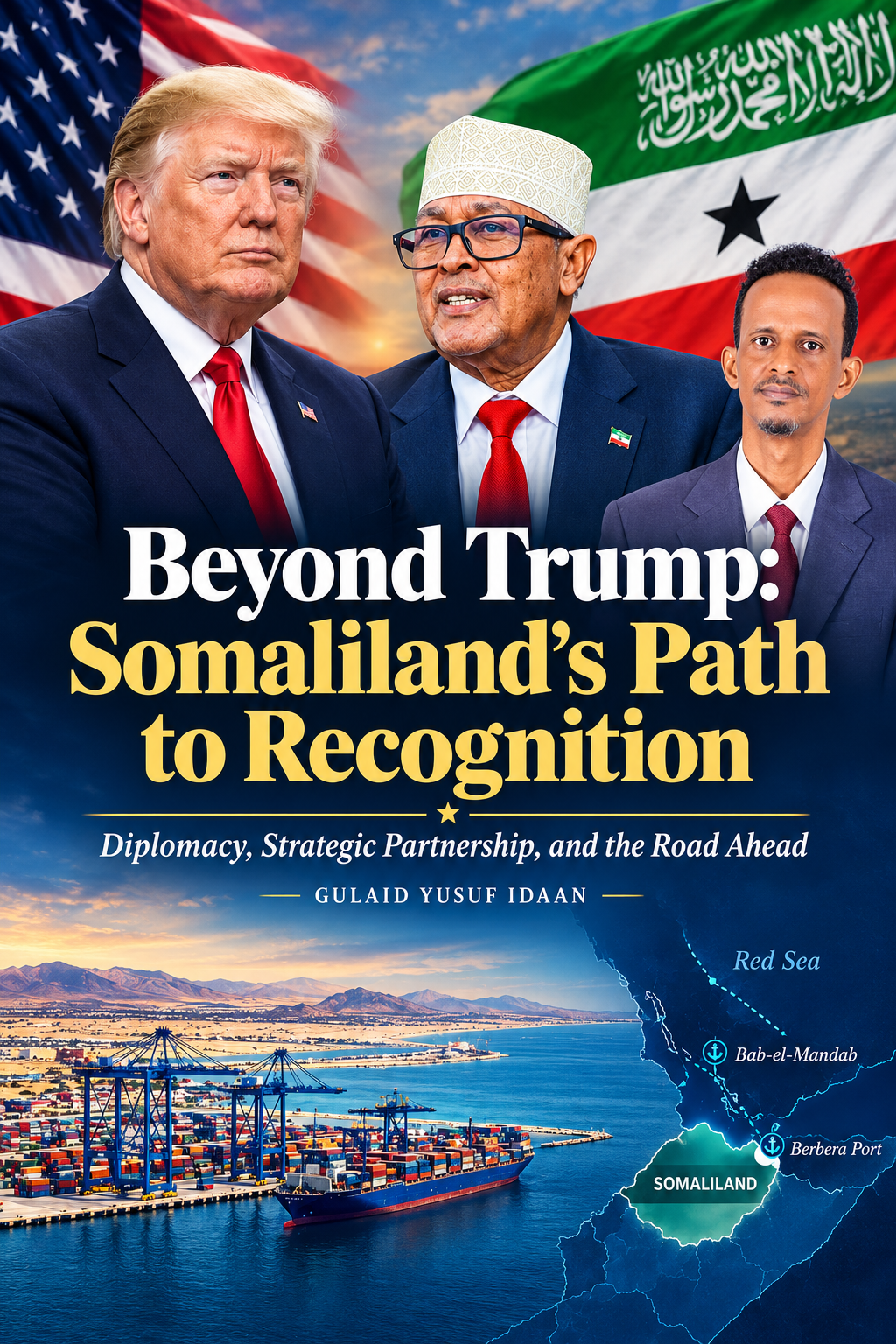
Beyond Trump: Somaliland’s path to recognition through strategic diplomacy, U.S. partnership, and Red Sea security. — Gulaid Yusuf Idaan #Somaliland #USSomalilandRelations #Geopolitics
For Somaliland, international recognition remains a central question of historical legitimacy, international law, diplomatic strategy, and national security. Since restoring its independence on 18 May 1991, Somaliland has developed its own political institutions, security structures, electoral processes, and administrative systems while pursuing formal recognition. Yet its unrecognised international status continues to limit its access to diplomatic, economic, and security opportunities.
Remarks by United States President Donald Trump may create an opening to reconsider Washington’s longstanding approach to Somaliland. Given America’s influence in international affairs and its strategic interests in the Horn of Africa, the Red Sea, and the Gulf of Aden, such remarks could bring Somaliland’s status into wider policy discussions. However, political attention does not constitute a formal policy commitment. Any change would depend on political decisions, institutional assessments, strategic calculations, and consideration of the implications for American relations with regional and international partners.
The central challenge for Somaliland is therefore to translate this political opening into sustained engagement with the institutions that shape American foreign policy. Rather than relying solely on appeals for recognition, Hargeisa must present a coherent case demonstrating how its historical and legal claim to restored independence aligns with United States strategic interests.
This requires connecting Somaliland’s experience of self-government and its legal arguments with practical contributions to Red Sea maritime security, counterterrorism, trade resilience, infrastructure development, and regional connectivity. At the same time, Somaliland must anticipate Washington’s assessment of the diplomatic costs of recognition, particularly its implications for relations with Somalia and other regional actors.
This article examines the roles of Congress, the Department of State, the Department of Defense, the United States Africa Command (AFRICOM), and the White House in shaping American policy. It then proposes a phased 90-day diplomatic roadmap focused on coordinated engagement, evidence-based proposals, institutional dialogue, congressional outreach, and measurable objectives.
The central argument is that Somaliland should treat Trump’s remarks as a potential diplomatic opportunity, not a guarantee of recognition. By combining legal legitimacy with strategic value and disciplined diplomacy, Somaliland can seek to turn Washington’s attention into a credible pathway towards formal recognition.
- Washington’s Decision-Making Process: From Congressional Momentum to Presidential Choice
Understanding how Washington approaches Somaliland requires distinguishing between political influence, institutional assessment, and executive authority. Congress can generate political momentum, the Department of State evaluates diplomatic and legal implications, the Department of Defense and United States Africa Command (AFRICOM) assess security opportunities, and the White House determines executive priorities. These institutions interact, but support from one does not automatically produce a change in American policy.
For Somaliland, the challenge is to connect its historical and legal claim to restored independence with a practical case for why closer relations would advance United States interests.
2.1. Congress: Building Political Momentum
Congress provides an important platform for raising Somaliland’s profile and encouraging reconsideration of Washington’s existing approach. Members of the House of Representatives and Senate can introduce legislation, request executive briefings, organise hearings, conduct oversight, and advocate for closer engagement.
However, congressional support does not automatically constitute formal recognition. Its value lies in generating sustained institutional attention and encouraging the executive branch to assess Somaliland’s position seriously.
Somaliland should therefore prioritise substantive engagement that produces identifiable outcomes, including policy briefings, hearings, requests for formal assessments, and dialogue with relevant committees. The objective is to establish Somaliland as a distinct foreign-policy question rather than an issue considered exclusively through Washington’s existing relationship with Mogadishu.
2.2. The Department of State: Diplomatic and Legal Assessment
The Department of State plays a central role in assessing the diplomatic implications of a potential policy change. Its considerations include international relations, regional stability, legal arguments, existing partnerships, and the consequences for American foreign-policy objectives.
Somaliland should present a documented account of its historical and legal position, including the former British Somaliland Protectorate, independence on 26 June 1960, the subsequent union with the former Italian-administered territory, and the restoration of independence in 1991. This case should explain Somaliland’s position under international law without assuming that historical arguments alone resolve every diplomatic question.
Equally important is a credible proposal for managing the consequences of closer relations. Somaliland should address potential regional objections, explain how diplomatic disagreements could be contained, and identify opportunities for constructive engagement with neighbouring countries and international partners.
The objective is to encourage an assessment of Somaliland’s distinct historical and political circumstances rather than treating its status solely as an extension of the dispute between Hargeisa and Mogadishu.
2.3. The Pentagon and AFRICOM: Assessing Strategic Value
The Department of Defense and AFRICOM evaluate regional developments through security requirements, operational feasibility, partnerships, and strategic risk. Their assessments can help establish whether Somaliland offers practical opportunities for American engagement.
Located along the Gulf of Aden, Somaliland has potential relevance to maritime security, commercial shipping, port infrastructure, and regional connectivity. Berbera could contribute to logistical resilience and diversified transport networks, while cooperation with Somaliland’s institutions could create opportunities for maritime awareness, port security, information-sharing, and counterterrorism.
Nevertheless, geographic importance does not automatically establish operational value. Somaliland should support its proposals with evidence of institutional capacity, clearly defined objectives, realistic resource requirements, and appropriate legal safeguards.
Any discussion of military access or defence arrangements should follow proper political and legal procedures. Somaliland should not assume that recognition would automatically produce a military agreement or make commitments before their implications have been assessed.
The purpose of engagement is to demonstrate that Somaliland could become a credible partner whose potential contributions merit serious consideration.
2.4. The White House: Strategic Benefits and Diplomatic Costs
The White House occupies a distinctive position because the president can establish foreign-policy priorities, direct executive diplomacy, and decide whether to pursue a fundamental change in policy. Congressional advocacy and institutional assessments may influence this decision, but they cannot guarantee it.
The central question is whether a different approach to Somaliland would advance American interests more effectively than maintaining the existing policy. This requires evaluating both the potential benefits of closer relations and the diplomatic costs of recognition.
Potential strategic benefits
First, Somaliland’s location gives it relevance to freedom of navigation and maritime security in the Gulf of Aden and the wider Red Sea region. Closer relations could create opportunities for cooperation in maritime monitoring, port security, and regional threat assessment.
Second, Berbera offers potential commercial and logistical value. Investment in infrastructure, trade, and transport connectivity could strengthen regional supply chains and support the diversification of routes serving Ethiopia and other markets. These benefits would depend on commercially viable arrangements and effective implementation.
Third, Somaliland could provide opportunities for security cooperation against shared threats, including terrorism. Such cooperation would require credible capabilities, defined objectives, and appropriate institutional arrangements.
Fourth, the wider strategic competition in the Horn of Africa, including China’s military presence in Djibouti, may influence Washington’s assessment of alternative regional partnerships. Somaliland’s relevance should be framed around constructive cooperation and regional stability rather than confrontation alone.
Finally, Somaliland’s geographic position and external relationships could contribute to broader Red Sea diplomacy. Any proposals involving Israel, Ethiopia, the United Arab Emirates, or other regional partners should be supported by verified developments and a clear explanation of their relevance to American interests.
These are potential advantages, not guaranteed outcomes. Their significance depends on feasibility, institutional capacity, and the broader political environment.
Diplomatic and political costs
Recognition could generate opposition from the Federal Government of Somalia and concern among some regional and international partners, potentially including Turkey, Egypt, Saudi Arabia, the African Union, and European governments. The extent of these reactions would depend on the circumstances and should be assessed individually rather than assumed to be uniform.
Washington would also need to consider the implications for its relationship with Mogadishu, existing security cooperation, regional stability, and wider diplomatic priorities. The administration would have to determine whether the potential benefits of closer relations with Somaliland justify these costs and whether the consequences could be managed without undermining other American objectives.
Somaliland cannot eliminate every objection or guarantee a favourable presidential decision. It can, however, strengthen its position by presenting credible evidence, realistic proposals, and a clear explanation of how closer relations could serve American interests.
Ultimately, its historical and legal case establishes the foundation of its claim, while strategic value explains why reconsideration may be relevant to contemporary American policy. Neither argument should replace the other.
2.5. From Institutional Engagement to a Coherent Strategy
Washington’s decision-making process should not be understood as a rigid sequence in which every institution must complete its work before another becomes involved. Congressional activity, diplomatic consultations, defence assessments, and presidential priorities can develop simultaneously and influence one another.
For Somaliland, the practical lesson is that diplomatic engagement must be coordinated across these different channels. Congressional support should encourage serious policy consideration; the State Department should receive a documented legal and diplomatic case; defence institutions should be presented with feasible proposals; and the White House should be able to evaluate the overall benefits, risks, and implementation requirements.
Progress in one institution does not automatically guarantee progress in another. Somaliland must therefore maintain a consistent message while tailoring its proposals to the responsibilities of each institution.
This is the difference between advocacy and strategy. Advocacy seeks attention and support; strategy connects political objectives with institutional engagement, practical proposals, and measurable outcomes.
For Somaliland, the ultimate objective is formal recognition. The immediate task is to make a change in American policy a credible, carefully assessed option.
- The Trump Factor: From Recognition Appeals to a Strategic Partnership
President Trump’s remarks provide a potential opening for Somaliland to present its case in terms of identifiable interests, practical cooperation, and measurable outcomes. The opportunity should not, however, be interpreted as a guarantee of recognition. Somaliland must connect its historical and legal claim with a convincing account of how a closer relationship could benefit the United States.
Its diplomatic presentation should therefore move beyond appeals based solely on historical injustice, democratic achievements, or the passage of time. Instead, it should demonstrate how Somaliland’s legal position, institutional experience, and strategic geography together provide a credible foundation for a durable partnership.
3.1. What Somaliland Could Offer
Somaliland’s strategic proposal should be organized around four interconnected areas.
Maritime security and regional stability. Somaliland can propose cooperation on maritime awareness, port security, commercial shipping protection, and the exchange of relevant security information. The aim should be to identify practical areas of mutual interest rather than make broad promises unsupported by operational detail.
Berbera and commercial connectivity. Somaliland can present Berbera as a potential platform for logistics, infrastructure development, and regional trade. It should identify opportunities for American businesses, explain relevant regulatory arrangements, and provide credible information about financing, infrastructure requirements, and commercial risks.
Counterterrorism and institutional cooperation. Somaliland can propose technical discussions on shared security threats, including the protection of transport infrastructure and the prevention of violent extremist activity. These proposals should be grounded in the capabilities of the institutions involved and accompanied by appropriate legal and operational safeguards.
Regional connectivity and economic resilience. Somaliland’s relationship with Ethiopia creates opportunities to examine trade diversification and transport networks. This should be framed as a contribution to regional economic resilience rather than as a zero-sum contest with neighboring countries or competing ports.
These areas should be developed into a coherent proposal. Somaliland should avoid presenting a long list of strategic advantages without explaining how they would be implemented, who would be responsible, and what results could reasonably be expected.
3.2. What Somaliland Seeks in Return
A partnership proposal must also clarify Somaliland’s objectives. Its ultimate goal is formal international recognition, but the diplomatic pathway may involve several intermediate steps.
Somaliland should seek a structured dialogue with relevant American institutions, a serious assessment of its historical and legal position, expanded direct engagement, and a clear indication of whether the administration is willing to consider a formal change in policy.
Where immediate recognition is not forthcoming, Somaliland should seek concrete interim outcomes rather than accept indefinite discussions without measurable progress. These could include regular bilateral consultations, technical cooperation, direct commercial engagement, or a defined process for reviewing existing policy.
Such steps would not constitute recognition in themselves. Their value would lie in building institutional relationships, demonstrating practical benefits, and clarifying whether Washington is prepared to move towards a different diplomatic position.
Somaliland should therefore distinguish between three outcomes: formal recognition, an organized process for considering recognition, and expanded practical cooperation without recognition. The first remains the objective; the other two may offer progress but should not be misrepresented as equivalent achievements.
- What Somaliland Should Do Next: A Coordinated Diplomatic Action Plan
The central weakness of many diplomatic campaigns is not the absence of a compelling argument, but the failure to translate that argument into coordinated action. Somaliland should use the political opening associated with Trump’s remarks to pursue a focused diplomatic strategy that connects its legal case for restored independence with its strategic value to the United States.
The Presidency should establish a small team to coordinate engagement with Washington. Comprising relevant foreign-policy officials, Somaliland’s representatives in the United States, and qualified legal and policy advisers, the team should maintain consistent messaging, coordinate diplomatic contacts, and ensure that meetings produce clear follow-up actions. This would strengthen the coherence and credibility of Somaliland’s diplomatic efforts.
A central priority should be preparing an evidence-based strategic dossier for American policymakers. The document should explain Somaliland’s historical and legal position, identify the American interests that closer relations could advance, assess potential diplomatic and security risks, and outline practical steps towards recognition. It should include a regional security assessment and proposals concerning Berbera’s commercial and strategic potential. All claims about existing capabilities, investment opportunities, and proposed cooperation should be supported by reliable evidence and clearly distinguished from unconfirmed commitments.
Somaliland should engage American institutions through coordinated but distinct channels. The Department of State should be approached on legal, historical, and regional diplomatic questions; the Department of Defense and United States Africa Command (AFRICOM) on feasible security cooperation and maritime security; Congress on sustained political engagement and appropriate policy initiatives; and the White House on the broader strategic decision. The objective should be to establish substantive institutional engagement and identify concrete policy steps rather than simply accumulate expressions of support.
This official diplomacy should be complemented by engagement with American think tanks, universities, former diplomats, security specialists, and business associations. Their involvement can encourage informed debate about Somaliland’s role in regional security, trade connectivity, and Red Sea stability. The emphasis should be on substantive policy analysis rather than publicity alone.
Berbera should be central to Somaliland’s practical offer. The government should develop a credible proposal identifying potential infrastructure and logistics projects, financing options, institutional responsibilities, and implementation constraints. Maritime security, commercial logistics, investment, infrastructure resilience, and trade diversification should be presented as complementary but distinct areas of cooperation. Realistic proposals would demonstrate how closer relations could advance identifiable American and regional interests.
Somaliland should also prepare evidence-based responses to concerns about regional stability, the African Union, relations with Somalia, and the implications of a change in American policy for Washington’s other regional partnerships. Addressing these issues through legal analysis and diplomatic consultation would help policymakers assess both the potential benefits and the costs of closer relations.
Formal recognition should remain Somaliland’s principal objective. The preferred outcome is United States recognition and the establishment of diplomatic relations through the appropriate processes. If Washington is not prepared to take that step immediately, Somaliland should seek a structured policy review and a clear indication of the process through which recognition could be considered. Practical cooperation in security, trade, investment, and institutional relations may also be pursued where feasible, but these measures should not be presented as substitutes for recognition.
Progress should be assessed against measurable indicators: substantive engagement with the executive branch; verifiable congressional initiatives; delivery and consideration of the strategic dossier; technical discussions on feasible security cooperation; development of a credible Berbera project pipeline; engagement with relevant policy institutions; and a clear indication of the administration’s position or next formal policy step.
The government should maintain accurate records of diplomatic contacts, review outstanding commitments, and adjust its approach in response to developments. Public statements must distinguish between expressions of interest, ongoing discussions, agreed initiatives, and formally established commitments. Appropriate confidentiality should be maintained where necessary.
Ultimately, Somaliland cannot control Washington’s decision, but it can strengthen the quality of its case, the credibility of its strategic offer, and the effectiveness of its diplomatic engagement. By connecting legal legitimacy with strategic relevance and political advocacy with practical proposals, Somaliland can move beyond reacting to presidential remarks and pursue a sustained, coordinated pathway towards recognition
- Conclusion: Somaliland Must Shape the Decision, Not Merely Await It
-
Trump’s remarks offer Somaliland a diplomatic opportunity, but recognition requires more than political attention. Somaliland must combine its legal and historical case with its strategic value in Red Sea security, maritime cooperation, and regional connectivity.
A unified Washington strategy, coordinated institutional engagement, and a clear diplomatic roadmap are essential to turn this opportunity into progress.
Somaliland must move beyond waiting for recognition and actively shape the decision through disciplined diplomacy, strategic engagement, and a clear policy agenda. Recognition remains the objective; diplomacy is the means.
Related Topics
Related Posts