
Book Review – Torah and the Army: The Relationship of Torah and IDF Service
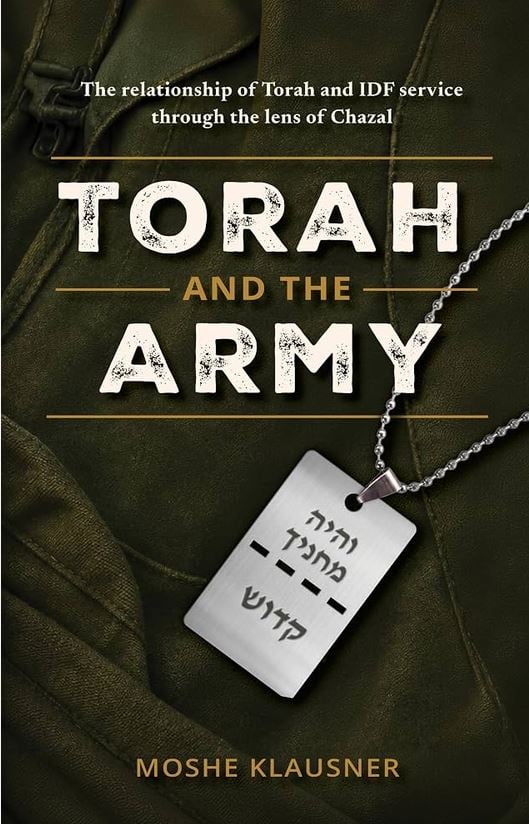
Few issues confronting Israeli society today are as contentious, emotionally charged, or consequential as the relationship between Torah study and military service. In the aftermath of October 7 and the ongoing challenges facing Israel, the question of who should serve in the Israel Defense Forces (IDF), and whether full-time Torah study provides a blanket exemption from that responsibility, has become one of the defining debates within the Jewish world.
In Torah and the Army: The Relationship of Torah and IDF Service Through the Lens of Chazal, Moshe Klausner tackles the subject by examining Tanach, Chazal, Rambam, writings of early and later authorities, and current rabbinic thought.
The book takes the form of a conversation between a rabbi and his student, using a question-and-answer format to explore the complex relationship between Torah learning and military obligations.
Personally, I would have preferred a more formal presentation, with a sustained development of ideas and arguments rather than a series of questions and responses. The format can sometimes feel uneven and interrupt the natural progression of the discussion. Nevertheless, while I didn’t particularly enjoy the book’s style, its overall message is far too important to ignore.
Rather than approaching the subject through contemporary political arguments or popular slogans, Klausner uses a framework grounded in traditional Jewish sources. He examines milchemes mitzvah, communal responsibility, the obligation to protect fellow Jews, and the importance of Torah study.
His central argument is that the tremendous importance of Torah study does not automatically eliminate the obligation to defend the Jewish people when they are under attack.
One of the book’s most important aspects is its willingness to confront sources frequently quoted in discussions about military service. Statements from Chazal and prominent Torah authorities can easily be taken out of context or selectively presented to support a particular position.
Klausner examines these sources in their broader context and shows how they relate to the Jewish people’s responsibilities. This is particularly relevant in an era when complex halachic discussions are often reduced to political slogans and sound bites.
The question of Torah study versus military service is not an abstract intellectual exercise. It involves the security and survival of the Jewish people, Jews’ responsibilities to one another, and the relationship between spiritual devotion and practical action. These are issues that deserve serious attention, thoughtful discussion, and an honest examination of the sources, even when the conclusions are uncomfortable or challenge established assumptions.
Importantly, this book does not argue against Torah learning or diminish the contribution of those who dedicate their lives to it. Rather, Klausner challenges readers to consider whether Torah values and the responsibility to protect fellow Jews should be viewed as competing obligations.
If there’s any flaw in the book, it is that Klausner is far too kind to those who completely abandon national service and the hardline right-wing Charedi central argument that the tribe of Levi is exempt from military service and therefore never subject to conscription. That argument is sourced in Rambam’s concluding discussion in Hilchot Shemittah v’Yovel, where he writes that the tribe of Levi does not wage war in the same manner as the rest of Israel.
This passage has become an important component of the Charedi argument against conscripting yeshiva students. According to this interpretation, contemporary Torah scholars and yeshiva students can be viewed as inheritors of the status of Shevet Levi and are therefore categorically exempt from national and military service.
In volume 2 of Milchemet Mitzvah – Religious Leadership and Halakhic Responsibility in the Military Service Debate, Dr. David Henshke, Professor of Talmud at Bar-Ilan University, applies the Brisker Rav’s analysis to this claim and shows why such a sweeping interpretation is fundamentally flawed.
The exemption of Shevet Levi cannot be understood as an unconditional prohibition against military participation. Rather, it must be understood in the context of the Jewish people’s responsibilities and needs. When war requires their participation, the exemption does not automatically shield them from that obligation.
The contemporary implications are difficult to overlook. When Israeli reservists have spent 300 days or more away from their families, careers, and civilian lives defending the country, the argument that the IDF doesn’t need additional military staffing becomes particularly difficult to sustain.
Torah and the Army is a timely and important contribution to one of the most consequential debates in contemporary Jewish life. Its subject is not merely the technical interpretation of a handful of Talmudic or halakhic sources; it goes to the heart of what it means to share responsibility for the Jewish people. Torah study is indispensable to Jewish continuity, but so too is the obligation to protect Jewish lives.
At a time when Israeli soldiers and reservists are making extraordinary sacrifices to defend the country, the question of who bears that responsibility cannot be dismissed or indefinitely deferred. Klausner deserves credit for bringing this discussion into serious Torah scholarship.
Ultimately, the challenge is not to choose between Torah and the defense of Israel, but to recognize that both are fundamental expressions of our collective responsibility to Klal Yisrael.