
Bridging the Gulf: Pakistan’s Expanding Strategic Relevance
In a Middle East undergoing rapid strategic realignment, Pakistan is no longer a peripheral observer—it is emerging as a bridge, a stabilizing force, and increasingly, a valued regional partner. From Riyadh and Amman to Washington, Islamabad’s diplomatic and military engagements reflect a confident recalibration of foreign policy that places Pakistan squarely at the centre of evolving regional power dynamics.
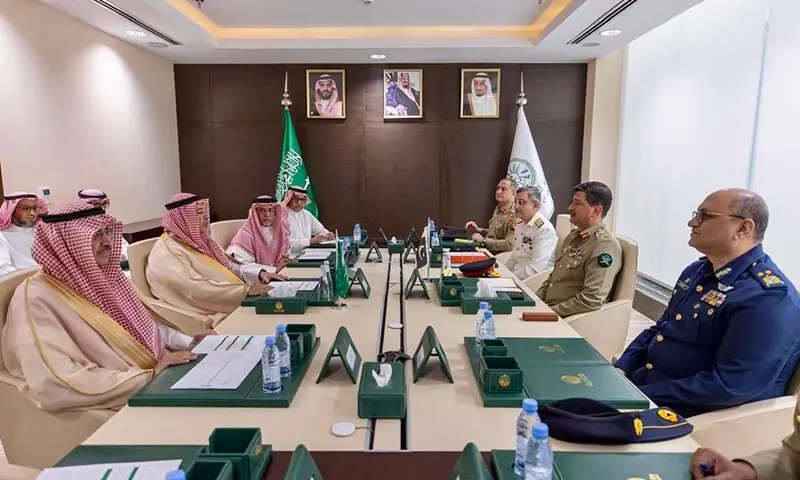
When Pakistan’s Chief of General Staff, Lt Gen Syed Aamer Raza, met his Saudi counterpart Gen Fayyadh bin Hameed Al-Rowaily in Riyadh, the deliberations underscored a partnership moving decisively beyond symbolic solidarity. Both sides reaffirmed their commitment to deepening defense cooperation, enhancing interoperability, and advancing collaboration under the Strategic Mutual Defense Agreement (SMDA). The pact—signed on September 17 by Prime Minister Shehbaz Sharif and Crown Prince Mohammed bin Salman—binds their security fates more closely than ever by treating an attack on either country as aggression against both. It marks a structural shift from episodic engagements to a durable, mutually binding security architecture.
Lt Gen Raza also led Pakistan’s tri-services delegation at the Special Meeting of the Pak–Saudi Bilateral Defense Industrial Forum, where both sides reviewed defense industrial projects and explored new joint ventures in emerging technologies. The emphasis on co-production and technological cooperation aligns with Saudi Arabia’s Vision 2030 and signals a maturation of defense ties that had long relied on training exchanges and operational cooperation. Riyadh’s appreciation for Pakistan’s sacrifices in the fight against terrorism further reinforced the alignment of strategic priorities.
Yet the broader regional context is equally significant. Jordan’s King Abdullah II arrives in Pakistan for a two-day state visit, a development that complements Islamabad’s deepening ties with Saudi Arabia. Jordan—one of the earliest countries to recognize Pakistan in 1948—shares a long history of political coordination with Islamabad, including participation in discussions surrounding the Gaza peace framework alongside Saudi Arabia, Qatar, Egypt, Indonesia, Turkiye, and the UAE. During the visit, wide-ranging discussions on political, economic, and cultural cooperation are expected, and Pakistan will confer its highest civilian award on the Jordanian monarch—an unmistakable signal of intent to elevate this relationship to a higher strategic plane.
These regional engagements unfold as Saudi Crown Prince Mohammed bin Salman prepares for a high-profile visit to Washington next week, where the White House is orchestrating a day of extensive ceremonies, bilateral meetings, and high-stakes discussions. According to senior U.S. officials, President Donald Trump plans to host MBS for an Oval Office meeting, followed by the formal signing of multiple defense and economic agreements. A Cabinet Room lunch and a state dinner in the East Room—hosted by First Lady Melania Trump—underscore the significance Washington attaches to the crown prince’s visit.
Trump’s affinity for Gulf leaders is well documented. His first major trip abroad in his second term included stops in the UAE, Qatar, and Saudi Arabia, where he was welcomed with a rare Air Force One escort by Royal Saudi Air Force F-15s. His rapport with MBS, whom he once called an “incredible man” and “my friend,” has remained a pillar of his regional diplomacy.
According to Axios, Trump recently urged the crown prince to accelerate normalization with Israel following the October 9 Gaza ceasefire deal. The phone call—made after the Sharm El Sheikh Peace Conference—was aimed at reviving a process that had stalled amid Riyadh’s insistence on a credible pathway to Palestinian statehood. Trump asserted that his Gaza plan created the conditions for such progress, while MBS reportedly expressed willingness to coordinate with Washington, even as he signaled caution. Saudi officials remain wary that the politically charged normalization debate could overshadow the upcoming White House discussions, which Riyadh seeks to focus on defense cooperation and investment.
These developments—the strengthening of Pakistan’s defense ties with Saudi Arabia, the elevation of Pakistan–Jordan relations, and the intensifying U.S.–Saudi diplomatic choreography—collectively reflect a region undergoing reconfiguration. For Islamabad, this moment offers both opportunity and responsibility. Its deepening partnerships with Gulf and Levantine states enable Pakistan to anchor itself more firmly within emerging regional blocs while contributing to stability and dialogue in an increasingly unpredictable environment.
Critics may argue that Pakistan risks entanglement in geopolitical currents beyond its control. But proponents contend that structured, transparent partnerships provide clarity where ambiguity once reigned. As the Gulf recalibrates its ties with global powers and revisits its positions on long-standing conflicts, Pakistan’s proactive engagement—grounded in history, trust, and shared strategic interests—positions it as a constructive and stabilising actor.
Taken together, the week’s diplomatic choreography suggests that Pakistan is weaving itself into a broader security and economic arc spanning Riyadh, Amman, and Washington. If pursued with strategic clarity, these engagements could help shape a more interconnected, resilient, and forward-looking Middle East—one in which Pakistan is not merely a participant, but a partner in peace and regional development.