
B’Tselem’s Genocide Report: Tough Reading We Have to Face
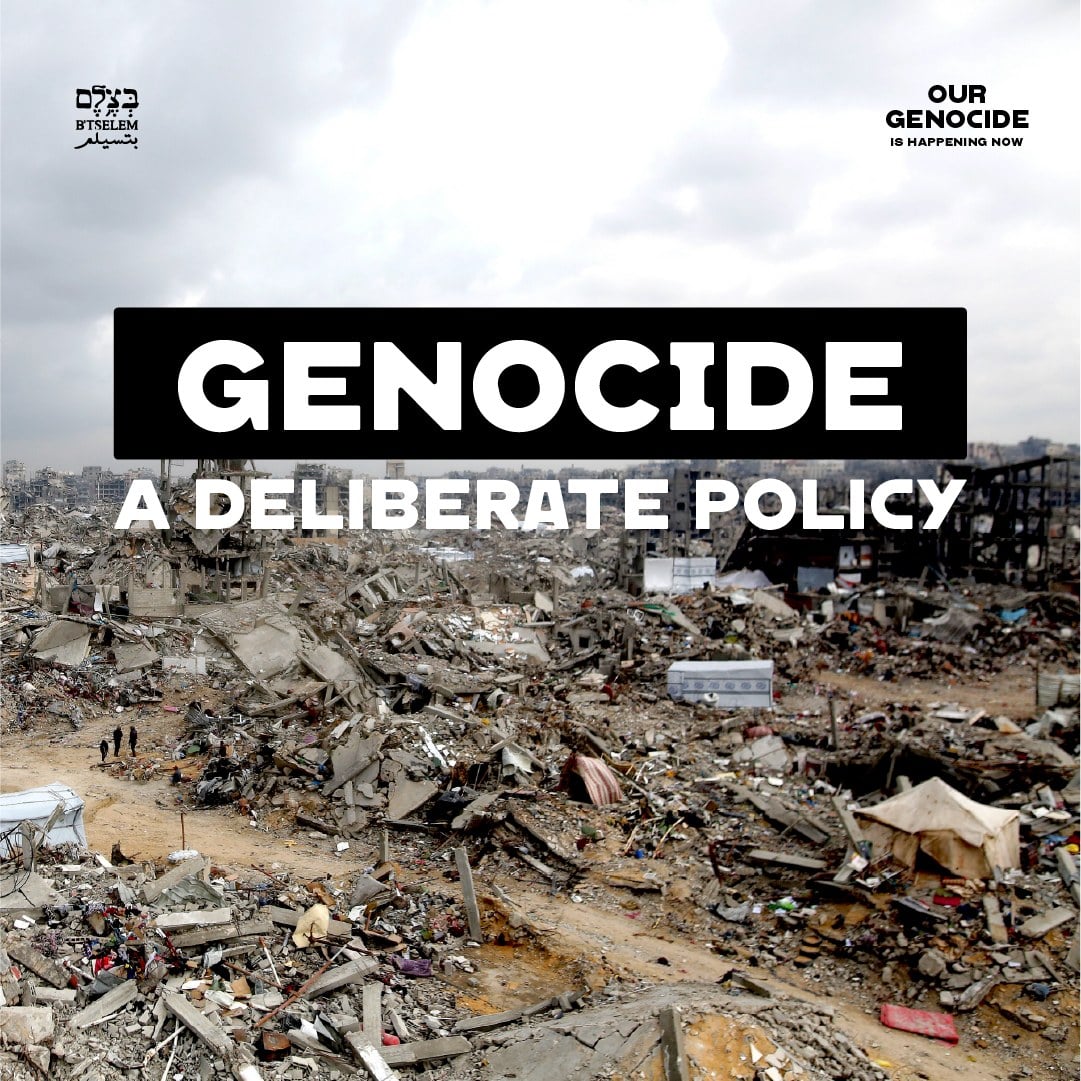
On July 28th, the Israeli human rights group B’Tselem released an 88-page report accusing Israel of genocide in Gaza. For those of us who care about Israel being a light unto the nations, the contents are hard to stomach but even harder to dispute.
Most of the report’s factual information is not new, but rather simply echoes what was written by Amnesty International last December and by the United Nations Pillay Commission last March. The difference is that this time it’s coming from Israelis, not international organizations known for bias. Also, rather than beginning with a token condemnation of Oct. 7th and then just denouncing Israel, B’Tselem puts much more emphasis on explaining why it considers the Gaza war genocide even in spite of Hamas atrocities.
B’Tselem says that genocide only occurs as the culmination of a long process, which includes dehumanization, deprivation of rights, and the target group becoming perceived as a threat which must be dealt with. They document how for years Palestinians in the West Bank and Gaza have been subjected to discriminatory treatment and degrading rhetoric. Countless terrorist attacks and the Intifada have reinforced to Israelis that Palestinians are a danger.
But this continued in a sort of equilibrium for decades, and did not have to lead to where we are today. B’Tselem calls the Oct. 7th attack ‘a triggering event’. It strengthened the narrative of Palestinian danger and dehumanization to such an extent that, combined with the continued provocation of the hostages, it pushed Israel to genocide. The justification of self-defense grew powerful enough to overcome all moral or legal restraint.
While that’s a compelling explanation of how we’ve reached this point, the report also has faults. It treats Palestinians only as passive victims, without agency or any role in bringing about the current crisis. B’Tselem claims Israel’s narrative that Palestinians represent an existential threat and constant danger is rooted in prejudice and is also self-serving. Maybe so, but that doesn’t mean it’s not true. This is one of the most infuriating aspects of the genocide accusation, with its echoes of the Holocaust. Jews were not threatening to annihilate Germany, and did nothing to bring the wrath of the Nazis upon themselves. Decades of terrorist attacks, culminating in Oct. 7th, mean that even if Palestinians have become victims, they are not of the completely innocent type.
B’Tselem doesn’t ask what if Palestinians, realizing the danger of being perceived by Israel as a relentless, uncompromising threat, had eschewed terror? What if throughout the years Palestinian leaders had consistently condemned violence against Israel, stating clearly that’s not what they stand for? B’Tselem agrees Oct. 7th was likely a crime against humanity, but says nothing about what responsibility or consequences that entails.
The report’s conclusion is also disappointing. It calls lamely for more action from the International Community. As the report itself notes, a genocide case is already underway at the International Court of Justice, Israeli leaders have been indicted at the International Criminal Court, UN officials and foreign leaders have issued demands and made statements, and none of this has accomplished anything at all.
Isn’t it time for human rights groups to recognize that endless, vitriolic condemnations of Israel are counter-productive? Villainizing Israel only deepens its sense that the world stands with the Palestinians against it, strengthening the belief that ever more extreme measures are needed for survival. Rhetoric that questions Israel’s very right to exist or to defend itself against terrorism only pushes Israel to use more force in pursuit of safety.
B’Tselem is undoubtedly correct that genocide is the tragic culmination of a long process. Human rights groups can best contribute by seeking ways to address and reduce the deep-rooted hatred and fear that have accumulated during this process and continue to fuel the conflict, not by piling on condemnations that add even more polarization and strife.
As the report notes (p. 72), violence resulting in genocide caused by disputes over land is unfortunately common throughout history. And sadly, Gaza is not even the largest or most severe humanitarian crisis in the world today- it just happens to be the one that gets the lion’s share of Western media attention.
This is neither an excuse nor a justification. Just a reminder that B’Tselem is not accusing Israel of being worse than other countries or doing something so horrible as to be without precedent. But it is making a clear statement that for Israel to live up to our highest moral aspirations, there’s a long way to go.