An Iranian voice in exile
Cardboard Cutout
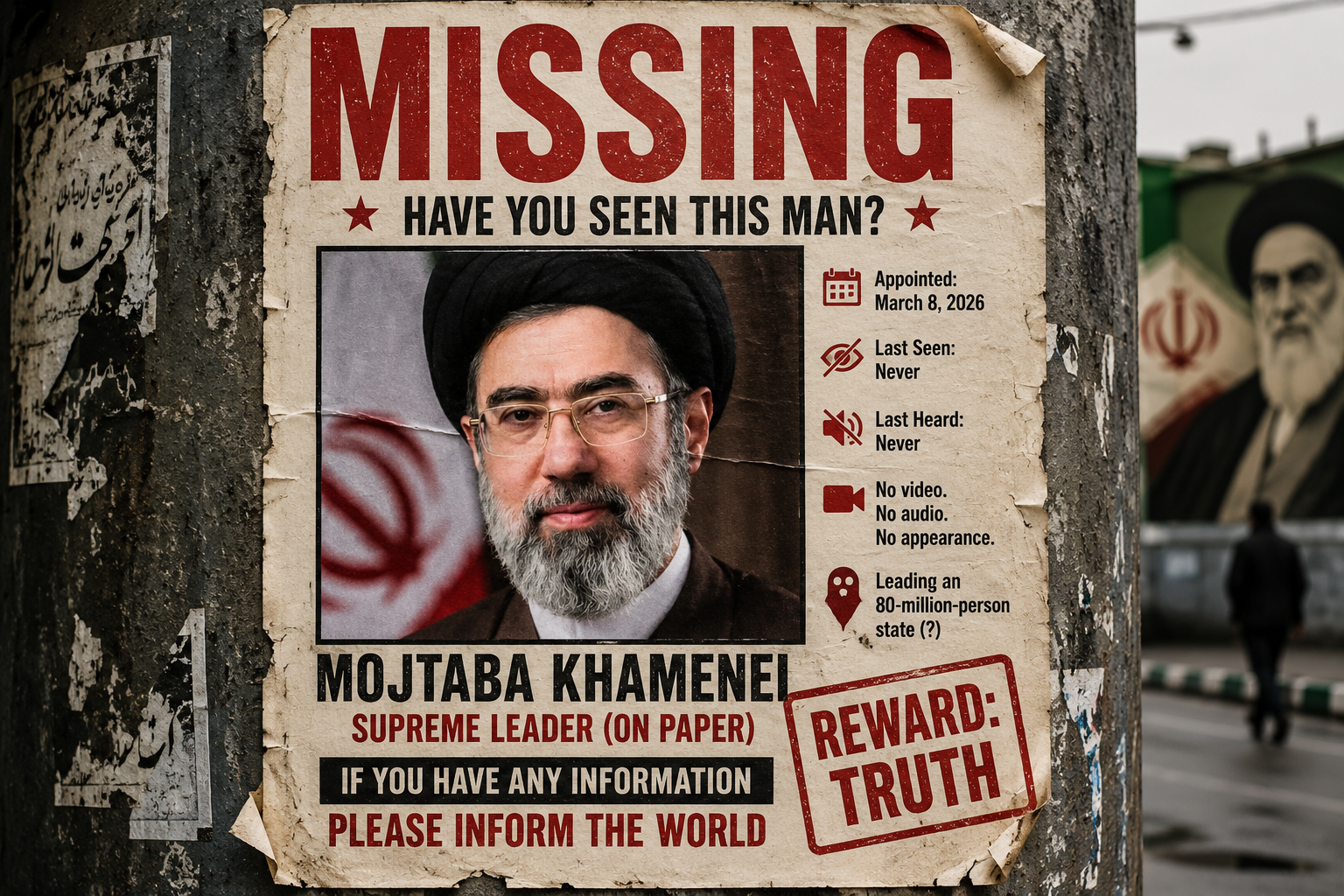
Missing: Iran's Supreme Leader. Last seen: Never. If found, please notify the international community — they just signed a nuclear framework in his name (AI-generated illustration).
Since February 28, 2026, the Islamic Republic has been governed — on paper — by a supreme leader no one has seen.
Mojtaba Khamenei was appointed on March 8. His first statement was read by a state television anchor. At his inauguration, a cardboard cutout stood in his place. President Trump: “Nobody’s seen him. We don’t know if he’s dead or not.”
It is now June. Nothing has changed. No video. No audio. No appearance. Statements issued in his name. A 14-point memorandum of understanding, signed today at Versailles, concluded in his name. Mojtaba Khamenei: still absent.
Not Bin Laden
The comparison to Osama bin Laden does not hold.
Bin Laden led a non-state organization. Concealment was operationally logical. He had no state functions, no foreign counterparts to receive, no constitutional obligations.
A supreme leader of an 80-million-person state has all of these. The Islamic Republic’s system assigns him final authority over military operations, nuclear policy, IRGC command, and treaty ratification. These cannot be delegated to a ghost. There is no precedent in modern statecraft for a head of state who vanishes at the moment of appointment and remains invisible through four months of active war culminating in today’s signed memorandum of understanding.
Two Possibilities
The facts permit exactly two explanations.
First: Mojtaba Khamenei is dead. Sources familiar with the situation indicate this possibility — that injuries sustained on February 28 were fatal, and that the regime has chosen fiction over disclosure.
The evidence is consistent with this reading. The regime has used AI-generated videos to show Khamenei delivering messages — which is itself confirmation that genuine footage does not exist. IRGC-linked Tasnim News Agency, in what it later called an “error,” referred to Mojtaba Khamenei as the “martyred leader of the revolution” before correcting the post. A mural in Mashhad Ardehal depicting him alongside dead commanders — Soleimani, Raisi, Khomeini — went viral before authorities could respond. The only public confirmation of his existence came from President Pezeshkian on May 7, who reported a two-and-a-half-hour meeting — with no location, no precise date, no other witnesses, and no verifiable record.
The funeral ceremonies for Ali Khamenei, scheduled for July 4–9, will serve as the definitive test: if Mojtaba does not appear at his own father’s state burial, the question answers itself. Should he later be confirmed dead, Pezeshkian’s unverifiable account would constitute an additional data point — one that speaks to the Islamic Republic’s relationship with truth at every level of its leadership, from supreme leader to president.
Second: he is alive but so severely incapacitated that his condition cannot be publicly revealed without triggering an immediate succession crisis. Reuters sources cited severe facial and leg injuries. Analysts at the International Crisis Group assess that he “is not in a state where he can actually make critical decisions” and that statements attributed to him serve as “cover for Iranian negotiators to protect themselves from criticism.”
In either case, the Islamic Republic is governed by a leader who may not exist in any functional sense.
The Silent Coup
Both possibilities lead to the same conclusion: a silent coup has taken place, not yet publicly declared.
The regime’s constitutional framework requires a visible, legitimate supreme leader. Instead, it chose a ghost. The only institution with the motive and capacity to make that choice is the IRGC.
The theocratic facade remains — Mojtaba’s name on statements, clerical language in communiqués — while actual power has passed to the military-security complex. President Pezeshkian signs the 14-point memorandum at Versailles, but the IRGC controls the ground. The invisible supreme leader provides the theological cover the IRGC cannot provide for itself.
The coup has not been announced because it cannot be. Domestically, it would strip the regime of its last legitimacy claim. Internationally, it would trigger responses a weakened Iran cannot absorb. So the fiction holds: a cardboard leader for a cardboard republic.
The Safety Valve
The ambiguity serves a purpose.
A supreme leader whose existence cannot be confirmed is more useful than one who can be held accountable. Mojtaba Khamenei — visible or not, alive or dead — is the religious authority whose name can be attached to any decree, at any moment, for any purpose.
Two triggers are possible.
The first: a legitimizing fatwa. If the regime needs religious cover for a major concession or strategic retreat, a decree in Mojtaba’s name provides it. This is the less likely scenario. The regime’s behavior — systematic use of the ceasefire to buy time and extract resources, continued preparation for multi-layered attrition — does not indicate genuine intent to settle. It indicates an organization purchasing breathing room.
The second: a fatwa of betrayal. Pezeshkian has signed at Versailles. Sanctions are being lifted. Frozen assets are set to flow. The regime rebuilds. And then, at a moment of its choosing, a fatwa is issued in the invisible leader’s name: the agreement is void, the nuclear program resumes, and the Islamic Republic presents a theological justification no diplomatic instrument was designed to counter.
This is the documented operating method. Every agreement the regime has entered has been honored precisely as long as it served the regime’s interests — and abandoned the moment it did not.
A Signature Without a Signatory
The international community has just concluded a nuclear framework with a government whose leader cannot be verified as alive.
An agreement is only as durable as the authority behind it. When that authority is a cardboard cutout — literally, at his own inauguration — the agreement is exactly as durable as the regime needs it to be, and not one day longer.
If the supreme leader of the Islamic Republic does not appear at his father’s state funeral in July, the world will have its answer about who has been governing Iran. The more important question is whether that answer will change anything about what the world is prepared to sign.
Related Topics
Related Posts