Urban Sociologist and Global Affairs Commentator
Case Notes on a Patient Called the Red Sea
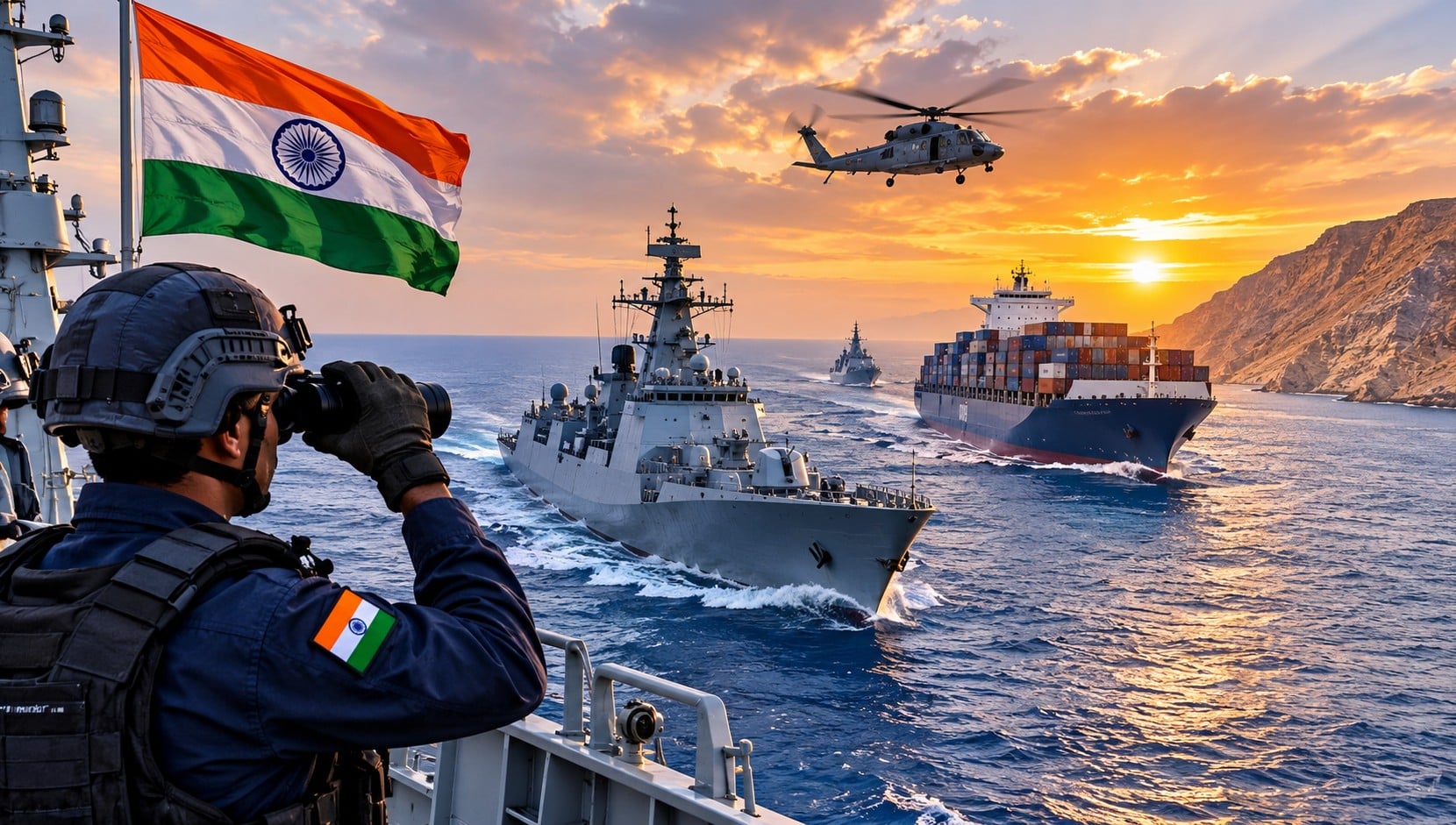
India providing protective escorts to Indian container ships in the high seas. An AI Illustration.
Chart prepared November 2026. Condition: acute, with chronic complications.
Chief complaint
The patient cannot swallow, and a body has two throats.
For the first time, both gateways of the Arabian Peninsula are disrupted at once: Iran has closed Hormuz, and the Houthi contest Bab el-Mandeb. Together they are the windpipe and the gullet of the world economy. The patient is not choking on a single obstruction. It is learning that its throat can be held shut by anyone with a cheap drone and a grievance.
Vital signs
Doctors begin with numbers.
Daily transits through Hormuz have fallen (95% drop) from over 100 to roughly 05-10 vessels. Large tanker earnings hit about $805,000 a day in October, against some $55,000 in 2025. Someone is getting very rich from the fever. A container from Shanghai to Rotterdam costs about 3.4 times what it did in October 2023. Suez revenue is about half its record.
One reading deserves special attention, because it shows the patient is not dying but adapting badly: by late October carriers had put roughly 63% of Far East-Europe container capacity back on Red Sea services, even as the Houthi escalated. Commerce is walking back toward the fire. It cannot afford to stay away, and it cannot afford to arrive. That is the physiology of a system with no reserves.
History of present illness
Old physicians knew that wars ended. The Horn once ended its quarrels in victory or on paper. The new disease is the war that cannot finish. No party is allowed to win or lose, patrons keep their partners fighting, and armed actors build administrations and revenue systems that need the war to continue.
This is an infection that learns to feed on its host. A ceasefire can quiet the fever and leave the parasite intact. The Houthi are the sharpest case: a deal with Tehran might ease Hormuz without ending attacks in the Red Sea, because they pursue goals of their own in Yemen.
Nor is it only one organ. The Med-Or Italian Foundation report (The Great Red Sea War, November 11, 2026) describes Iran, the Gulf and the Horn as a single theatre, with armed networks stretching across the Gulf of Aden. The patient has a whole-body disease.
The inequality of pain
Here the case history becomes social.
The Gulf’s rich monarchies built bypasses and recovered, though Saudi Arabia’s bypass itself had to be bypassed once drones hit its East-West pipeline. A poor country has no second pipe. Ethiopia sends over 90% of its trade and fuel imports through Djibouti; diesel prices nearly tripled and fuel was rationed. A truck driver in Addis Ababa felt a war in the Gulf at the pump, within weeks. Egypt, which hoped to be an energy hub, is again a net gas importer. And all of it unfolds beneath an El Niño drought-and-flood cycle, as hunger deepens in Sudan and Somalia while relief shipments are delayed and deterred by sea insecurity.
A deeper symptom has appeared. Safe passage is no longer a public good but a private privilege. It depends on whose flag a ship flies and who can negotiate for it, and Chinese-linked tankers have crossed while others paid ruinous premiums. A commons that checks your passport before it lets you drink is no longer a commons.
The nerve
Beneath the skin lies the nervous system, and it is hanging by a thread.
Bab el-Mandeb, roughly 30 km wide, carries 17 cable systems and an estimated 17% of global internet traffic, including over 90% of Europe-Asia capacity. Those cables are about as thick as a garden hose. The rocky seabed prevents burying them, and in 2024 a single ship’s drifting anchor, after a Houthi missile strike, cut three of them.
Now the horror. Africa has one permanently stationed repair ship, in Cape Town, and repairs near the strait would need the assent of a movement under terrorism designations. The Med-Or report adds that obtaining permits after the 2024 cuts, expected to take about eight weeks, stretched into roughly six months of restoration. A nervous system whose surgeon needs permission from the attacker is not a protected system.
Differential diagnosis: why the obvious cure fails
The reflex prescription is a bigger fleet. Escorts matter, but the chart shows why they cannot be the whole treatment. Naval escorts around Hormuz and Bab el-Mandeb have not brought war-risk premiums down substantially. An insurer prices fear, not firepower: one successful strike can reroute an entire corridor. And no hull can govern a coastline. As the Med-Or report puts it, escorts protect ships, but only coastal governance and political settlements on both shores can secure the routes.
The consulting physician
Every ward needs someone who can get the other doctors into the same room. This is India’s role, and the verb is convene, not command.
Its qualifications are plain. It has a body of its own at risk: by some estimates around 50-60% of its crude imports pass through Hormuz. It has a working practice: Operation Urja Suraksha escorts India-bound energy ships through Hormuz, and its navy has monitored and supported merchant transit through Bab el-Mandeb. It chairs a table nobody else can: the Indian Ocean Naval Symposium includes both Saudi Arabia and Iran, and an Indian officer took command of Task Force 154 in February. And it practises a rare discipline: simultaneous ties with Saudi Arabia, the UAE, Iran and Israel, without joining rival blocs. The region is hardening into camps, with a UAE-linked network of ports and corridors on one side and the Mecca Joint Defence Agreement on the other. The patient needs a physician who belongs to neither ward.
Treatment plan
Five prescriptions, none of which requires peace to start.
- A pantry for the poor. Pooled stocks of fuel, grain and fertiliser at regional hubs, so that a closed strait buys less leverage. A society that can wait is harder to hold hostage.
- A truce for the repair ship. A protocol that treats cable-repair vessels as protected civilian assets, with pre-cleared permits and a pooled fleet. It is the Red Cross principle applied to the seabed.
- Insurance that doesn’t check passports. Sovereign-backed war-risk cover open to every flag, so that passage stops tracking patronage.
- One map. India’s Information Fusion Centre could link the EU’s Aspides, the Djibouti Code states and the Saudi-led coalition launched in July, sharing a picture without merging commands.
- A reason to guard the coast. Coast guard training, port security and revenue-sharing, so that open sea lanes pay better than piracy. Six ships have been seized off Somalia since late April, against three in the previous fourteen years. The skin is where infection enters.
Resilience means different geography, not just a second pipe. Lamu, Dar es Salaam and Mombasa are emerging as alternatives, but a pipeline along the same exposed route protects against breakdown, not against attack.
Contraindications
A good chart records what the treatment cannot do.
India is not a Gulf guarantor. Its Hormuz mission mainly protects India-bound cargo, and analysts judge its regional presence more commercial than security-centred. Some doubt that US allies would stay in a middle-power coalition led by India. Its balancing act is also an obligation: closer ties with Abu Dhabi, such as the May 2026 defence framework, may sit awkwardly with Riyadh’s new alignments.
And the deepest lesions are not maritime. Hormuz needs a bargain with Tehran. The Houthi need a Yemeni settlement. The Saudi-Emirati rift, which the Med-Or report names as the place to start, is a quarrel only the two capitals can end. An Ethiopia-Eritrea war, the report’s other near-term danger, would be fought on land. Europe, the Gulf and African states are co-physicians here, not patients. Under these multifactorial conditions, India may not offer any clinically validated antidote, but no answer assembles without someone playing India’s part.
Prognosis
Guarded, but not hopeless, and depending on what we decide the patient is.
If it is a pipe, we will keep building gunboats and bypasses and be surprised each time. If it is a metabolism, we will build buffers, repair rights and shared insurance, the dull tissues of a body that can survive its own bad day.
The test of whether it worked will not be a communiqué. It will be a Sudanese clinic whose lights stay on, an Ethiopian trucker who can fill the tank, and a refinery in Gujarat that does not need to check the news. The sea has no owner. It has only patients, and only physicians who agree to practise together.
End of chart.
Related Topics
Related Posts