
A Moroccan Journalist
Ceuta is Moroccan, and the Israelification of its crisis changes nothing
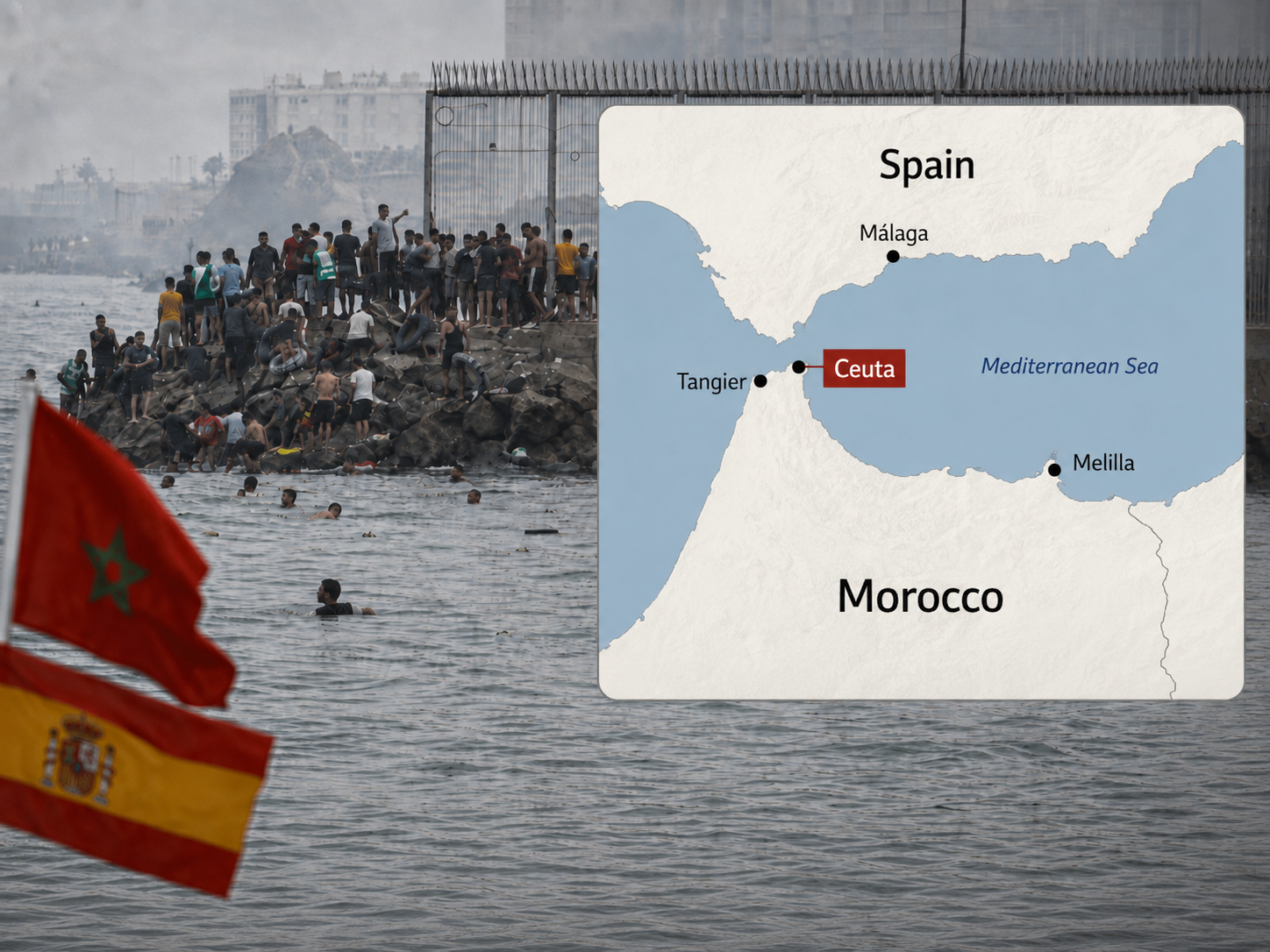
Anyone with little sense of the geography who first heard of a “migration crisis into Ceuta” might reasonably have imagined desperate migrants reaching mainland Spain – only to discover, perhaps with some astonishment, that Ceuta is quite literally a city on the Moroccan coast, separated from the rest of Spain by the Mediterranean and distinguished from its Moroccan surroundings chiefly by the fact that Madrid still governs it. (AI-generated).
I am late to this – partly because I was away on summer vacation, but also deliberately so, because the sheer density of bad analysis, conspiratorial reasoning, and historical amnesia that followed the events of July 30-31 in Ceuta required something that the commentariat has been conspicuously unwilling to provide: patience.
So here, two weeks after approximately 70,000 Moroccans crossed into a city that sits on Moroccan soil and has sat on Moroccan soil since before Spain existed as a unified kingdom, is what the Ceuta episode actually reveals – and it has nothing to do with the fantasies that consumed social media in the days that followed.
The first revelation is the one that Madrid has spent five centuries avoiding: Spain is a colonial power in Africa, and no amount of progressive rhetoric about Palestinian liberation can obscure this fact. Pedro Sánchez is the same prime minister who recognized the State of Palestine in May 2024, labeled Israel a “genocidal state,” canceled arms deals with Tel Aviv, dispatched a Spanish naval vessel to escort the Sumud Flotilla, joined South Africa’s genocide case at the International Court of Justice (ICJ), and positioned himself as one of Europe’s most vocal champions of anti-colonial principle.
I anatomized this contradiction at length in September 2025, in a more searching indictment published on The Times of Israel Blogs under the title “Spain Condemns Israel While Occupying Moroccan Land.” The paradox was no less damning then; time has merely stripped it of whatever fig leaf of plausibility remained.
Yet his government rules two cities on the African continent acquired by Spain through conquest centuries ago, and has refused, with a consistency that transcends left and right, every suggestion that this arrangement might constitute precisely the kind of colonial occupation he so readily denounces when Israel does it.
The historical irony is sharper than the familiar claim that “modern Morocco only appeared in 1956” suggests. Morocco’s political history stretches back to the Idrisid state founded in 788, making Moroccan statehood centuries older than the political unification of Spain. Spain itself emerged gradually: the dynastic union of Castile and Aragon began with the 1469 marriage of Isabella and Ferdinand, Granada fell in 1492, and political centralization remained incomplete until the Nueva Planta decrees of 1707-1716. The contemporary democratic Spanish state, meanwhile, rests on the 1978 Constitution.
If 1956 is treated as Morocco’s “birth” merely because it marks the end of the French and Spanish protectorates, then intellectual consistency would require Spain to be dated either to its own gradual unification or, by the same logic of modern constitutional statehood, to 1978. Morocco did not suddenly come into existence in 1956 any more than Spain suddenly came into existence in 1978. Independence, constitutional refoundation, and historical statehood are not the same thing.
Ceuta was conquered by Portugal in 1415 and passed to Spain in the 17th century. Melilla was taken by Spanish forces in 1497. Both predate the colonization of the Americas. Both remain, after the entirety of African decolonization, the only European-held territories on the African mainland. Spain also retains a constellation of even smaller possessions – the Chafarinas Islands, Peñón de Vélez de la Gomera, Peñón de Alhucemas – rocky outcrops off the Moroccan coast whose strategic purpose has long since evaporated but whose symbolic function endures: they are the physical evidence that Spain’s commitment to decolonization ends where its own territorial interests begin.
The hypocrisy is not subtle, and it does not require a sophisticated observer to detect it. Spain delegitimizes Israel in favor of a state that has never exercised sovereignty over its claimed territory and calls Jerusalem occupied, while maintaining African outposts that exist only because Spain literally was – and, in Ceuta and Melilla, still is – a settler-colonial state.
Writing in the Middle East Forum on March 12, scholar Michael Rubin put it with admirable bluntness: Sánchez’s British counterpart, Keir Starmer, rescinded British claims to the Chagos Islands; whatever one thinks of that decision, Rubin argued, “at least Starmer is true to his principle.” Sánchez, in his view, is not.
When Israeli Ambassador Danny Danon responded to the Ceuta crisis by asking why Spain “still maintains colonial enclaves in Africa,” the Spanish government reacted not with self-reflection but with diplomatic fury – as though the question itself were an act of aggression rather than the most obvious observation available to anyone with a map and a calendar.
And this brings us to the second revelation, which is darker and more instructive: the speed and eagerness with which the crisis was repackaged as an Israeli conspiracy. Within hours of the first crossings, a narrative crystallized across the political spectrum – left, right, and everything in between – that Israel, in coordination with the United States and Morocco, had orchestrated the mass movement of people into Ceuta as retaliation for Sánchez’s pro-Palestinian posture, his opposition to the Iran campaign, and his recent rapprochement with Algeria.
Spanish political commentator Carolina Alonso called it “a coordinated attack between Morocco, the United States, and Israel.” Spanish Transport Minister Óscar Puente implied that Danon’s remark was itself evidence of Israeli involvement. Candace Owens circulated a 7-year-old social media post from Yair Netanyahu – a private citizen with no government role – as though it were an operational blueprint.
The conspiracy theory also reached back to a March 16 Middle East Forum article by Rubin, published more than four months before the late July events, in which he provocatively argued that Morocco should organize a new Green March into Ceuta and Melilla to challenge Spain’s continued possession of Ceuta and Melilla as colonial bridgeheads on African soil.
The mechanism was always the same: take a real geopolitical tension, add an Israeli official’s comment, stir in the ambient conviction that nothing happens in the world without a Jewish hand behind it, and serve the result as “analysis.”
As HonestReporting documented in a methodical debunking, there is no evidence – none – that Israel organized, financed, or coordinated the mass crossing into Ceuta. The crisis stemmed from Spain’s own migration policies, a court ruling that human trafficking networks exploited, Morocco’s long-standing leverage over the permeability of a border it does not recognize, and the socioeconomic pressures that drive tens of thousands of young Moroccans to risk their lives for a chance at Europe.
What makes the accusation especially cynical is the underlying European assumption that Morocco should function indefinitely as the continent’s outsourced border guard: absorb the political cost, police the coastline, intercept migrants, contain African mobility, and spare Europe the consequences of its own migration regime – all in exchange for comparatively modest annual funding and periodic diplomatic praise.
Madrid and Brussels cannot treat Morocco as a subcontracted watchman for Fortress Europe when it suits them, then feign shock when Rabat reminds them that border enforcement is an exercise of sovereign policy, not a permanent service owed to Europe. The arrangement is revealing in its asymmetry: Europe expects Morocco to militarize its northern frontier on Europe’s behalf, while simultaneously insisting that the two Spanish-held cities on that same African coastline are beyond serious political discussion.
These are real, structural, documented causes. But they are boring. They do not satisfy the appetite for a villain with a flag. And so the conspiracy theory flourished – prompting David Keyes, a former spokesman and adviser to Netanyahu, to build, with a kind of weary brilliance, the Israel Conspiracy Generator: a satirical website powered by Grok AI that, with the click of a button, generates a random location and a random disaster and connects them with a theory that always – always – leads back to Israel. “Because you know who did it,” the site reads. The joke landed because the joke was already the reality.
What both revelations share – Spain’s colonial denial and the world’s reflexive Israelification of every crisis – is a deeper refusal to see Morocco as a sovereign actor with its own interests, its own grievances, and its own agency. The Moroccans who crossed into Ceuta in late July were not instruments of an Israeli plot. They were not pawns in an American retaliation scheme.
They were people walking into a city that their country has claimed as its own for as long as it has existed as a nation – a city separated from the rest of Morocco not by geography, not by culture, not by language, not by history, but by a fence built to preserve a 600-year-old colonial fact that the rest of the world, when it encounters the same fact in Palestine, calls an occupation. The only difference is who is doing the occupying – and in the hierarchy of acceptable imperialisms, European imperialism in Africa has always ranked considerably higher than Middle Eastern imperialism anywhere.
Spain wants to liberate Palestine. It might start closer to home. If “from the river to the sea” is to remain the preferred grammar of anti-colonial liberation, then Madrid should not be surprised to hear an African variation of its own: from the border to the sea, Ceuta and Melilla free.
Related Topics
Related Posts