Choose Life: A Rosh Hashanah and Yom Kippur Meditation
We live in turbulent times. When I am not finding refuge in literature, film, or music, I turn to the visual arts. The Cincinnati Art Museum in my hometown offers a masterclass in facing reality, especially, for me, its American Impressionist collection. Artists such as Robert Duncanson, Frank Duveneck, Elizabeth Nourse, Childe Hassam, and John Singer Sargent saw the world through shifting light, color, and movement. Their work reminds us that perception is never fixed: a familiar scene can become strange and new simply by learning to look at it differently.
Great writing can do the same. Recently, I read Walter Isaacson’s brilliant brief book, The Greatest Sentence Ever Written (2025), about the opening of the Declaration of Independence: “We hold these truths to be self-evident, that all men are created equal, that they are endowed by their Creator with certain unalienable Rights, that among these are Life, Liberty and the pursuit of Happiness.”
Isaacson shows how this sentence established a radical political ideal: that all human beings possess equal dignity and rights. Its power lies not only in its promise but also in the nation’s failure to live up to it. The sentence became a standard by which America could judge itself—and a resource for those who insisted that “all” must finally include everyone. Its influence extends far beyond the founding of the United States, shaping modern ideas of democracy, human rights, and human dignity.
Reflecting on Isaacson’s book led me to think about the relationship between great writing and great art—about how a few words, like a powerful image, can open an inexhaustible field of meaning. Art can also reveal the tensions and contradictions within the stories a nation tells about itself.
Consider Emanuel Leutze’s iconic Washington Crossing the Delaware (1851), with its heroic, almost theatrical vision of the American Revolution: Washington standing upright in the boat, surrounded by a company of intrepid soldiers, carried forward toward freedom and national destiny. Now place it alongside Grant Wood’s Daughters of Revolution (1932), which hangs at the Cincinnati Art Museum. Wood’s satirical painting depicts three stern-looking members of the DAR (Daughters of the American Revolution) standing before a reproduction of Leutze’s heroic scene. Their severe, anxious self-satisfaction is undercut not only by a mass-produced mechanical lithograph of the German immigrant’s famous painting, the Japanese teacups they hold, and their Irish-inspired crocheted lace collars, but by the very irony of setting up aristocratic pretensions in a modern republic. The painting punctures the polished mythology of America’s founding and exposes the exclusions and hypocrisy beneath a white Protestant account of the nation’s origins.
Together, the two paintings show how art can create a national myth while also teaching us to look critically at the people and histories that absorb and lay claim to that myth.
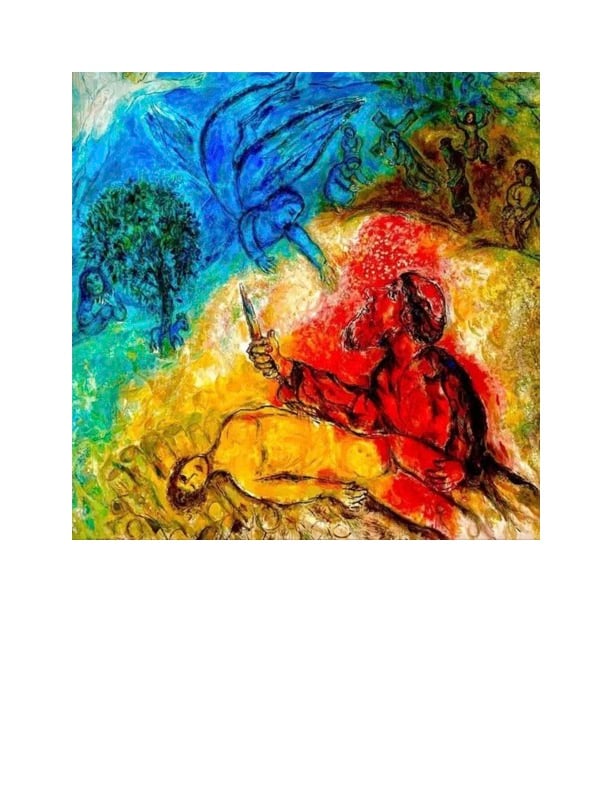
In a similar vein, the inherent complexity of sacred literature invites us to open ourselves to alternative—and often competing—perspectives. In this season of the High Holy Days—as we move between Rosh Hashanah and Yom Kippur—I find myself turning to a key phrase that has inspired a vast tradition of interpretation: Abraham’s repeated “הִנֵּנִי” (Hineni—“Here I am”) in the story of the binding of Isaac (Akedah). The story reverberates through literature and art—from Kierkegaard’s Fear and Trembling and Elie Wiesel’s reflections on Abraham and Isaac to Caravaggio’s and Rembrandt’s Sacrifice of Isaac and Marc Chagall’s haunting treatments of the Akedah.
Each work returns to the same disturbing questions that shadow the Days of Awe: What does faith demand? Where is the boundary between obedience and moral blindness? And how do we recognize the voice that tells us, at the crucial moment, “Do not lay your hand on the boy”?
As a child, I found the story of the Akedah puzzling and frightening. As an adult, I find it terrifying and magnetizing. Like Bertolt Brecht’s Verfremdungseffekt, or alienation effect, it prevents us from settling comfortably into a familiar interpretation. Each retelling estranges us from the story just enough to make us look at it again in a new light. It forces us to ask what faith requires, where obedience must end, and how we are to recognize the voice that tells us to stop.
The story begins with a simple sentence: “Here I am.”
Abraham says it when God calls his name (Gen. 22:1). He says it when Isaac speaks to him (Gen. 22:7). And he says it again when the angel calls from heaven: “Abraham, Abraham!” (Gen. 22:11). Each time, his response is the same: “Here I am.”
At first, these words sound like an ordinary answer. They might mean, “I am present,” or “I am listening.” But in the story, “Here I am” becomes much more than a reply. It becomes a posture toward reality—a way of standing at the meeting point between the temporal and the sacred.
The temporal is this world of ordinary life: family, work, responsibility, fear, uncertainty, and the limits of time. Isaac is Abraham’s son, his future, and his beloved child. He represents everything human beings seek to protect and preserve. The sacred, by contrast, is the dimension of meaning that exceeds our control: the call, the mystery, the demand that comes from beyond the self.
Abraham’s “Here I am” does not mean that he has everything figured out. It does not mean that he is free from confusion or pain. It means that he is willing to be present to the call before he understands where it will lead—present before understanding and certainty. “Here I am” is not passive surrender. It is attentive availability. Abraham does not disappear from the world; he remains a father, a traveler, and a person making decisions in real time. Yet he allows his this-worldly, temporal life to be interrupted by a claim larger than himself.
This is where the story becomes difficult. The sacred does not always arrive in a form that feels comforting. Sometimes the call seems to threaten what we most value. Sometimes devotion and responsibility appear to collide. Sometimes we must ask whether our understanding of God, duty, or truth has become too narrow.
The story does not resolve this tension by pretending that the temporal is unimportant. Isaac is not merely an object in a religious drama. He is a son. His life matters. And the sacred does not finally demand his death. The angel calls Abraham to stop.
A second phrase—“Now I know that you fear God” (Gen. 22:12)—marks the transformation of the story. It does not mean that God has acquired information in the same way a human observer might. Rather, Abraham’s inward devotion has become visible through action. What was hidden in the heart has entered time. It has taken form in a decision, a journey, a raised hand—and then in the willingness to lower that hand when the call changes.
“Now I know” can therefore serve as a metaphor for the way sacred meaning becomes known through lived experience. We may possess beliefs, intentions, and ideals, but they become real only when embodied. Courage becomes known in a moment of fear. Compassion becomes known when it costs us something. Faith becomes known when it encounters uncertainty.
Yet the story also teaches that genuine fear of God is not the same as rigid obedience or unquestioning violence. Abraham’s faith is not completed by carrying out the sacrifice. It is completed by hearing the command to stop. The same God who calls him forward also calls him back. The sacred is not merely a demand; it is also a limit placed upon human power. Abraham’s encounter with God ends not with Isaac’s death but with Isaac’s preservation.
In that sense, “Here I am” contains two movements. First: I am open to the call. Second: I am present to what is actually before me. Abraham must be open to the transcendent, but he must also see the ram caught in the thicket. He must not become so focused on the original command that he misses the new possibility standing before him.
This may be one of the deepest lessons of the passage to contemplate: spiritual maturity requires both receptivity and responsiveness. We must be able to hear beyond ourselves, but we must also recognize when the situation has changed. The sacred is not a substitute for moral perception. It sharpens moral perception.
“Here I am,” then, becomes a practice for daily life and for this season of return:
“Here I am—in this body, in this time, in this particular responsibility.”
“Here I am—with my fear, my uncertainty, and my incomplete understanding.”
“Here I am—open to a meaning larger than my immediate desire.”
“Here I am—ready to listen again when the call takes a different form.”
If “Here I am” is the internal posture of ready availability, “Now I know” is the moment that posture enters the world through concrete action. It is where presence bears fruit in real choices. In this light, “Now I know that you fear God” turns into a defining question for Rosh Hashanah and Yom Kippur: What do our lives reveal about what we truly revere? What becomes visible when our values are tested? Do our convictions protect life, or do they merely protect our image of ourselves as righteous?
The sacred is not found only in extraordinary visions or dramatic tests. It appears whenever ordinary life reveals a deeper responsibility: when a parent chooses patience, when a stranger is treated with dignity, when power is restrained, or when we refuse to treat another person as a tool for our own ends.
Abraham’s story begins with a human being who says, “Here I am.” It reaches its crisis when that human being is forced to discover what those words truly mean: Are they a willingness to obey without reflection? Loyalty to an idea? Or a readiness to remain present before God, before another human being, and before the changing demands of reality?
The angel’s words suggest that the answer is revealed not in what Abraham claims but in what he does. “Now I know” means that his faith has become visible. The visible sign of that faith is not simply that he was prepared to give up Isaac. It is also that he was willing to receive Isaac back.
To live between the temporal and the sacred is to inhabit that tension: to remain open to transcendence without abandoning the world; to recognize mystery without surrendering moral judgment; to offer ourselves without treating others as expendable; to listen for the call, and to listen again.
“Here I am” is the beginning of that life. “Now I know” is what becomes possible when our deepest convictions are made visible through the way we act.
Between those two phrases lies the human journey: from being called, to being tested, to seeing more clearly—and finally to discovering that the sacred does not lead us away from life but toward a more faithful way of preserving it.
If Abraham’s “Here I am” is a posture of spiritual attentiveness, then it must be spoken not only in private devotion but also in response to the world we share.
In our time, as we mark Rosh Hashanah and Yom Kippur, the Jewish people is called to say, “Here I am” before the realities of Israelis and Palestinians: before the grief of families who have lost loved ones, before the fear of communities living under threat, before the pain of displacement, occupation, antisemitism, and violence, and before the consequences of decisions made in our name or with our support.
The relationship between Israel and the Palestinians cannot be reduced to a simple contest between innocence and guilt, nor can historical suffering be used to excuse the suffering of others. Jewish history, including the experience of persecution and exile, gives the State of Israel’s transformative sovereignty profound significance for the Jewish people and the world. At the same time, Palestinian history—marked by dispossession, displacement, military control, unequal power, and the loss of home—must not be treated as an obstacle to someone else’s safety or national fulfillment. To recognize one people’s suffering and national claims is not to deny another’s. A serious ethical and spiritual response—in this season and beyond—must have room for both.
The same complexity underscores American Jewry’s relationship to Israel. For many American Jews, Israel is not simply a foreign country. It is bound up with kinship, family, history, prayer, memory, and the promise that Jewish life will never again be wholly dependent on the goodwill of others. Yet love for Israel need not mean uncritical agreement with every policy of its government. Indeed, our love for Israel requires attentive engagement, including moral criticism.
Nor should American Jews be expected to speak with one voice. Some experience Israel primarily as a refuge; others as a democratic project in need of reform; others as a source of spiritual and cultural connection; and still others feel alienated by actions taken in the state’s name. These differences do not make Jewish concern less authentic. They reveal how deeply and painfully the relationship matters.
The story of Abraham offers no political blueprint. It does, however, give us a spiritual warning. Abraham is prepared to sacrifice what is most precious because he believes he has heard a divine command. Then, at the critical moment, another word comes: “Do not lay your hand on the boy.” The faithful person must be capable not only of hearing an original call but also of hearing the interruption—the command that places a limit on violence.
That interruption matters today, arguably, more than ever. No nation, movement, or community is entitled to place human beings on an altar in the name of security, sovereignty, revenge, destiny, or historical necessity. Children cannot become symbols whose lives are expendable. Civilians cannot be reduced to obstacles. One people’s trauma cannot be used to sanctify another people’s suffering. If the readings of this season teach that God sees the human heart, they also teach that human life must not be transformed into an instrument.
“Now I know that you fear God” should therefore not be understood as praise for unquestioning obedience. It should challenge every community—including our own—to ask what our actions reveal about what we truly fear and revere. Do we revere a higher moral truth, or do we fear standing apart from our own camp? Do we revere human life, or only the lives of those like us? Are we capable of seeing the humanity in those whose story is not our own?
Perhaps what’s needed as we move between Rosh Hashanah and Yom Kippur is not certainty but faithful attention—not the surrender of moral judgment, but its purification; not indifference disguised as neutrality, nor loyalty that excuses everything, but the courage to remain present to the full truth.
The present moment may be asking us to say:
“Here I am—in the presence of Jewish trauma and Palestinian grief.”
“Here I am—willing to remember history without allowing history to imprison the future.”
“Here I am—prepared to love my people without denying the humanity of another.”
“Here I am—ready to challenge violence, even when it is committed by those with whom I feel connected.”
“Here I am—listening for the voice that says, ‘Do not lay your hand on the child.’”
The sacred does not release us from the world’s complexity. It sends us more deeply into it. It asks us to resist easy answers, reject the logic that some lives matter less, and seek a future in which security is not built upon permanent domination and justice is not imagined as the destruction of another people.
Abraham’s final lesson is that faith must remain open to interruption. We may begin with one understanding of what is required, but we must continue listening. The voice of God may come not as confirmation of our certainties but as a summons to stop, to see, to repent, and to choose life.
Our answer, then, must be more than words. It must be a way of inhabiting the world: “Here I am.”
Here, in this history.
Here, amid these competing claims and inherited wounds.
Here, responsible for what I support, what I excuse, what I ignore, and what I am willing to change.
Like the greatest works of art, “Here I am” continues to disclose new meanings. It does not give us the last word; it asks what word—and what action—will come next.
As we face the New Year and the reflection of Yom Kippur, may we have the courage to remain present, the humility to listen for interruption, and—when faced with the altar of fear—the wisdom to choose life.