
Diamonds Up the Hill: Part Two

Our Story Continues:
The first minyan in the shul took me by surprise. It was nicely populated, and those who attended were not there merely to “check the box” of having davened, anxiously looking at their watches or phones to get back to the pool or sauna or dining room. Rather, it was an unhurried group of men who genuinely wanted to be there.
That was reinforced the following morning, when I arrived early to shul. I’m not known for arriving early, but when the starting time is 8 a.m., it’s a lot easier. I entered expecting to be the first one in attendance. But there sat a man roughly my age (gosh he looked old!), earbuds in place, teaching the Daf Yomi in Israeli-accented flawless English to someone over the phone. Others had arrived early as well, to take their time with the morning prayers. The mood was distinctly relaxed.
It was a good sign.
—
Meet the Maintenance Man
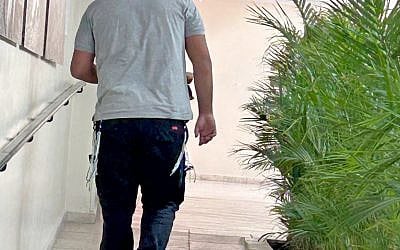
Later that day, Chana and I decided to go to the patio outside our room to read. It was a glorious day, and we attempted to open the umbrella for shade. It seemed to be stuck, so I called the front desk for assistance. A few minutes later, a maintenance man arrived. Sephardim don’t have the same strong tradition of wearing kippot outside of davening and eating. In walked this religious maintenance worker. How did I know he was religious if he had a bare head? Because his tzitzit swung long and proud, complete with a sea-blue strand of techelet!
Far from what I had expected in a place like this, I had found a diamond.
—
Meet Avishai
Avishai is an affable 44-year-old father of three, who grew up in Haifa, and now lives just south of the Lebanese border in Nahariya, Israel’s northernmost coastal city. For the last 15 years, he’s traveled to the hotel to work in the dining room. He greeted and seated us at our dinner table the first night. I’m not sure why I noticed his name tag, but I would be glad that I did.
Meet Eli
Eli is a handsome, tall 24-year-old single man from Haifa. His full beard is streaked with brown, blond and ginger, all of which does nothing to conceal his broad smile. Eli is a people person, who loves interacting with others. He’s somewhat of a renaissance man — he’s the hotel’s sommelier, and gives wine workshops. Wise beyond his years, he’s a seeker of knowledge, a devotee of the study of history, and has a broad knowledge of Tanach (the Hebrew Bible) and Greek mythology. He served in the Israel Air Force, but not in a capacity he can talk about. He ran a coffee shop in the Children’s Oncology Department at Rambam Hospital.
He clearly takes care of himself, enjoys physical challenges, and he stands half a head taller than Avishai. I know this because I saw them together on our second morning.
At shacharit (morning prayers), Avishai walked in and, to my mild surprise, donned a kippah. I had no idea that he was religious. He was there for a few minutes when another employee walked in.
It was Eli.
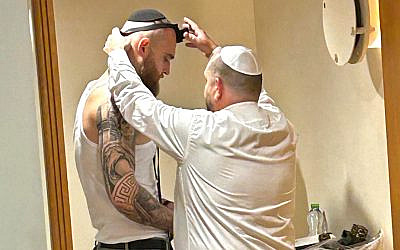
After a period of soul-searching on Pesach, Eli had decided to investigate his questions in Tanach in a more serious manner. Feeling inspired, he put on a kippah. Avishai, noticing that his coworker had taken this unusual step, asked him if he would like to take another, by putting on tefillin. Eli readily agreed.
Avishai took his time to help Eli figure out how to put them on. They seemed to be stuck for a minute, as they realized that the shirt sleeve of Eli’s uniform could not be pulled far enough up his arm to allow him to wear the shel yad (the tefillin which goes on the upper arm). The issue was not so much the uniform but the bulk of Eli’s well-sculpted biceps and triceps.
Without embarrassment, Eli removed his shirt, revealing not only a developed physique, but also rather prominent tattoos up his arms, including representations of Julius Caesar, Pegasus, and Hercules. As he stood there in his undershirt, Avishai helped him don tefillin and recite the Shema.
It was the very first time in his life that the cows’-leather boxes and parchment scrolls of the tefillin had graced his arm and his head. And we casual minyan-goers were privileged to see it happen! Eli reported later that he felt new energy escort him throughout his day.
Avishai and Eli: two more amazing diamonds.
—
Meet Dalal
I haven’t met Dalal, but Chana has. Her job at the hotel doesn’t sound very glamorous (at least to me). She does the manicures and pedicures in the spa. Since the goal of our trip was to pamper my wife, she went to get her nails done, something for which she normally has no patience.
Dalal is a 33-year-old Druze Arab woman. For those unfamiliar, the Druze are followers of a monotheistic, Abrahamic faith. They are a distinct religion, not Muslims. They are, by and large, fiercely loyal to the state of Israel, and serve in the IDF, including combat and elite units. Dalal lives nearby, and both she and her husband work in the Carmel Forest Hotel.
She’s a good shmoozer, and so is my wife, so they hit it off immediately. It turns out that her husband is in miluim (army reserve duty), and serves in the Homefront Command, just like our older son Avi. He was due back from duty the day we left, to his job as a chef. By the time the polish dried, Chana and Dalal were fast friends and exchanged phone numbers. She refers to my wife as “yafati” — my beautiful one. She told us that if her husband returned before we departed, she would have him cook us up something special. And she invited us to visit them in their village, Daliyat al Carmel, at the foot of the mountain.
A new friendship. An unlikely friendship.
Another diamond gathered along the way.
—
Meet Shai
Another encounter in shul.
While waiting for a minyan to gather, I sat with just one other man. I said hello, and got to meet Shai, who introduced himself as the hotel’s butcher and prep cook. I replied: “Kol Hakavod!” (roughly translated as “kudos to you”, but more literally “all honor to you”). He answered that “all honor goes only to our Creator.” I told him that he is created in the image of G-d, so he gets to reflect that honor.
Shai couldn’t wait for the quorum, as he had to get back to work, so he proceeded to daven on his own. When he reached Shema, I couldn’t help but notice that he arched his head back, planted his fingers on his eyes, and prayed fervently.
How long did his first line of Shema take? Permit me to replay for you the conversation I had in my mind:
“I should take a picture of this!”
“Would that be intrusive?”
“Maybe, but he wouldn’t have to know.”
“Still, it’s not nice.”
“Maybe I’ll take the picture, and ask him afterwards if he minds.”
At the end of this mental debate, I still had time to take out my phone and snap the picture. That’s how long his six-word Shema took.
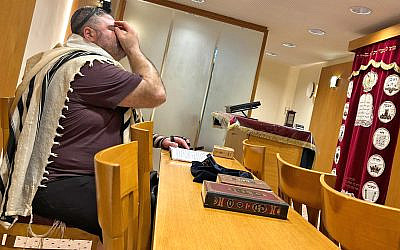
A few minutes later, he was reciting Hallel, singing to himself. Was this a man rushing to work and merely going through the motions? Hardly! After Musaf he was wrapping up, and began to sing again, even shuffling in dance. I strained to hear what he might be singing at that point, until I finally recognized “Mashiach, mashiach, mashiach!”, using the lively tune popularized by Mordechai Ben David.
We talked for a few minutes afterward. When I asked if I could use the picture I had taken, Shai replied that if it would help inspire people, then he is happy to allow it. I knew it had been meaningful to me, and I hoped it would be for others as well. But he wasn’t finished being inspiring.
“We made Pesach here at the hotel,” he told me. “We don’t usually open for Pesach. But with the war and everyone dealing with all the pressures we’ve been under recently, it was decided that, as the flagship hotel of Israel’s largest chain, we need to be there for our people. We need to open, and give them an unparalleled holiday experience.
“We prepared a Seder for 150 people, and it was like nothing you’ve ever seen!”
He wasn’t bragging. He practically had tears in his eyes as he told me what a privilege it was for him to be part of this holy mission.
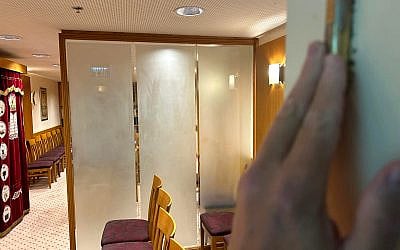
Before he turned to go, he wished me a good month, and uttered a prayer that this would be the day we hear the Shofar blasts heralding Mashiach. As he left the shul he approached the aron kodesh (the holy ark). He spread his arms wide and embraced the ark, burying his face in the curtain, and it felt as if I was witnessing him alone in an intimate encounter with G-d. The moment lasted 20–30 seconds, but this time I just sat admiring, and my phone stayed in my pocket.
Shai the butcher. Shai the diamond.
—
Along our winding way up Mount Carmel, childhood memories resurfaced, and old fears softened comfortably into nostalgia. But the real discovery was not the road or the pool, but the unexpected people who had entered our lives.
The maintenance man.
Avishai.
Eli.
Dalal.
Shai.
We traveled north for a break and came back with something else entirely.
On a journey seeking a treasure of rocks, we returned home with suitcases full of unforgettable diamonds.