
Flight 1073 Exposes Security Paradigm Flaws
Even before it had landed, Flydubai flight 1073 was fueling rumors, unsubstantiated claims, and outright conspiracy theories. Some details have already been clarified, while other questions may take days or weeks to determine, or even remain shrouded in dispute, as with EgyptAir Flight 990. Regardless, the immediate response of the passengers on board reflects the “banality of heroism” to adapt the famous phrase by Hannah Arendt. Real life heroes can come in all shapes and sizes, and it was the quick-thinking and action of civilians on board the plane that saved nearly 200 people and prevented a catastrophe.
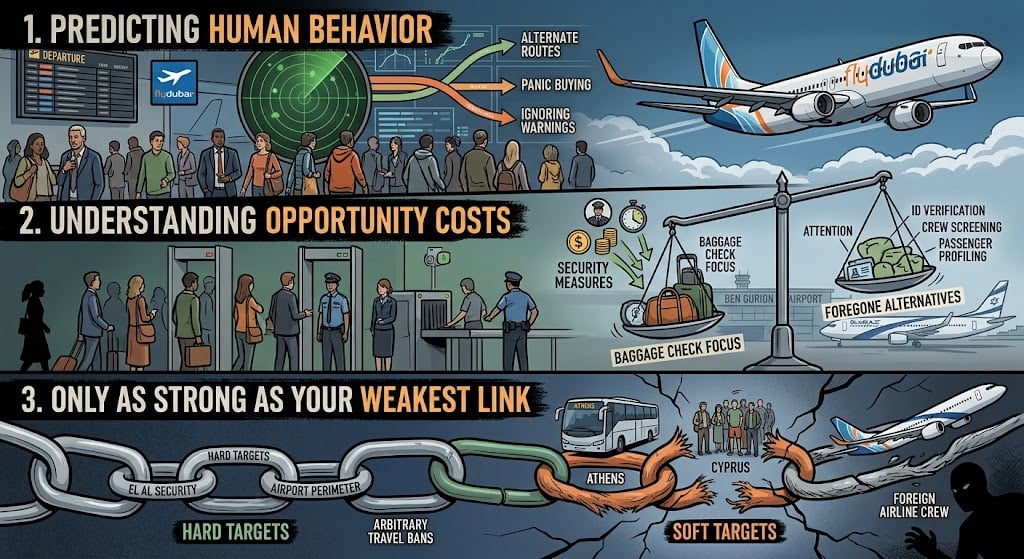
Yet above all else, this incident exposes clear holes in the vaunted Israeli governmental approach to national security. It is imperative to understand and address these gaps to prevent future disasters. There are wide-ranging security paradigm flaws that have broad manifestations and implications, as I’ll show with some concrete examples. They can be distilled down to three main issues: 1. A failure to accurately forecast human behavior; 2. A failure to factor in opportunity costs; 3. Focusing on strengthening hard targets rather than soft targets, missing the point that you are only as strong as your weakest link.
Failure to forecast human behavior: Security agencies often issue warnings, based on concrete intelligence reports or general concerns about vulnerabilities. What such warnings often fail to properly weigh, is how people will respond. An obvious example of this would be the first few days of war in October 2023, when well-intentioned but misguided warnings by the Homefront Command led to a “run on water”, with stores soon running out of plastic bottles, rumors about water shortages spreading, and a general air of panic that was counterproductive. The situation could have easily been prevented by considering basic human behavior. When it comes to travel, there are often travel advisory warnings issued, but what seems not to be overlooked once again is what the impact will be on Israelis and their travel patterns. If a country or region is avoided, it will almost definitely lead to increased travel to other locations, not simply people staying home. For example, during the Iran-Israel/US war in March 2026, Israel put severe and constantly changing restrictions on flights to and from Tel Aviv, especially prior to the Passover holiday (and school break). While that did heavily depress travel abroad, it also led to thousands of Israelis traveling abroad on alternative flights from airports in Jordan and Egypt, taking longer and more circuitous routes, or in some cases even traveling by sea. From a human behavior perspective–those decisions needed to have been forecast and the risk properly accounted for.
This failure is compounded by the Opportunity Cost gaffe. Opportunity cost refers to the idea that any choice must be weighed against the alternatives. This means that if I spend $50 on a meal, I should consider what else I might have used that money for: a gift for a friend, or savings, or a range of other uses. But it also means that when security directs their attention in one area, it means less focus on another area, since time, manpower and mental energy are all finite resources. For example, after several incidents in late 2025 of people boarding planes without proper documentation, Ben Gurion airport tried to change the procedures at security by having staff check boarding passes as an extra measure, but it came at the cost of checking IDs themselves, and was soon scrapped. Every bag (or person) that’s pulled aside to get an extra check will inevitably mean that others get less focus, which needs to be incorporated into top-level decisions on policy and approach. That calculus goes into every aspect of aviation security, whether those participating in it realize or not.
Finally, you are only as strong as your weakest link. This means that the greatest marginal benefit can come from plugging the biggest vulnerabilities, rather than investing more into strengthening pieces that have fewer security vulnerabilities (strengthening “soft targets” rather than hardening “hard targets”). For a clear example of this failing, during the wars with Iran, tens of thousands of Israeli citizens were stranded abroad without a way to return for days (in March 2026 those who already had ELAL tickets had to wait over a week to get back on emergency repatriation flights). For Israel’s enemies: the government and its non-state terror proxies, this meant that civilian targets were within reach and with little protection throughout European cities, with particularly large numbers concentrated in Athens and Cyprus. Thankfully everyone got home safely, but it was a colossal gaffe that put many at risk and needed to have been foreseen and planned for. The focus on strengthening security for those flying to and from Ben Gurion left those who were at greatest risk exposed.
How do these relate to Flight 1073? For months, Israeli intelligence had issued warnings about flights to and from Dubai, with flights to Israel from Dubai airport (but not Abu Dhabi) subject to special security screenings by Israeli security, and eventually Israeli airlines not being allowed to fly between the countries. What the latter decision failed to consider was how it might impact the behavior of Israeli citizens, what the opportunity costs would be, and where the weakest security links might be. Israelis have continued to travel to the UAE en masse in recent years–and with good reason, as it’s been one of the most welcoming and safest destinations for Israelis in recent years. It’s also a useful place from which to continue traveling farther east to popular destinations like Japan, Thailand, the Philippines, etc. Without the presence of Israeli airlines, that simply means that all of them are flying on foreign carriers, or softer targets. While travel advisory warnings do work at times, that’s particularly where direct flights no longer exist and the destination country itself has been overtly hostile (i.e. Turkey), neither of which apply to the UAE; indeed Israelis continue to travel to many other countries where there have been repeated overt cases of hostility towards Israeli tourists (unlike the spotless track record in the UAE).
That’s not to say that what happened on Flight 1073 was foreseeable. While there are a rare few instances of pilot suicide or attempted pilot suicide, there is no known case in commercial aviation history of a company’s hired pilot trying to hijack or crash a plane due to political considerations/terrorism. This was unprecedented and unheard of, regardless of airline or pilot’s nationality.
However, it should, it must, pose as a warning and lead to paradigm changes to prevent future catastrophes. Rather than preventing Israeli airlines from flying to Dubai, which will not keep Israelis safer, the relevant Israeli government bodies and agencies need to be cooperating with Emirati counterparts to close gaps and harden the most vulnerable aspects of all security to keep everyone safe and ensure that all airlines can fly back and forth with security. Because Israelis will keep traveling to the UAE (as well they should; alternative choices would likely come at greater security costs)–and you are only as strong as your weakest link.