
Flying Blind: The Cost of Israel’s War Without a Trusted Media
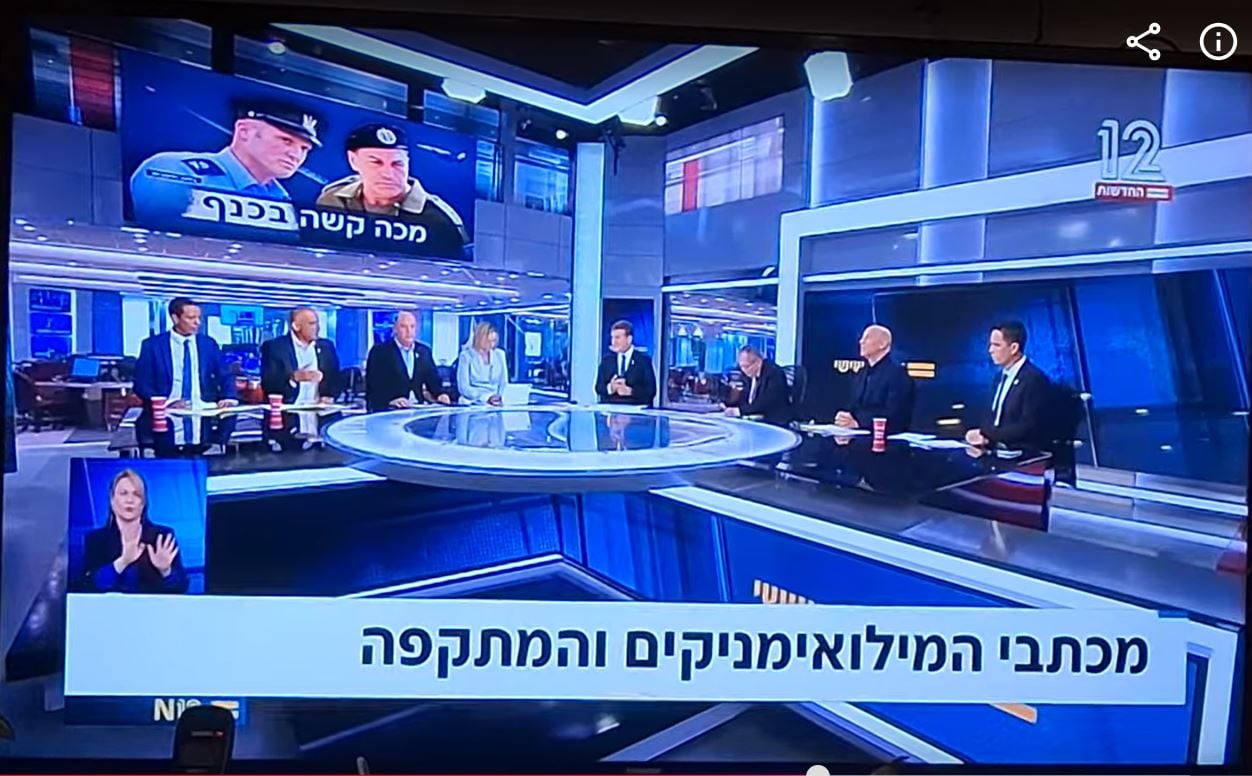
For the past twenty months, Israelis have lived through a devastating war, one that has touched every home and shaken our collective sense of security. Twenty living hostages and nearly thirty dead hostages are still held in Hamas’s tunnels. And yet, even as we’ve watched events unfold daily on our screens and heard the sirens and funerals around us, we Israelis have been alarmingly cut off from the full picture – not because information doesn’t exist, but because we lack a news source that the majority of the Israeli public both trusts and that dares to provide unflinching, comprehensive reporting on what is happening in Gaza and the extent of the destruction and suffering.
This absence is not just a media failure – it’s a national vulnerability.
Since October 7, Israel’s main television stations have rallied behind the war effort, offering round-the-clock coverage steeped in patriotism, military triumphs, and reassurance of the righteousness of our mission. For nearly two years, we have seen war through a tightly controlled lens: infrared tunnel footage, weapons caches, captured suspects, and rubble.
These are not lies, but they are curated truths. What is missing are the images of the cost of war, the devastation, civilian suffering, and dissenting voices that challenge the dominant narrative. We have not seen the children pulled from the rubble. We have not seen the crowded shelters, or the hospitals turned to morgues. Criticism of the war – including concerns about potential war crimes – is treated not simply as wrong, but as threatening to national morale or worse: Collaboration with the enemy.
Channel 12, by far the most influential media outlet, is particularly guilty of ignoring dissent and critical perspectives regarding the war (although their criticism of the Netanyahu government is boundless). I don’t know if the same is true to the same extent for Channels 11 and 13, but Channel 12’s record is unambiguous. Meanwhile, Channel 14 can be considered an outright propaganda channel – not only waging media war on Palestinians and the foreign press, but also leading the incitement against the Israeli left and anyone who dares question the morality of the army (as long as it is sufficiently aggressive) or the conduct of the state, especially regarding the war in Gaza or Israeli actions against Palestinians in the West Bank. Dissenting voices rarely filter into the broader national conversation, except in the form of being denounced as a fifth column.
This isn’t entirely surprising. In times of war – especially one triggered by the horrific crimes of October 7 – the instinct to circle the wagons is strong. Journalists fear being labelled disloyal. Politicians imply – and sometimes outright declare – that those who question military conduct are weakening the country’s moral backbone. The result is a suffocating consensus, where public debate is muted and uncomfortable facts are disregarded or hidden.
Alternative media do exist. Haaretz has offered consistent, fact-based reporting on the war, including coverage of civilian casualties, humanitarian crises, and allegations of disproportionate force. But within the Israeli mainstream, they are frequently dismissed as anti-Zionist, pro-Palestinian, or simply “out of touch.” Their reporting rarely enters the sanctioned discourse of the mainstream media.
What about the foreign press? Here, the situation is even more fraught. Many Israelis, understandably, feel misrepresented or targeted by global outlets. Accusations of antisemitism or unfair anti-Israel bias are not without basis – coverage in outlets like Al Jazeera and The Guardian maintains a consistent and monolithic anti-Israel line, and the BBC is often viewed as one-sided or worse. Michael Oren recently published a searing critique accusing CNN and The New York Times of fueling hatred against Israel through false or exaggerated claims and accepting Hamas press releases as fact. And popular commentators like Channel 12’s Almog Boker scoff at international criticism, suggesting that such outlets “will never change” and cannot be taken seriously.
Consider the now-infamous Sky News interview in which British journalist Kay Burley asked former Israeli spokesperson Eylon Levy whether Israel’s willingness to trade a handful of Israeli hostages for hundreds of Palestinian prisoners indicated that Israel believes that “Palestinian lives are not valued as highly as Israeli lives.” (It’s worth clicking the link to see Levy’s Master Class diplomatic response.) Yet, this is how much of the world now sees us – and part of the reason is that we have not reckoned with these questions ourselves, largely because we are denied the full picture.
We are now in a situation where the Israeli public is effectively flying blind. We reject what the rest of the world sees, yet we have only a very limited picture of our own. As Thomas Friedman warned in The New York Times, “Virtually no independent foreign journalists have been allowed to report firsthand from Gaza — unescorted by the Israeli army. When this war is over and Gaza is saturated with international reporters and photographers free to roam, the level of death and destruction is going to be fully reported and pictured — and that is going to be a very bad time for Israel and world Jewry.”
But what’s the alternative? In the fog of war, where is the Israeli public supposed to turn for a fuller understanding of the consequences of our government’s decisions? Should we rely on our soldiers, who are themselves struggling to make sense of their duties? Testimonies from groups like Breaking the Silence are routinely vilified and dismissed before they are read. Other soldiers unwisely posted celebratory videos of themselves in Gaza – videos that anti-Israel outlets use to fuel their propaganda. Government spokespeople speak in absolutes and are charged with defending (or denying) Israel’s actions. Who, then, do we turn to?
This is why, alongside my consumption of the mainstream media, I read Haaretz. Because they are unafraid to ask these questions, to document the destruction in Gaza, and to share stories of our enemies and those of Israelis who dissent. This is why I listen to the foreign press, even when I wince at their framing. Bias exists, but facts still matter. And in the absence of a widely trusted, critically engaged Israeli media, the responsibility falls on each of us to seek out the truth – fractured, contested, uncomfortable as it may be – and shape our moral and political stances accordingly.
Hamas’s strategy is brutal and cynical: to hide among civilians and in mosques, schools, and hospitals, to provoke massive retaliation, and to weaponize the empathy of the international community. But acknowledging that does not absolve us from asking: Are we doing everything in our power to avoid the unimaginable? Or have we walked straight into the trap Hamas has set for us – one that poses impossible decisions for a country that upholds ethical principles (a trap I warned about back in November 2023)?
We must end this war in light of its diminishing returns for Israel, take stock of our victories and limit our losses, return our hostages through negotiation (which is how most have been returned until now) and begin planning for the reconstruction of Gaza without Hamas.
But we cannot get there until our media provides us with information and commentary that reflects the true extent of the war so that the population can make informed decisions. We must stop flying blind.