Geopolitical Analyst: Bridging Somaliland & Israel to the world
Free Speech Is Not Absolute—Neither Is Government Power
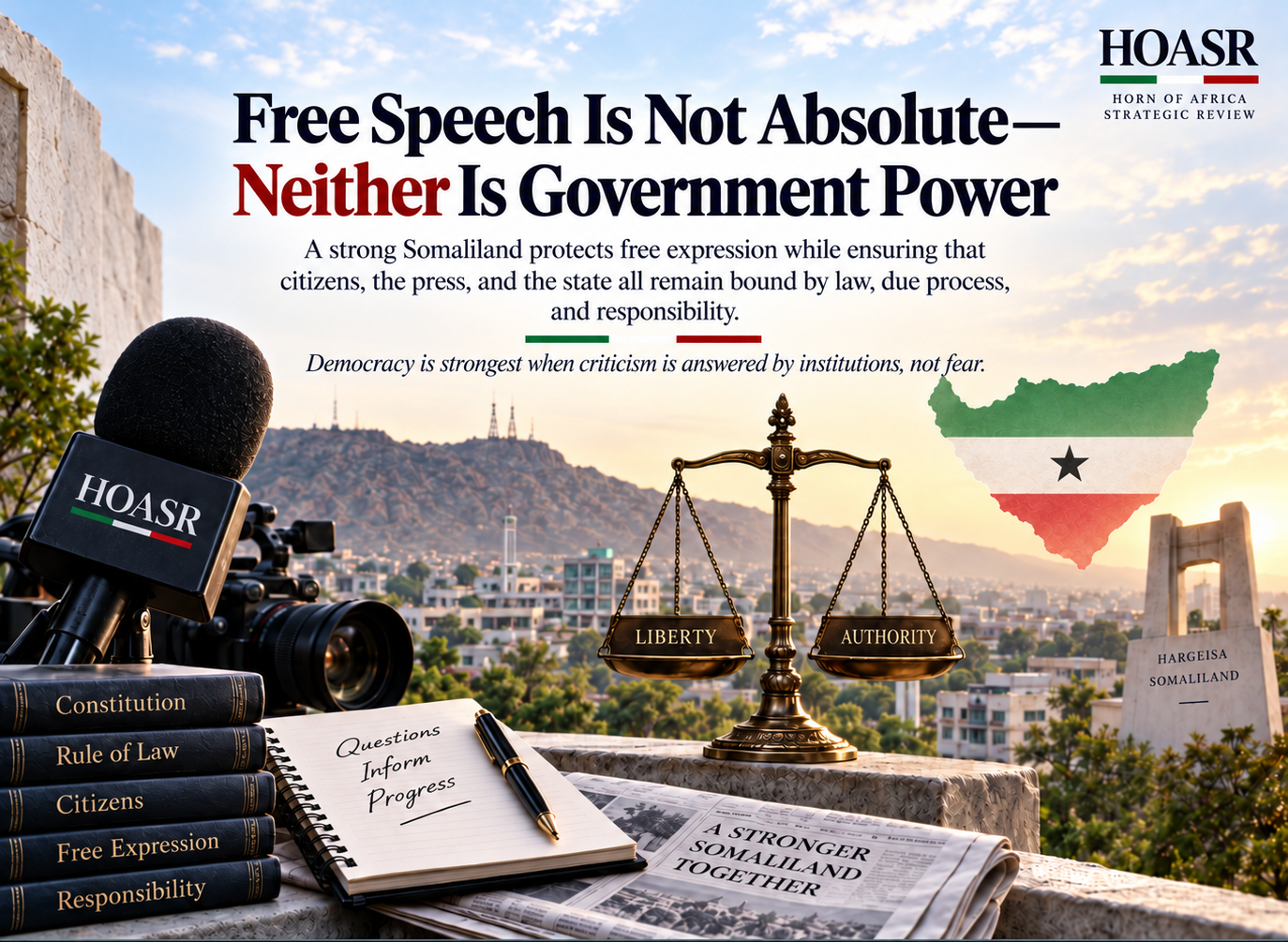
An editorial illustration depicting Somaliland’s debate over freedom of speech and government authority, featuring press imagery, the Constitution, rule of law and balanced scales representing liberty and state power. Credit: HOASR Original Infographic artwork
Somaliland’s latest debate over freedom of speech, journalist arrests and government authority has reopened one of the most important questions facing its young democracy: how far should free expression extend, and where should legitimate legal limits begin?
A year ago, I argued that a freer voice means a stronger Somaliland. That position has not changed, but the latest controversy shows why the principle must be stated more precisely. Freedom of expression is broad and indispensable, yet it is not a licence for defamation, incitement or genuine threats; equally, those exceptions are not a licence for government to punish speech merely because it is harsh, insulting or politically inconvenient. The real democratic test is whether Somaliland can draw those lines through clear law, independent courts and due process rather than through political instinct or the coercive power of the state.
That test is now before the country in the detention of journalist Abdiqani Hussein Abokor, known as Baylood, and poet Ismail Yusuf Abdi, known as Jiheeye. According to the Committee to Protect Journalists (CPJ), Jiheeye appeared in an August 27 interview complaining that two plots of land had been taken and recited a poem warning that President Abdirahman Mohamed Abdillahi Irro would face a curse if he did not intervene. CPJ reports that Jiheeye was arrested on August 28 and Abdiqani on August 29, after the journalist responded to a Criminal Investigation Department summons. As of CPJ’s September 7 report, Abdiqani had not been formally charged, and CPJ said requests for comment to the presidency, information ministry and police had received no response.
Source: CPJ, 7 September 2026
Those facts should be treated carefully. The poet’s land claim is an allegation that should be investigated, not accepted as established fact, and the government may possess information or evidence that has not yet been made public. The same caution applies to the poem itself: describing it automatically as a criminal threat would prejudge a legal question that depends on the precise words, context, intention and applicable law. A democratic system should be capable of examining both the alleged property grievance and the contested speech without converting either political anger or public sympathy into a substitute for adjudication.
The Constitution Protects Speech—and It Also Protects Property
The first point is constitutional. Article 32 of the Somaliland Constitution protects expression and the freedom of the press and other media, placing public criticism within the architecture of Somaliland’s democratic order. Article 31, in the same Constitution, protects private property and addresses expropriation for public purposes and compensation. That means the current controversy is not only about what a poet said or what a journalist broadcast; it also began with an allegation that a citizen exhausted government channels while seeking redress for property he says was taken without compensation.
Source: Somaliland Constitution, Articles 31–32
If the property was lawfully acquired for a public purpose and compensation was properly handled, government should be able to demonstrate that through records and a transparent process. If compensation remains legally due, the grievance should be resolved rather than allowed to harden into a political confrontation. If the claimant is wrong, an accessible court or administrative mechanism should say so and explain why. Good governance is not simply the power to enforce an order; it is the capacity to give a citizen a lawful answer before frustration is pushed into the street, the media or the poetic tradition.
Free Speech Has Limits, but Government Must Prove the Limit
The phrase “free speech is not absolute” is correct, but it is often used too casually. Every serious legal system recognizes circumstances in which expression may be restricted, including carefully defined forms of defamation, direct incitement, genuine threats, or disclosure that creates a specific and lawful national-security harm. The decisive question is not whether restrictions can exist, but whether the restriction in a particular case is prescribed by law, directed at a legitimate harm, necessary, and proportionate. Without those disciplines, the phrase “free speech is not absolute” can become an empty justification for almost any official response.
International human-rights jurisprudence provides a useful benchmark for that distinction. The UN Human Rights Committee’s General Comment No. 34 on freedom of expression emphasizes that political speech concerning public figures receives especially high protection and that the mere fact that expression is insulting to a public official is not enough to justify punishment. It also warns that defamation laws should not be used to stifle expression and that criminal penalties should be reserved, if used at all, for the most serious circumstances. The principle is important for Somaliland: the president has rights, but the office of the president cannot be placed beyond criticism simply because criticism is offensive or culturally unsettling.
Source: UN Human Rights Committee, General Comment No. 34, paras. 38 and 47
A Curse, an Insult, a Threat and Incitement Are Not the Same Thing
Somaliland’s debate would improve immediately if several concepts now used interchangeably were separated. A defamatory factual allegation, a political insult, a traditional curse, a satirical statement, an expression of anger, a true threat and incitement to imminent violence are not legally or morally identical. Each requires different evidence and different analysis, and the context of a poem is not necessarily the same as the context of a direct instruction to commit violence. If the state alleges that particular words crossed a criminal boundary, it should identify the words, identify the offence, and establish the required elements before an independent court.
This is also why the familiar line about not being allowed to “shout fire in a crowded theatre” should be used with caution. The phrase came from the 1919 American case Schenck v. United States, but US free-speech doctrine later moved toward the much more protective Brandenburg standard for incitement, focusing on speech directed to producing imminent unlawful action and likely to produce it. Somaliland is not governed by American First Amendment law, and it should not copy foreign doctrine mechanically. The useful lesson is narrower: mature legal systems distinguish concrete danger from mere offensiveness, and they require the state to prove that distinction rather than assume it.
Defamation Requires More Than Hurt Feelings
Defamation is another area where public education is badly needed. A damaging assertion presented as fact is different from an opinion such as “this government has failed,” just as knowingly spreading a fabricated accusation is different from publishing a disputed allegation in the public interest after reasonable verification. Truth, evidentiary support, fair comment, public interest and the distinction between fact and opinion are central to responsible defamation law. If every damaging criticism of a political leader can be relabelled as defamation or an offence against prestige, constitutional protection becomes dependent on the tolerance of the person being criticized.
Public officials are not without reputation rights, but holding public power carries a higher burden of tolerance. Political leaders routinely make decisions involving land, contracts, taxation, policing, appointments and public resources; citizens must therefore have wide latitude to question their conduct. The stronger answer to a false allegation is often evidence, correction, a right of reply, or a proportionate civil remedy—not immediate detention. Criminal law should be the narrow instrument of last resort, not the first reflex when political speech becomes uncomfortable.
Journalists Have Rights—and Professional Duties
A defence of press freedom should not romanticize Somaliland’s media sector. Digital publishing has dramatically lowered the barriers to entry, and the category “journalist” now includes trained reporters, broadcasters, commentators, activists, political partisans, influencers and citizens operating Facebook or YouTube platforms. Some practitioners have little formal training in verification, media law, defamation, privacy, source protection, corrections, conflicts of interest, or the difference between reporting an allegation and endorsing it. That professional weakness is real, and ignoring it weakens the case for media freedom rather than strengthening it.
Journalists should verify claims where reasonably possible, identify allegations as allegations, seek comment from the people accused, and supply enough context for audiences to understand what is being broadcast. When a guest uses inflammatory language, the interviewer still has editorial responsibilities: to ask follow-up questions, clarify whether the statement is literal or rhetorical, and avoid sensational presentation designed mainly to provoke outrage. Media freedom protects the public’s right to receive information; it does not eliminate the professional duty to handle that information responsibly. Stronger journalism therefore requires both protection from state intimidation and much higher internal standards within the profession.
Somaliland Already Has a Press-Law Framework—Use It and Clarify It
Somaliland does not need to begin this debate from zero. The Press Law, Law No. 27/2004 was enacted to regulate the media within a framework that expressly recognizes press freedom and rejects censorship, while also setting professional duties and a code of conduct. Article 8 has long been cited for the principle that a journalist should not be imprisoned for press activity except pursuant to an order of a competent court. The law’s existence makes the recurring resort to broader penal provisions against journalists a legal-policy question that Somaliland should finally resolve with clarity rather than leaving reporters, police and prosecutors to operate in overlapping systems.
Source: Somaliland Press Law, Law No. 27/2004 • Somaliland House of Representatives – Acts 2004
The present case illustrates that problem. CPJ reported that Abdiqani’s lawyer was informally told police intended to pursue allegations involving the honour or prestige of the president and anti-state propaganda under the penal code, while the journalist had not been formally charged as of September 7. Whatever the eventual legal theory, a person should know promptly and precisely what offence is alleged, what conduct supports it, and when the accusation will be tested in court. Pre-trial detention should never become a substitute sentence imposed before guilt has been established.
Source: CPJ case report and reported prospective charges
Government Bears the Heavier Constitutional Burden
Responsibility is shared, but power is not. A journalist has a camera, microphone or social-media account; the state has police, prosecutors, detention facilities, licensing authority and the coercive force of government. That imbalance means government carries the heavier burden of restraint, because a wrong by a reporter can damage a reputation while a wrong by the state can deprive liberty and chill an entire profession. The stronger a government is, the less it should need detention to answer criticism that can be met with facts, law and transparent procedure.
That does not require government to tolerate genuine criminal conduct. Where authorities believe speech constitutes a real threat, direct incitement or another clearly defined offence, they should investigate professionally, preserve evidence, state the charge, provide access to counsel and bring the matter promptly before an independent judge. Where the dispute concerns reputation, correction, reply and civil remedies should ordinarily be preferred over imprisonment. The rule of law is demonstrated not by the number of people the state can arrest, but by the discipline with which it limits its own power.
The Opposition Must Pass the Same Consistency Test
Somaliland’s political class also needs to confront a recurring pattern. Opposition parties often become vigorous defenders of press freedom when journalists are detained by the government, only for attitudes to change when political power changes hands. Parties in government can likewise treat criticism as irresponsible or destabilizing until they return to opposition and rediscover the value of unrestricted political speech. A constitutional liberty cannot mature if every party treats it as a tactical weapon rather than a rule that binds winners and losers alike.
The correct standard is therefore easy to state even if it is harder to practice. Waddani should defend the same speech rules it would demand under a Kulmiye government; Kulmiye should defend the same due-process rules it would want if its own supporters were detained; journalists should apply the same verification standards to allies and opponents. Constitutional culture begins when institutions and political actors accept rules that sometimes protect people they dislike. That is the difference between partisan tolerance and democratic principle.
Recognition Diplomacy Raises the Cost of Getting This Wrong
The timing adds a strategic dimension that Somaliland cannot ignore. President Irro is currently in Washington on a working visit aimed at expanding diplomatic, security and economic relations and advancing Somaliland’s case for recognition, according to public reporting on the visit. Somaliland’s democratic record is not a decorative part of that case; it is one of the arguments used to distinguish Somaliland as a functioning, law-governed political system capable of sustaining international partnerships. Arrests involving a journalist and a poet therefore attract attention beyond the immediate legal dispute because they test the credibility of that democratic narrative.
Source: Hiiraan Online, President Irro in Washington, 6 September 2026 • Horn Diplomat, 5 September 2026
Somaliland should not protect freedom of expression merely because Washington is watching. Constitutional rights belong to Somalilanders whether or not recognition is granted, and institutions built only for foreign approval are too fragile to survive domestic pressure. But foreign partners are entitled to ask whether a government seeking the political benefits of democratic legitimacy also accepts the institutional constraints democracy imposes. The most convincing answer is not to insist Somaliland is perfect; it is to show that Somaliland can identify a problem, apply law impartially, correct mistakes and improve its institutions.
The Missing Institution Is Civic and Media-Law Education
The deeper problem exposed by this controversy is educational. Many citizens understandably treat “freedom of speech” as either an unlimited personal permission or a vague Western slogan, while some officials appear to treat the concept as a privilege that can be narrowed whenever public order or official dignity is invoked. Many media practitioners are equally uncertain about where criticism ends and defamation, incitement or unlawful threats begin. A young democracy cannot rely on constitutional text alone; rights must be taught, interpreted and practiced before they become political culture.
The Ministry of Information should lead a national program on media law and freedom of expression in partnership with the Ministry of Education, universities, law faculties, SOLJA, the Bar, civil-society organizations, media houses, police, prosecutors and the judiciary. The purpose should not be to teach citizens how to speak less, but to teach everyone—officials included—what speech is protected, what professional responsibility requires, what the lawful exceptions are, and who has authority to decide when a line has been crossed. Training should be available in Somali, practical rather than theoretical, and built around real cases drawn from Somaliland’s own experience. This would do more for durable stability than another cycle of arrest, protest, political accusation and eventual release without institutional learning.
A basic national handbook could explain Article 32, property rights under Article 31, the Press Law, the difference between fact and opinion, the elements of defamation, the meaning of incitement and true threats, the rights of reply and correction, and the procedural rights of people accused of media-related offences. Universities should make media law and ethics mandatory for journalism students, while police and prosecutors should receive specialized training before handling press cases. Media houses should adopt written editorial standards, corrections policies and procedures for obtaining comment from people accused of wrongdoing. Courts, in turn, should publish reasoned decisions in significant freedom-of-expression cases so that the boundaries of the law become knowable rather than mysterious.
What the Irro Government Can Do Now
The current government has an opportunity to turn a damaging controversy into an institutional demonstration. It should ensure that the journalist and poet have full access to counsel, are promptly informed of any formal charges, and receive a speedy judicial determination rather than open-ended investigative detention. It should make the property dispute subject to transparent administrative or judicial review, including the compensation question, so that the original grievance is not lost behind the later speech controversy. And the Ministry of Information should use the case as the beginning of a wider legal and civic-education initiative rather than treating it as an isolated public-relations problem.
If the evidence shows that no clearly defined criminal offence occurred, continued detention would be difficult to reconcile with Somaliland’s democratic claims and should end. If the state believes an offence did occur, it should prove that case publicly before an independent court under a specific law, while respecting the presumption of innocence and the special importance of political expression. Either outcome is stronger than ambiguity, because constitutional government depends on reasons that citizens can inspect. Democracy is not weakened when government is required to justify the use of coercive power; that requirement is one of democracy’s defining strengths.
A Freer Voice Still Means a Stronger Nation
Somaliland does not have to choose between a responsible press and a respected government. It can demand higher professional standards from journalists while also demanding stricter constitutional discipline from public authorities. It can protect citizens from genuine defamation or threats without creating special zones of immunity around political leaders. And it can protect national stability without confusing stability with silence.
The principle at stake is larger than two detainees, one poem, one interview or one presidency. Somaliland is deciding what kind of democratic culture it wants as its institutions mature and its international profile rises. A freer voice still means a stronger nation—but only when freedom is matched by responsibility, and only when government power is matched by law, restraint and accountability. Free speech is not absolute; neither is government power, and a serious democracy must be capable of protecting both truths at the same time.
Related Topics