
Strategist and Diplomat Analyzing Somaliland and Horn Affairs
President Irro’s Washington Mission:
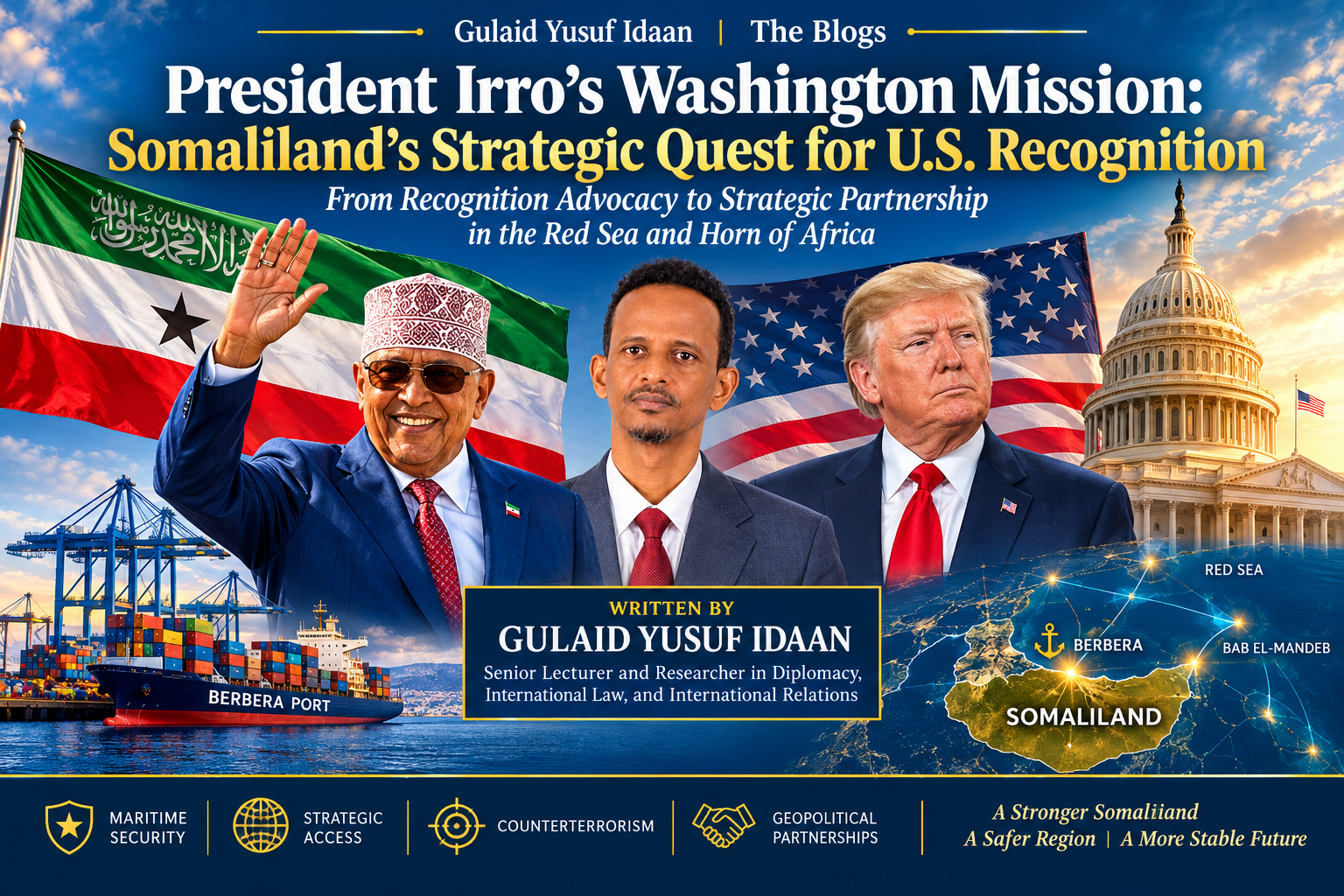
President Irro’s Washington Mission: Somaliland’s Strategic Quest for U.S. Recognition — From Recognition Advocacy to Strategic Partnership in the Red Sea and Horn of Africa.
From Recognition Advocacy to Strategic Partnership
1. Executive Summary
President Abdirahman Mohamed Abdullahi ‘Irro’s’ visit to Washington is best understood not as a recognition bid but as an attempt to reposition Somaliland inside the strategic calculations of the United States. The central question is therefore not ‘Will the United States recognize Somaliland?’ but: Can Somaliland convince Washington that recognizing and partnering with it would better serve U.S. strategic interests than continuing to approach it solely within the framework of U.S.–Somalia relations?
This paper argues that Somaliland’s case now rests on a two-layer argument: a legitimacy layer (history, institutions, stability, democracy) and a strategic-interest layer (Berbera, the Red Sea, counterterrorism, great-power competition). Recognition, if it comes, will be the final stage of a long institutional process — not the product of a single visit. The practical objective of the Washington mission is to move the relationship one rung up the U.S. policy chain: from diplomatic visibility to institutionalized strategic cooperation.
2. Why This Visit, Why Now
Several developments have raised Somaliland’s strategic stock well above its level of a decade ago.
Israel’s recognition
Israel’s decision in December 2025 to recognize Somaliland broke a three-decade barrier: for the first time since 1991, a UN member state formally treated Somaliland as a state. Whatever its immediate practical effects, the move changed the diplomatic equation by demonstrating that recognition is no longer politically impossible — and it gave Hargeisa a powerful demonstration effect to bring to Washington. [Sources: Times of Israel, 26 Dec 2025 | New York Times, 26 Dec 2025] [Also: Washington Institute, 16 Jan 2026 | The Conversation, 25 Jan 2026]
Red Sea insecurity
Since the Houthi attacks on commercial shipping from late 2023, the security of the Bab al-Mandab strait and the Gulf of Aden has become a first-order international economic problem, not a regional one. Roughly a tenth of global seaborne trade and a significant share of container traffic normally transit the Red Sea; prolonged rerouting around the Cape of Good Hope has imposed measurable costs on supply chains. Somaliland’s 850-kilometre coastline sits directly on the Gulf of Aden at the African gateway to this corridor, giving its geography renewed value for maritime security and freedom of navigation. [Sources: UNCTAD rapid assessment, Feb 2024 | IMF Blog, 7 Mar 2024] [Also: UNCTAD Review of Maritime Transport 2024]
Berbera’s transformation
Berbera is no longer a minor regional port. Under DP World’s management, its first expansion phase — reported at roughly US$440 million, including a new container terminal and an adjoining free zone — was completed in 2021, with a total investment program pledged toward US$1 billion. The port and the Berbera–Wajaale corridor now anchor an alternative trade route for landlocked Ethiopia, giving Somaliland significance in trade, logistics, and potentially maritime security beyond its own small economy. [Sources: DP World press release, 24 Jun 2021] [Also: Seatrade Maritime, 28 Jun 2021]
The Ethiopia–Somaliland Memorandum of Understanding (January 2024)
In January 2024, Ethiopia and Somaliland signed an MoU under which Ethiopia seeks commercial and naval access through Berbera in exchange for a path toward recognition. Whatever its final legal form, this document made Somaliland central to the Horn of Africa’s connectivity architecture overnight. It is also the main reason Mogadishu treats Somaliland’s external diplomacy as an existential issue — and it means that any serious U.S. assessment of Somaliland must now weigh not only the port itself but the Ethiopia corridor that depends on it. [Sources: Crisis Group Q&A, 6 Mar 2024] [Also: ISPI, 30 Jan 2024]
U.S.–China competition
The Horn of Africa has become a meeting point of major-power interests. China’s People’s Liberation Army has operated a support base in Djibouti since 2017, a short distance across the Bab al-Mandab from Somaliland’s coast, and Beijing’s broader posture in the region favors the sovereignty consensus that keeps Somaliland inside Somalia. This cuts both ways for Washington: closer ties with Somaliland offer a rare counterweight to Chinese port and basing advantages in the western Indian Ocean, but any U.S. move would be read in Beijing — and in Ankara, Abu Dhabi, and Addis Ababa — as strategic positioning. Managing that perception is part of the cost calculation, not an afterthought. [Sources: Congressional Research Service, IF11304] [Also: Semafor, 10 Dec 2024]
3. The White House Calculation: Benefits and Costs
A presidential decision on Somaliland requires weighing what the United States would gain against the diplomatic and political costs of changing a thirty-five-year policy. The benefit side has strengthened considerably.
Red Sea security and maritime domain awareness
Somaliland’s position near Bab al-Mandab offers Washington additional capacity to monitor maritime activity, support freedom of navigation, and expand situational awareness in a corridor where U.S. and allied naval operations are already stretched. A coast-guard-to-coast-guard relationship, port-security training, and eventually sensor and information-sharing cooperation at Berbera would be low-cost, high-value steps.
Berbera as a logistics and contingency asset
A deep-water, professionally operated port on the African side of the Gulf of Aden — with an expanding free zone and a corridor to a market of more than 120 million Ethiopians — is a genuine strategic asset. Washington could view Berbera as additional logistical capacity, a monitoring point for maritime activity, and a contingency option for regional security operations. Berbera’s importance alone does not produce recognition, but it changes what recognition would be worth.
Counterterrorism and intelligence
Somaliland’s stability and its security institutions make it a plausible additional partner for counterterrorism cooperation, intelligence sharing, and early warning in the Horn. Defense institutions may therefore come to regard Somaliland as a security partner before the diplomatic establishment regards it as a recognized state.
Strategic competition
In a region where China holds a military base in Djibouti and other powers maintain substantial economic and security footprints, a relationship with Somaliland gives Washington added strategic depth and a foothold in one of the few remaining coastal locations in the western Indian Ocean not already locked into a rival’s portfolio.
Ethiopia and the corridor
Ethiopia is Africa’s second most populous country and is landlocked. The Berbera corridor diversifies Ethiopia’s sea access beyond Djibouti, and the United States has an interest in that diversification succeeding. A trilateral logic — Somaliland, Ethiopia, the United States — around trade, logistics, and connectivity is now part of Washington’s broader Horn of Africa calculation.
Israel and the Red Sea
Following Israel’s recognition, closer U.S.–Somaliland relations can also fold into a wider U.S.–Israel conversation on Red Sea security, adding Somaliland to the emerging security and cooperation architecture spanning the Red Sea and the Horn.
The cost side
Against these benefits, the White House must weigh strained relations with Somalia, friction with partners committed to Somalia’s territorial integrity, and the precedent a recognition decision would set elsewhere. The strategic question is not whether these costs exist, but whether the benefits have grown large enough — and irreversible enough — to outweigh them.
4. Somaliland’s Argument: Legitimacy Plus Strategic Interest
For three decades, Somaliland’s recognition campaign rested on historical independence, legal continuity, democratic governance, self-determination, and stability. Those arguments remain the foundation of the case — and they are the reason the case is morally and politically serious. But on their own they have not overcome the strategic constraints shaping U.S. policy. President Irro’s Washington strategy adds a second layer: strategic utility.
Combined, the two layers deliver a stronger message than either could alone. Somaliland is not asking the United States to sacrifice its interests for a moral argument; it is arguing that recognition and formal partnership can serve U.S. interests directly — in Red Sea security, maritime access, counterterrorism, economic connectivity, and competition with rival powers. This is the shift from recognition-seeking diplomacy to recognition-through-strategic-leverage diplomacy. The two layers are complementary, not alternatives: legitimacy explains why Somaliland deserves recognition; strategic interest explains why recognition is worth the cost.
5. The Emerging Network of Overlapping Interests
Somaliland does not operate in a vacuum. An informal structure is converging around it: the UAE brings investment and logistics (the largest share of the Berbera expansion), Israel brings diplomatic and security partnership, the United States brings strategic weight, and Somaliland contributes territory, the port, and geography. It would be a mistake, however, to describe this as an alliance: there is no evidence of a single plan or umbrella agreement uniting these actors. It is better understood as an emerging network of overlapping strategic interests.
That network has two faces. It raises Somaliland’s value to each actor in it — but it also raises the number of powers with interests in Somaliland’s territory and, therefore, the exposure Somaliland carries. As strategic value increases, so does strategic exposure. Somaliland’s task is to harvest the value without becoming a theater for other powers’ rivalries.
6. How Washington Decides: The Policy Chain
Strategic value does not automatically become policy. American policy toward Somaliland is not made by one institution; it emerges from a chain, and Somaliland’s challenge is to move its case along that chain rather than stopping at political advocacy:
Somaliland advocacy → congressional interest → policy debate → State Department review → Pentagon/AFRICOM assessment → interagency deliberation → White House strategic calculation → presidential decision.
Each link has a different lens. Congress can generate momentum through legislation, hearings, and engagement — building on the precedent of the 2020 defense authorization requirement for a Pentagon report on security cooperation with Somaliland — but congressional sympathy does not by itself change executive policy. The State Department weighs the diplomatic consequences of any shift and will distinguish between recognizing Somaliland’s usefulness and concluding that formal recognition serves U.S. interests. The Pentagon and AFRICOM ask an operational question: can Somaliland contribute to maritime security, counterterrorism, intelligence cooperation, and freedom of navigation in the Gulf of Aden and Red Sea? Their answer can be ‘yes’ well before State’s answer is ‘yes.’ Think tanks and the wider policy community connect Somaliland to debates Washington already cares about — Red Sea security, maritime freedom, shipping protection, counterterrorism, and strategic competition — which is how an issue becomes embedded rather than episodic. The White House is where these assessments converge; its calculation is whether changing policy advances American interests more than keeping it does. [Sources: FY2020 NDAA (Public Law 116-92)] [Also: Atlantic Council, 17 Dec 2024 | Christian Science Monitor, 12 Jun 2025]
7. What Success Looks Like
Because recognition is the final stage of a process, it should not be the only measure of the visit. Success can be graded on five levels:
- Level 1 — Symbolic: a high-level meeting with senior U.S. officials.
- Level 2 — Political: clear support from influential members of Congress for stronger U.S.–Somaliland relations.
- Level 3 — Institutional: a formal mechanism for security, trade, investment, and maritime cooperation.
- Level 4 — Strategic: visible, concrete U.S. involvement in Berbera and Red Sea security.
- Level 5 — Diplomatic breakthrough: formal recognition.
A visit that converts political support into institutional cooperation, and institutional cooperation into strategic relationship, has advanced Somaliland through the policy chain — whatever the headlines say. The most important measure is not what Washington says during the visit but what U.S. institutions do after it.
8. Indicators to Watch
| Indicator | Why it matters |
| Trump meeting | Highest-level political and symbolic signal |
| White House statement | Direction of executive-branch policy |
| State Department language | Institutional policy direction |
| Congressional statements | Political and legislative momentum |
| AFRICOM / SOCAFRICA involvement | Security and strategic significance |
| Discussion of Berbera access or military use | Major geographic and strategic signal |
| Investment agreements | Economic dimension |
| Ethiopia’s response | Implications for the Horn of Africa |
| UAE response | Regional strategic dimension |
| Israel’s response | Diplomatic coordination |
| African Union response | Impact on the recognition question |
| China’s response | Great-power framing of the issue |
9. From Access to Policy Change: A Concrete Agenda
The risk of any high-profile visit is that it produces photographs without institutions. Somaliland should therefore leave Washington with specific, deliverable asks rather than general goodwill. Six stand out.
- Institutionalize the relationship: establish an annual U.S.–Somaliland strategic dialogue at assistant-secretary level, and pursue a resident U.S. commercial and security engagement office in Hargeisa — incremental, de facto arrangements of the kind Washington has used elsewhere, which create a permanent channel that survives personnel and election cycles.
- Sign a maritime security cooperation memorandum: maritime domain awareness, port-security training, and coast-guard capacity-building, with a pathway to include Somaliland in AFRICOM-hosted regional exercises and to designate Berbera as a logistics port of interest for contingency planning.
- Anchor the economic dimension: seek Development Finance Corporation backing for Berbera corridor and free-zone projects, investment guarantees for U.S. firms, and technical support for customs and port-governance standards that make Berbera bankable and, over time, suitable for dual-use infrastructure.
- Codify congressional momentum: build on the 2020 NDAA precedent with a new provision authorizing and reporting on annual security cooperation, so that engagement is mandated by statute rather than dependent on executive discretion.
- Treat domestic capability as foreign policy: governance quality, legal institutions, coast-guard capacity, and port administration at Berbera are not only development goals — they are the substance of Somaliland’s credibility as a strategic partner. External advocacy cannot indefinitely substitute for internal capability.
- Plan for the most likely outcome: a security and economic partnership without formal recognition. This is arguably the most probable near-term result, and it should be planned for rather than treated as failure. The asks above are deliberately designed so that partial wins still lock in an irreversible U.S. institutional presence — the condition under which recognition later becomes thinkable.
These steps form a phased roadmap between diplomatic access and recognition: expanded congressional engagement, sustained institutional dialogue, security and maritime cooperation, investment, and broader international partnerships. Recognition remains the long-term objective; the roadmap is the mechanism for reaching it.
10. Conclusion
If the visit produces only meetings and photographs, it is a diplomatic visit. If it generates a permanent institutional mechanism, it becomes a strategic partnership. If it visibly changes U.S. policy, it could become a geopolitical turning point. The distinction between diplomatic visibility and actual policy change is what Somaliland must keep in view.
President Irro’s mission, properly understood, is an attempt to change how Somaliland is perceived within the U.S. strategic system: from an unrecognized region seeking recognition to a strategic partner whose geography, port, and stability carry security, economic, and geopolitical value. If that intellectual and policy shift occurs, recognition could follow as its outcome. If it does not, success will still be measured by how far the relationship moves from episodic diplomacy toward sustained, institutionalized strategic cooperation.
The final question is not simply whether the United States will recognize Somaliland. It is when Washington will conclude that Somaliland’s strategic value exceeds the political cost of recognizing it — and what Somaliland does between now and then to make that conclusion irresistible.
Related Topics
Related Posts