
A Day in the Life
Free the Funds, Free Iran: Is this the Endgame?
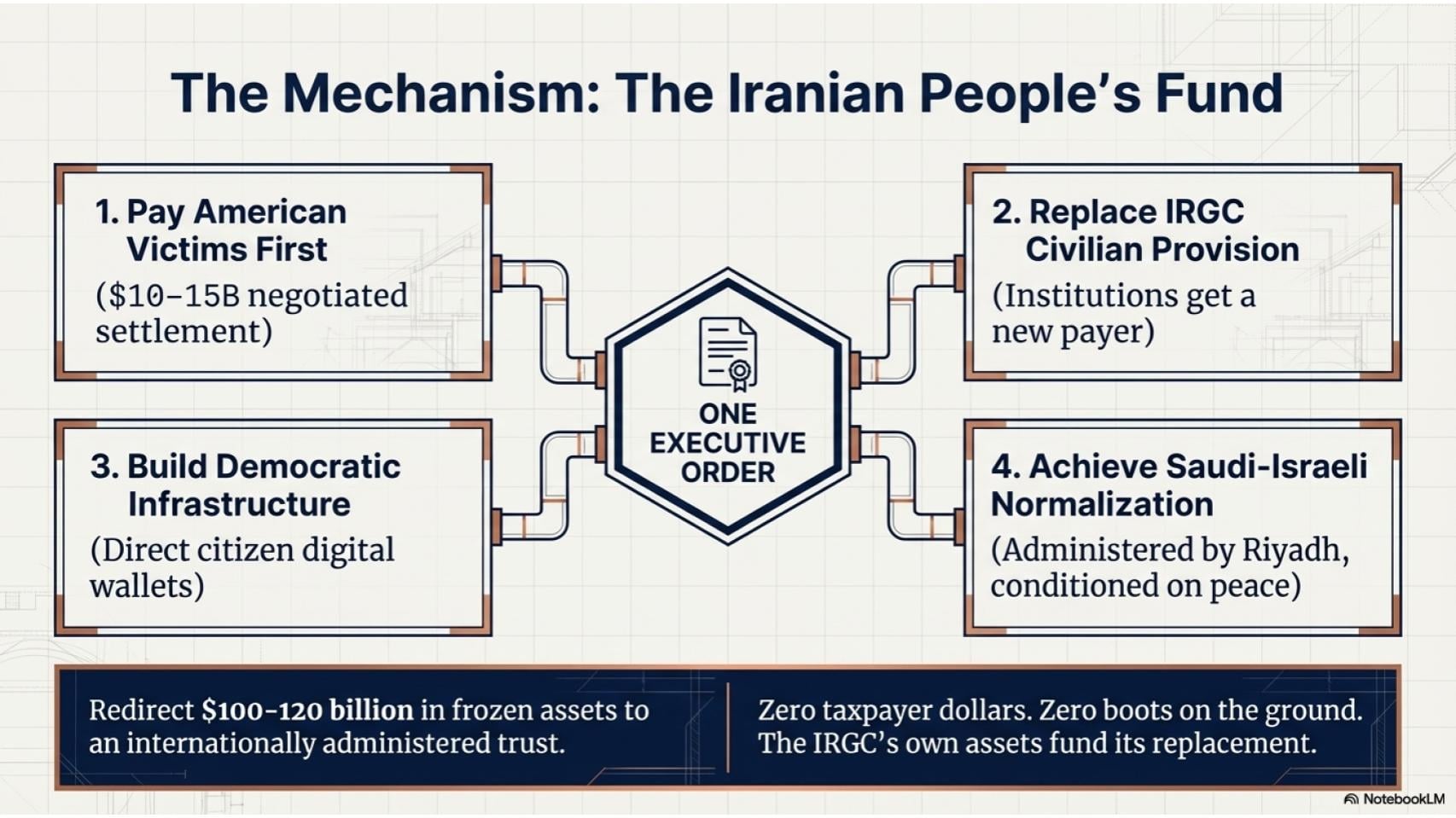
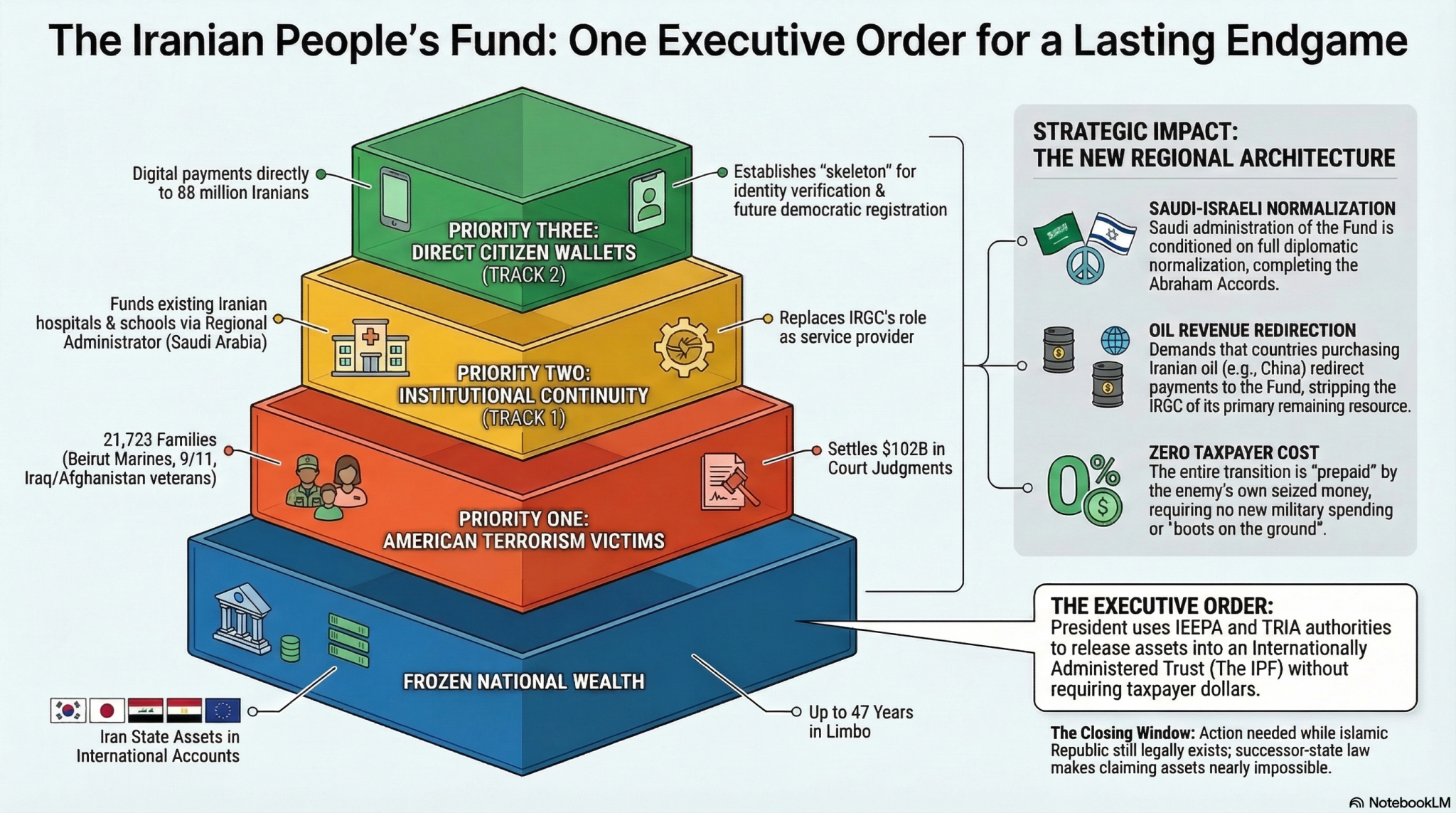
The Iranian People's Fund Infographic based on the Miftan Protocol from Miftan Labs. Free for use. Created by Miftan Labs
What if this war with Iran has an endgame that nobody is talking about yet? What if it can be done without boots on the ground, and without any outside money needed to be spent on Iran?
The answer is staring us all in the face. Treat Iran’s frozen assets like a trust. Free the funds, give them to the people of Iran and it will dramatically reshape the future, give them more power and help them to get out from under the grip of the IRGC.
It can be done as soon as Trump decides to. All it takes is an executive order to move the frozen assets to a sovereign wealth fund, and then create a path to use that money for humanitarian aid. It’s not easy — but the path is simple, clear, and has been in front of us the whole time.
Let me tell you how I got here.
The Theory Came Before the War
I’m a behavioral economist. I studied game theory under Professor Robert Aumann at Hebrew University — the Nobel laureate. My career has been primarily tech and finance but last year I started doing theoretical work and decided to change gears. I founded MIFTAN Labs — a strategic simulation company built on a question that had been nagging me for years: why do powerful organizations, led by smart people, march straight into their own destruction? Kodak invented the digital camera and then spent three decades defending film until bankruptcy. The American Mafia watched RICO dismantle family after family and never restructured. Resistance movements persist in strategies that provoke ever-more-devastating retaliation.
I formalized the answer as the Identity Trap — a theorem, pre-published on SSRN, that proves: when an organization’s internal obligations to its own members exceed the value those members generate, no strategy preserves both the organization’s identity and its survival. Continuing as-is bleeds them dry. Adapting destroys them from within. Both paths end the same way.
I built a war game engine around this — tested it against Kodak, against organized crime, historical armies and current day bad actors. In every case, the same result. When I find a trapped actor, there is no strategy available that can save them. Their end is a matter of time. This was as true for the Soviet Union as it was for the Roman Empire.
Then I turned it into a business. Corporate war games. Executive simulations. Boards and leadership teams playing against the math to see if they could beat the trap.
Then the war started.
Built Under Fire
On February 28, the US and Israel launched the largest military operation against Iran in history. I live in Tel Aviv. Life became a series of sirens and bombings. I had a war game engine sitting on my laptop.
So I did what I know how to do. I pointed the engine at the IRGC.
I mapped their constitutive actions — the things they must do to remain who they are. External: proxy networks, nuclear program, Strait of Hormuz, missile development. Internal: Basij stipends, military pensions, bonyad patronage, community funding, martyrs’ family payments. I estimated their obligations based on open source data at roughly $2.5 billion per month. I estimated their revenue — collapsing under strikes and sanctions — at $1.5 billion and falling.
The ratio was moving, the core was emptying. By my own theorem, the IRGC was already in the trap and so the question really was — What are the moves that will lock this in, speed this up and then what happens next?
I’ve tested enough war games to know what “trapped” means without a plan. What the aftermath looks like in a vacuum. Causing a collapse is not the same as building a better future. It means Iraq. It means Libya. It means the bombs stop, the vacuum forms, and the chaos fills it. The IRGC’s collapse isn’t the victory. What fills the vacuum is the victory.
That’s when I found the single move that toppled the regime and set up Iran for a future that doesn’t need boots on the ground or foreign aid — frozen assets.
$120 Billion in Frozen Assets, Hiding in Plain Sight
It turns out that between $100 billion and $120 billion in frozen Iranian assets have been sitting in banks around the world for up to 47 years. South Korea holds $6 billion — transferred to Qatar in 2023, refrozen, not a single dollar disbursed in two and a half years. Japan holds $1.5–3 billion. Iraq owes $5–10 billion. China holds $20–30 billion. The US, EU, UK, Oman, and others hold the rest.
This money was generated by Iranian oil and gas. It was frozen because of the regime’s actions — hostage-taking, nuclear proliferation, terrorism, proxy warfare. The Iranian people didn’t do any of that. But they paid the price. For 47 years, their national wealth sat in foreign banks while their hospitals ran out of medicine, their currency lost 96% of its value, and their children went hungry.
If we reframe this, it changes everything.
The freeze wasn’t a punishment. It was a trust. Iranian national wealth, held outside the IRGC’s reach, accumulating for 47 years, waiting for the moment it could be safely returned to the people without passing through the regime’s hands.
The regime that caused the freeze is now collapsing under the weight of a war it cannot sustain. The trust has matured. The conditions for release — for the first time in 47 years — are met and the Iranian people have been giving their lives to be free of the regime.
The Iranian People’s Fund
I designed a mechanism — the Iranian People’s Fund — a sovereign wealth fund that converts the frozen assets into a transition architecture. It is based on the Miftan Protocol. One executive order from Trump launches it.
First: pay the American terrorism victims. Nearly 22,000 Americans hold billions in court judgments against Iran. Beirut Marines families, 43 years waiting. September 11 families. Iraq and Afghanistan veterans. The fund pays them a negotiated settlement immediately, from the asset pool, before a single dollar goes to Iran. They’ve waited long enough.
Then: give the rest to the Iranian people. Not to the regime. Not to the IRGC. To the people. Through existing institutions — direct payments to existing hospitals, salaries for doctors, teachers, and essential workers. THEN create a digital wallet that delivers a Universal Basic Income directly to individual Iranians.
The fund replaces the IRGC’s role as provider of civilian services. What’s left unfunded? Military salaries. Proxy payments. Paramilitary stipends. The apparatus of control.
Next: Set up future oil payments so that whatever gets through current embargos is paid to the fund and not the IRGC. This creates an income stream for the fund that gets replenished, allows the movement of Iranian oil, and essentially means that China and other countries can have access to the oil they want by changing where the payment lands. It still goes to Iran, just not the regime.
I tested this mechanism in adversarial war games. No IRGC strategy defeated it or even survived it. Their best “move” is what they are already doing — crackdowns, missile launches, escalation — and it’s not working. It could preserve a limited power but it will never win this war. Hardening delays the collapse but accelerates resource depletion. Every missile fired cannot be replaced. Every crackdown costs money the regime doesn’t have. The IPF (Iranian People’s Fund) resources are external. The IRGC’s are not.
Regional Stability
The final piece that locks this into promoting regional peace and stability is the involvement of Saudi Arabia. A country will need to take the lead and manage the funds. The optimal administrator for the institutional track — the hospitals, the schools, the aid distribution — is Saudi Arabia. The condition: full diplomatic normalization with Israel. MBS doesn’t normalize as a concession. He normalizes as the leader of the coalition that rebuilt Iran. For Israel, this is the most significant diplomatic achievement since Camp David. For the United States, it completes the Abraham Accords. The IRGC spent forty-five years trying to prevent exactly this. Oct 7th was triggered by the desire to interrupt normalization between Israel and the Saudis. Now, the regime’s own frozen assets fund the plan that makes them irrelevant.
Not Aid. Inheritance.
This costs the American taxpayer nothing. It costs the Israeli taxpayer nothing. It costs nobody anything. The money is already there. It has been there for 47 years.
Iraq cost over $2 trillion. Libya’s pledges went unfulfilled. Both produced failed states. This plan uses Iran’s own money, they have wealth as a country and this allows the Iranians to benefit from their own resources. The first regime transition in modern history that is prepaid.
For Trump: This idea should be a no brainer. It’s the deal of a century.
For the Iranian people: this is not foreign intervention. This is your inheritance.
The Window
Here is what keeps me up at night. This works while the IRGC’s obligations exceed its revenue — while the war has pushed them past the breaking point. If the military campaign ends without this in place, the IRGC reconstitutes. Obligations get renegotiated. Subsidies resume. The trap resets.
We are bombing a country of 88 million people with no plan for what comes next. The money to fund that plan has been sitting in banks for 47 years. It belongs to the people we are supposedly liberating.
The path is simple. The path is clear. One signature.
The game theory is clear. The implementation requires policy architects, legal expertise, and diplomatic coordination that go beyond what any model can simulate. What I can tell you is that in every adversarial scenario I’ve tested, the mechanism holds. The question is whether anyone in a position to act will test it in the real world.
Free the assets. Free Iran.
More information available here
Related Topics
Related Posts