Leadership With Heart
From Freebies to Control: The Mechanics of the Mamdani Agenda
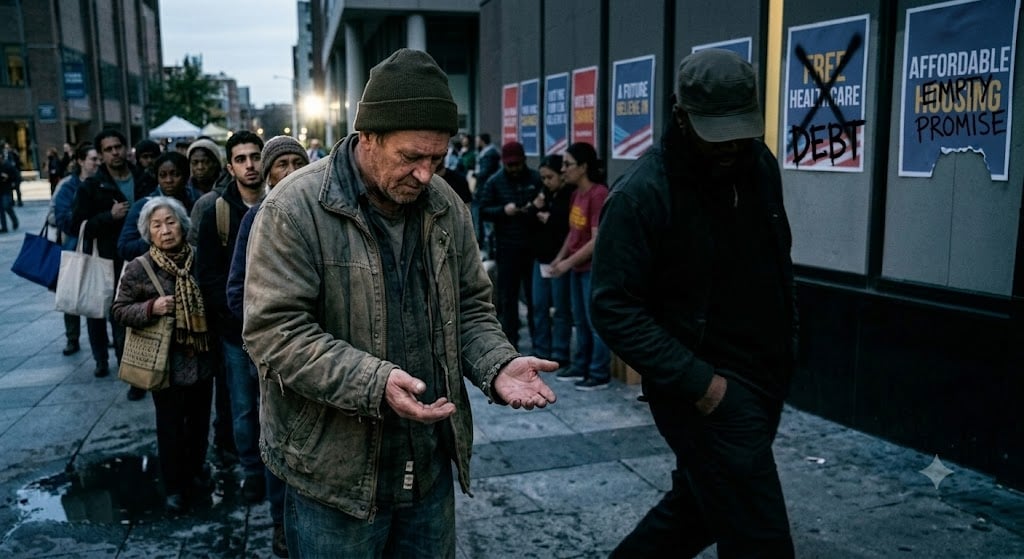
AI generated image
In the tight-knit Jewish neighborhoods of New York, humor has always been our primary armor against hardship. Growing up, I remember neighbors joking through grit and gritted teeth that they were so poor they “couldn’t afford the o or the r.” It was classic New York Jewish self-deprecation, but it pointed to a stark, unvarnished reality.
I grew up in what outsiders saw as affluent communities. From the sidewalk, it looked like a postcard of American prosperity—grand homes, fine cars, and manicured lawns. But inside our doorway, the reality was far more humble. My family were Holocaust survivors who had escaped the wreckage of Europe to rebuild in America with dignity and determination. Our world wasn’t manicured estates; it was rent-controlled apartments, mice, roaches, and streets where crime was a constant neighbor.
Yet, looking out those windows, I never saw a zero-sum game that required tearing down the mansions to fix our apartment. I saw a ladder that needed climbing.
Today, a growing chorus in American politics looks at inequality and preaches resentment—a doctrine that demands tearing the system down, seizing what others have built, and redistributing it. But that was not my takeaway. Not even close.
Jewish Wisdom: Empowerment Over Dependency
New York Mayor Zohran Mamdani and the Democratic Socialists of America (DSA) speak the language of compassion. No decent person should dismiss the pain of working families struggling with skyrocketing rents, food prices, or transit costs. But compassion becomes dangerous when it mistakes a temporary safety net for a permanent system of dependency.
Judaism demands that we open our hands to the poor (Deuteronomy 15:7-8). Sensitivity to human suffering is non-negotiable. But Jewish wisdom has always drawn a sharp, uncompromising line between a safety net that catches you when you fall and a hammock that invites you to stay there.
More than eight centuries ago, Maimonides (the Rambam) codified the eight levels of tzedakah (charity). At the absolute peak—the highest tier of righteous giving—is helping a person become fully self-sufficient through a loan, a trade, a job, or a partnership (Mishneh Torah, Hilchot Matanot Aniyim 10:7). The Torah’s agricultural laws echo this exact framework: farmers were commanded to leave the corners of their fields for the poor (Leviticus 19:9-10), guaranteeing access to sustenance while requiring the poor to go out and harvest it themselves. The Talmud goes so far as to declare that a parent who fails to teach their child a trade teaches them banditry (Kiddushin 29a).
The approach the Torah mandates is not about making poverty comfortable; it is about making poverty temporary. It is about teaching people to fish, ensuring that the hand they receive today becomes the hand that gives tomorrow. As my dear mother used to remind us: “What costs nothing isn’t worth anything.” When you replace tools for self-determination with permanent “freebies,” you rob people of their dignity and their capacity to build.
The Mechanics of Control: From Social Relief to Ideological Leverage
The strategy of using social subventions as a wedge for political dominance is not a novel invention; it is a time-tested operational blueprint.
Consider how radical political movements consolidate authority. Before Hamas ever governed Gaza, it spent decades operating Al-Mujama al-Islami—a network of free medical clinics, subsidized schools, and food distribution centers. To a population facing severe economic hardship, these programs looked like pure altruism. In political science, this is known as the Da’wah model: out-delivering a central authority to make basic human survival contingent on a political infrastructure. Over time, that charitable footprint was converted into institutional legitimacy, civic control, and an inescapable system of patronage that silenced dissent and funded a radical ideological agenda on the backs of the vulnerable.
While the contexts and methods differ drastically, the underlying political mechanics of Zohran Mamdani and the DSA draw from that same structural playbook.
When Mamdani and the DSA champion universal rent freezes, “free” public transit, state-run grocery stores, and government-funded childcare, they are not simply proposing economic policy—they are substituting private agency with state dependency. The political transaction is straightforward:
-
The Bait: Offer price controls, mandated rent freezes, and “free” municipal services to lower-income communities under the banner of basic human rights.
-
The Dependency: Transform citizens into permanent clients of the state whose housing, commutes, and daily bread depend directly on the party staying in power.
-
The Leverage: Once an electorate is bound to the political machine for its survival, that consolidated leverage is mobilized to advance a far broader, more radical worldview—one where anti-Zionism and alignment with radical anti-Western agendas are bundled directly into the price of “free.”
When state-managed handouts and artificial mandates are weaponized to buy political allegiance, they do not uplift the poor. They degrade personal dignity and empower political structures that actively undermine the safety, continuity, and values of our communities.
The Choice Before Us
We stand at a critical junction.
The first path seeks to seize control of the populace through dependency and false promises—promising to eliminate poverty through wealth redistribution, price freezes, and institutionalized reliance on the state. It is an old tactic, and the movements that embraced it never eliminated poverty; they universalized it, weaponizing state patronage to lock citizens into reliance while driving their societies toward scarcity, division, and the erosion of human dignity.
The other path—the path of the Torah, the Rambam, and the common sense of every immigrant who ever arrived on American shores with nothing—promises to end poverty by building human capacity. It says: educate, empower, employ, and uplift. It says: give people the skills, the opportunity, and the dignity to build their own future, not a permanent handout.
My family came to this country with little more than the clothes on their backs. They lived in rent-controlled apartments surrounded by wealth they could not touch, dealing with poverty, crime, and the unspoken trauma of escaping the Holocaust. They did not ask the government to freeze rents forever or redistribute the mansions down the block. They asked for the chance to work, to learn, to build, and to achieve.
That chance is what made their lives worth living. That chance is what built the free world. And that chance is what we owe to everyone struggling today—not a freebie, but a future.
Related Topics
Related Posts