The views expressed herein are solely mine.
From Jesus to Real Genocide: Palestinian Reckoning
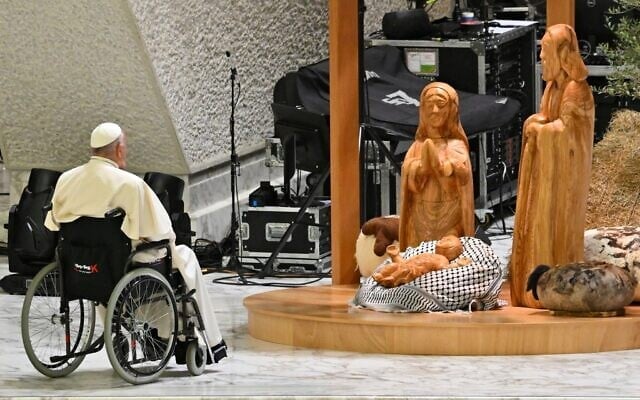
Illustrative: Pope Francis prays before the 'Nativity of Bethlehem 2024' with baby Jesus wrapped in Palestinian keffiyeh, upon its inauguration in the Paul VI Hall at the Vatican on December 7, 2024. (Andreas Solaro/ AFP)
The Christian presence in Palestinian society—once ancient, visible, and integral—should never need an obituary. Yet today, it does.
In recent years, repeated incidents across Palestinian Authority–controlled areas have revealed a troubling pattern: Christian symbols vandalized, churches threatened, religious minorities intimidated—not by foreign occupiers, not by invading armies, but by fellow Palestinians shaped by a growing culture of Islamist intolerance.
One such incident occurred recently in Jenin, where a Christmas tree was set on fire and desecrated in public view. The episode was quickly dismissed by local officials as vandalism, an aberration, or youthful provocation. But its symbolism was unmistakable—and familiar to Palestinian Christians who have watched their space in society steadily shrink.
These incidents are often dismissed as isolated; but they are not. They are symptoms.
The flames that periodically consume Christian symbols in Palestinian towns are not random acts of vandalism. They are symbolic. A warning. A continuation of a long, quiet purge.
This is not an anecdote; it is demography.
Before the Oslo Accords and Israel’s withdrawal from major Palestinian population centers in the mid-1990s, Christians constituted a substantial share of Palestinian society—particularly in historic urban and semi-urban centers such as Bethlehem, Beit Jala, Beit Sahour, Ramallah, and surrounding areas. In several of these communities, Christians once formed pluralities or outright majorities.
The case of Bethlehem is especially instructive. Before Israel’s withdrawal in 1995, Christians made up roughly 60–80% of the city’s population. Bethlehem was governed under Israeli civil administration, its churches protected, its Christian institutions economically viable, and its communal balance largely intact.
After the city passed into Palestinian Authority control, that balance collapsed with startling speed.
By the early 2000s, the Christian share of Bethlehem had fallen below 30%. Today, credible estimates by church authorities, academic demographers, and parish-based counts suggest that fewer than 1,500 Christians remain in a city globally synonymous with Christianity.
However, this pattern was not unique to Bethlehem. Similar declines followed Israel’s withdrawal from other Palestinian localities.
In each case, the trigger was not Israeli policy but the disappearance of effective legal protection for a vulnerable religious minority once Islamist social pressure became unchecked.
Today, credible estimates place the Christian share of the overall Palestinian population at well under 2%, with some localities approaching functional extinction.
Indisputably, Palestinian Christianity is becoming a civilization of churches without congregations.
Evidently, people do not abandon ancestral homes lightly—especially communities rooted there for nearly two millennia. They leave when pressure becomes systematic.
Multiple reports by organizations such as Open Doors, Aid to the Church in Need, and testimonies from Palestinian Christian clergy document patterns that are disturbingly consistent: intimidation, coerced land sales, harassment of Christian women, forced Islamization in family-law disputes, vandalism of churches, and physical assaults that go uninvestigated. In several documented cases, Christian families reported being told explicitly that seeking justice would only make things worse.
This is not “occupation”; it is intra-Palestinian persecution.
Furthermore, sociological studies of Christian emigration from Palestinian Authority–governed areas show that religious insecurity consistently outranks economic hardship as a driver of departure. Surveys among emigrant families cite fear of Islamization, lack of legal protection, and social marginalization more frequently than Israeli policy—particularly in areas where Israel no longer maintains civil governance.
And here lies the fatal irony.
Across the line, inside Israel, Christian communities are not disappearing—they are growing.
Today, Christian Arabs in Israel have the highest educational attainment of any religious group in the country, according to the Israel Central Bureau of Statistics. They are overrepresented in medicine, law, academia, and technology. Churches operate freely. Holy sites are protected by law. Christians serve as judges, diplomats, IDF officers, and members of parliament. Christmas in Israeli cities is not feared—it is celebrated, televised, and protected.
If Israel were the problem, Christians would be fleeing Israel. Instead, they are leaving Palestinian-ruled society at rates comparable to the Christian exoduses from Iraq, Syria, and Egypt—societies hollowed out by Islamist pressure while the world looked away.
That is why attacks on Christian symbols anywhere in Palestinian territory matter. The incident in Jenin was not about a tree. It was about signaling. It was not about one city but about governance. At the same time, this was carrying a clear message: “This society no longer has room for you.”
The echoes are familiar—from Mosul before the crosses came down, from Gaza after churches were attacked by jihadist groups, from parts of Lebanon before Hezbollah absorbed entire neighborhoods.
Indeed, Palestinian Christianity did not wither because Jews governed it but because Christians were abandoned—politically inconvenient, numerically weak, and ideologically expendable.
Nevertheless, the West prefers fairy tales: oppressed Palestinians, evil Israelis, clean moral binaries. Nevertheless, reality is uglier.
The disappearance of Palestinian Christians is among the clearest indictments of Islamist radicalization within Palestinian society—and of the international community’s refusal to confront it.
Beyond dispute, one of the oldest continuous Christian communities on earth is being reduced to heritage tourism.
Thus, amid hymns, candlelight, and comfortable illusions, it is worth remembering that the strongest empirical protector of Christian life in the Holy Land is not slogans, ideology, or international advocacy—but the State of Israel.
Related Topics