
Jewish Educator, Aspiring Artist, and Hopeless Idealist
Featured Post
From Rebekah’s fear to Ben-Gvir’s hate: The crisis of Jewish narrative
The matriarch was afraid for her son, but when that same anxiety is weaponized, as it has been recently, it's toxic - and what we need is justice and compassion
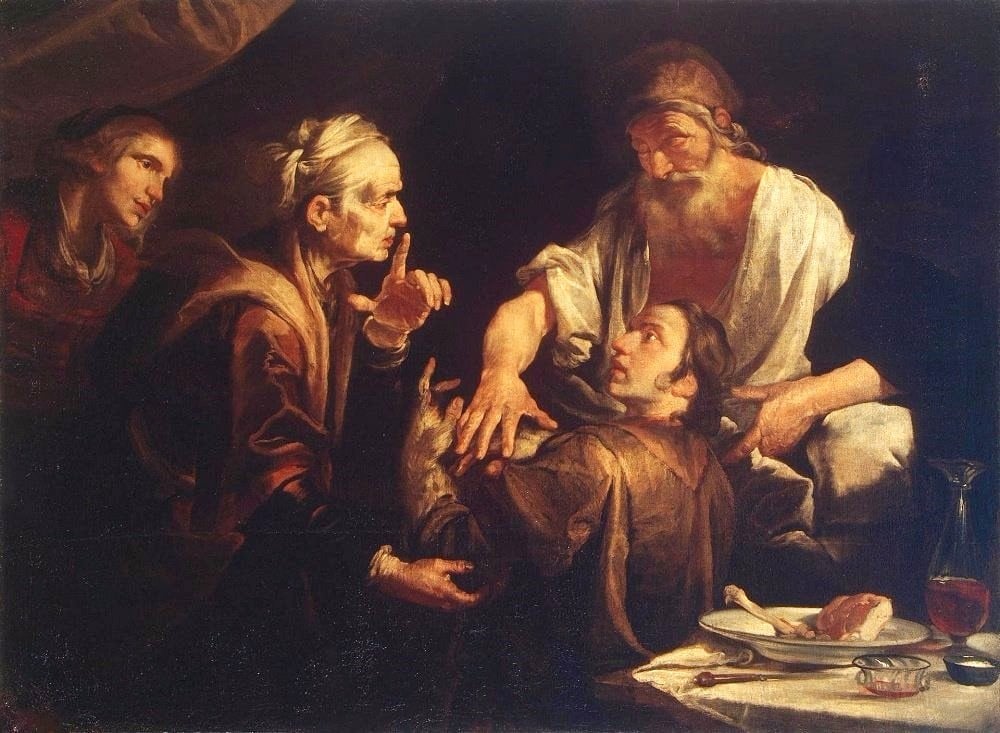
'Isaac Blessing Jacob,' by Gioacchino Assereto, 1640s.
In Parashat Toldot, we witness the painful genesis of a family fracture that echoes through history. Rebekah’s decision to withhold God’s message that Esau was meant to serve Jacob and instead encourage Jacob’s deception of Isaac to obtain the blessing establishes a dangerous precedent. This action highlights the peril inherent not just in a lack of communication, but in narratives framed from a place of fear and negativity. The rivalry between Jacob and Esau transcends a simple biblical conflict; it becomes a foundational story of trauma, escalating tensions, and the years of consequence and fear that follow.
Rebekah’s motivation was not malicious, but her method was rooted in profound fear, resulting in a critical lack of necessary ethical nuance. By choosing deceit and expediency, she failed to communicate the complex truth of the divine choice. Her actions established a toxic internal narrative of the “chosen” one, stripped of its theological mandate for justice and easily corrupted into a justification for exclusion. This failure of nuance is what allows the narrative to be hijacked, tragically becoming the polarizing message that plagues the world’s perception of Jews today.
The fracture point in Toldot — the failure of communication driven by fear — finds its devastating modern echo in the current conflict. Today, the very vacuum of considered language that Rebekah’s action foreshadowed is manifest in the conflicting messages emanating from within the Israeli government itself. While the government rightly condemns and seeks accountability for extremist settler violence in the West Bank, figures like Itamar Ben Gvir and his ideological allies seize upon the ancient anxiety and lack of moral clarity to transform it into a doctrine of hate. They continue to present the current reality as a zero-sum game. They assert a unilateral Jewish right to the land, often without any consideration for basic human dignity or international law. Crucially, they actively perpetuate the corrosive belief that the “other” is a direct, existential threat who must be entirely removed.
This hate-filled narrative has not remained theoretical; it has fueled the extreme settler violence and, as harrowing accounts from released hostages have confirmed, directly worsened their experience in captivity. Ben Gvir’s attempts to thwart potential release deals are a blatant example of how someone claiming to defend the very core of Jewish law and values can choose to ignore the most important directive of all: the preservation of human life and dignity through justice.
At a time when educators and organizations globally are working tirelessly to address the human aftermath of October 7th and combat a relentless surge of antisemitism, the Israeli government must be the unwavering, moral voice of its people. This demands a narrative that is both steeped in nuance, promoting healing and resilience, and entirely devoid of generalizations and hate.
The choice before us, therefore, is not merely political; it is spiritual, and fundamentally, it is about survival. Rebekah’s initial error stemmed from a mother’s profound fear, lacking the clarity of prophetic nuance, but it did not carry the venom of hate. Today, however, we see that same underlying anxiety — the very real existential fear post-October 7th — dangerously amplified and deliberately weaponized into hate.
The Jewish future cannot be built on the scorched earth of xenophobia or the brittle foundation of a zero-sum, “us-or-them” philosophy. We must reclaim the depth of our ancient tradition, which mandates justice and compassion for all, echoing the warning that the preservation of a single life is akin to saving an entire world. This demands that every public utterance from our leaders be filtered through the lens of accountability, that hateful narratives are unequivocally rejected, and that the profound nuance of our existence — as a people anchored in history yet responsible for the present — be upheld. To ensure the enduring safety and ethical strength of the Jewish people, we must choose language that heals rather than inflames and leadership that unites rather than divides, forging a path forward rooted in the moral clarity that true security requires.
Related Topics