
CFO | Empower Society for Good I Author
From Scarcity to Responsibility – Water, Food, and Shared Knowledge
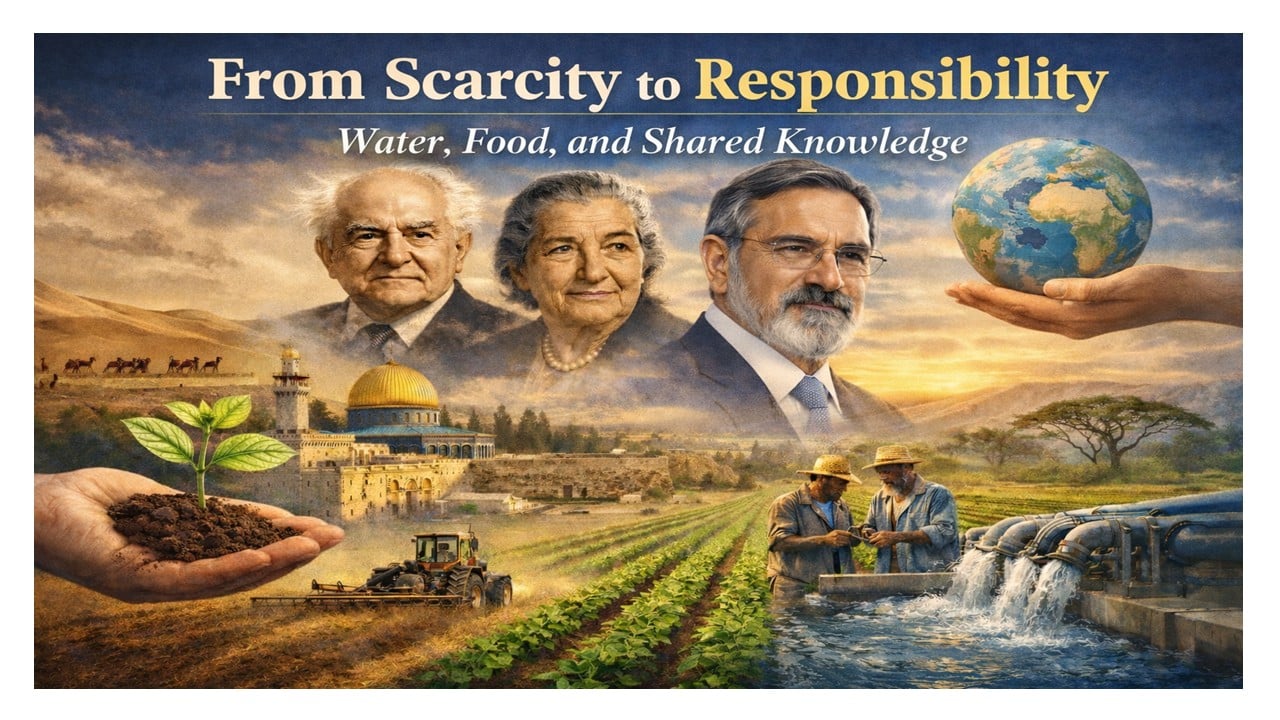
Tu Bishvat, the New Year for Trees, invites reflection not only on growth but on responsibility — on what sustains life long before fruit appears.
In part 1, we examined how water scarcity, drying landscapes, and food inflation are no longer distant threats but present realities that are reshaping societies and testing sovereignty worldwide.
https://blogs.timesofisrael.com/water-and-the-test-of-responsibility/
Part 1 ended with David Ben-Gurion’s challenge: a nation that cannot master scarcity cannot sustain sovereignty.
What Israel confronted early — desert, water stress, food insecurity — is now confronting the world.
The question today is no longer whether scarcity can be managed.
It is whether it can be managed responsibly, collaboratively, and at scale.
Israel’s answer was not a single invention, nor a miracle technology. It was the deliberate construction of an ecosystem — water, agriculture, innovation, cooperation, and long-term thinking working together.
This blog continues from that challenge and turns to responsibility, exploring how Israel translated constraint into resilience through water systems, cooperative agriculture, innovation, and the sharing of experience, and why, in an age of global water and food stress, shared knowledge may be as vital as technology itself.
When Crisis Moves From Theory to Fields
Before turning to responsibility and response, it is important to acknowledge how advanced the global food and water crisis has already become.
Recent reporting describes farmers in parts of Europe taking drastic, emergency measures to keep land productive — redirecting water, deliberately flooding fields, and bypassing long-standing water controls simply to prevent soil collapse. On the Great Hungarian Plain, farmers are attempting to recreate historical flood patterns from the Danube and Tisza rivers that were eliminated decades ago by river regulation and drainage. What is taking place is not innovation; it is improvised survival — an attempt to repair systems that were broken by design.
Similar pressures are visible across Africa, India, the Middle East, and even parts of Europe and North America. The conclusion is unavoidable: traditional agricultural systems are breaking down under water stress, and the crisis is no longer future-tense.
This is the reality into which Part 2 is written.
From Water Security to Responsibility
Israel encountered these constraints earlier than most.
As a desert nation with limited water, fragile land, and constant security pressure, Israel was forced to treat water not as a commodity but as critical national infrastructure. Through desalination, wastewater reuse, integrated distribution, and long-term planning, water moved from an existential threat to a managed system.
But Israel’s response did not end at national resilience.
Under peace agreements — most notably with Jordan, one of the most water-scarce countries in the world — water cooperation became a quiet pillar of regional stability. Even during political tension, water continued to flow. This was not charity; it was realism. Shared survival creates shared responsibility.
Water, when managed wisely, becomes peace infrastructure.
From Exporting Technology to Sharing Experience: The Booky Oren Model
At this point, Booky Oren’s contribution is essential to understand correctly.
As former Chairman of Mekorot, Israel’s national water company, Oren saw firsthand that the world did not lack water technologies. What it lacked was implementation knowledge — a practical, experience-based understanding of how systems actually work under pressure.
In response, he founded Booky Oren Global Water Technologies and later the Knowledge-to-Implementation (K2i) platform, a practitioner-led, non-commercial network enabling utilities around the world to share what worked, what failed, and how solutions were adapted locally.
This was a shift in mindset:
from exporting solutions → to sharing experience.
Food security now faces the same fragmentation water once did — and requires the same maturity of response.
Golda Meir: Knowledge Sharing as Foreign Policy
This approach has deep historical roots.
As Foreign Minister, and later as Prime Minister, Golda Meir believed Israel’s legitimacy would be earned through contribution, not rhetoric. In the 1950s and 1960s, Israel had little wealth to offer newly independent nations, particularly in Africa — but it had hard-won agricultural and water experience.
Israeli agronomists, irrigation experts, and cooperative specialists worked across Africa and the developing world, sharing practical farming methods, water management, and cooperative agricultural models. The goal was not dependence, but capacity-building.
This became an early form of knowledge diplomacy, linking Israel’s agricultural model to global development long before today’s language of sustainability or SDGs.
The Israeli Agro Model: Cooperation, Export, and Value
Israel’s agricultural success was never based on scale. It was built on cooperation and value.
Through kibbutzim and moshavim, farmers shared water infrastructure, storage, logistics, research, and risk. Innovation moved rapidly from field trial to implementation. This cooperative base enabled Israel to orient agriculture toward premium export markets, rather than commodity volume.
Israeli agriculture focused on:
- High-value fruit and vegetables
- Off-season supply to Europe and beyond
- Quality, traceability, and post-harvest excellence
This export-oriented, premium model allowed farmers to remain economically viable under extreme constraints — a critical but often overlooked pillar of food security.
This model also travelled well: across Africa, the Middle East, and Asia, Israeli agro-water knowledge was adapted to local conditions rather than imposed wholesale.
Innovation Across the Food System
Over time, this ecosystem expanded:
- Biological pest control, reducing chemical dependence
- AI-based pest monitoring and early-warning systems, lowering crop loss
- Precision irrigation, aligned with soil and climate data
- Integrated agro-water solutions, matching water quality to crop needs
- Soil health and microbiome science, strengthening long-term resilience
AI does not replace farmers.
It reduces uncertainty — the enemy of stability and investment.
A Personal Perspective
Through my involvement with FarmUp.tech, and through engagement in food-security initiatives in India and Africa, one lesson has become increasingly clear: the challenge today is not innovation, but connection.
Knowledge exists. Experience exists. But it remains fragmented — across countries, institutions, and sectors.
Food security, like water security before it, now requires structured sharing of practical knowledge, not another layer of theory.
Beyond Image: Responsibility First
This is not primarily about improving Israel’s image — although responsible action inevitably shapes reputation.
Judaism teaches moral responsibility before recognition.
Rabbi Jonathan Sacks articulated this powerfully, arguing that a good society is built on covenantal responsibility — obligations we accept because they are ours.
Food security is not a slogan, nor an SDG checkbox.
It is a moral responsibility tied to dignity, stability, and peace.
A Modest Call Forward
I have written for years about ethics, sustainability, and responsibility. Writing matters — but it is not always sufficient.
I am already involved, in small and practical ways, in food-security initiatives beyond Israel. It may be time to explore how experience can be shared more deliberately, learning from models that have worked in water and adapting them carefully to food systems.
Not as a grand launch.
Not as a campaign.
But as a conversation among practitioners who understand the stakes.
If this resonates, the next step is not publicity — it is quiet collaboration.
In an age of scarcity, the most valuable contribution may not be technology at all, but experience shared with humility and responsibility.
Related Topics
Related Posts