From Survival to Kindness: What Three Weeks in Asia Taught Me
What three weeks in Singapore and Vietnam taught me about trauma, safety, and the courage to remain human.
I have just returned to Israel after three weeks in Singapore and Vietnam, and I find myself carrying something home that I hadn’t expected.
Not souvenirs. Not photographs. Not even the beautiful memories of places I visited.
I came home with a question.
What happens to our capacity for kindness when we have lived in a state of fear for so long?
And perhaps an even more important question: How do we find our way back?
Representing Israel, far from home
My journey began in Singapore, where I attended an international expressive arts therapy conference. I was the only participant representing Israel, something that felt particularly meaningful during these difficult times.
I arrived as an expressive arts therapist, eager to connect with colleagues, learn, and immerse myself in the healing power of the arts. But I also arrived as an Israeli, carrying the weight of everything our country has endured.
I was surprised by how little some people knew about what was happening in Israel, and by some of the assumptions they held about Israelis. In conversations, I found myself explaining something that seemed so obvious to me: that Israelis want peace. That we love our children. That we want to live safely, to build our lives, to love, to create, and to grow old without fear.
I was surrounded by professionals from Hong Kong, Japan, Australia, Singapore, and many other parts of the world. People whose work is rooted in compassion, creativity, and human connection. We immersed ourselves in music, movement, dance, visual arts, and conversations about trauma, grief, and healing.
Despite our different backgrounds, we connected through our experiences, knowledge, and shared desire to bring healing into the world.
And I left feeling enriched by the beautiful souls I had encountered. But something else was beginning to happen within me.
We are here for an exchange of culture
I had the privilege of spending part of my time in Singapore with Reverend Dr. Mary Putera, a dear friend and colleague who traveled from the United States.
Before her arrival, a friend living in Singapore had kindly given me a list of places to visit and said no need for a tour. Naturally, I was excited to see the famous sites, explore the city, and check things off my list. I shared this with Mary.
Mary replied, “We are here for an exchange of culture,” she told me.
Mary explained that every encounter was a chance to exchange wisdom and gifts, to learn from one another rather than simply pass through a place.
I remember thinking, Okay, Mary. I’m with you. Let’s try this.
And so we did. Instead of simply visiting places, we began meeting people.
Our tour guide became more than someone showing us the city. He shared stories about his upbringing, his family, his culture, and the history of Singapore. We listened. We asked questions. We shared stories of our own.
Suddenly, travel wasn’t about seeing things. It was about seeing people. And something about that shift began to change me.
When the body has been holding too much
During my time in Singapore, I became quite ill. I was suffering from flu-like symptoms, migraines, body aches, and exhaustion.
Mary kept noticing something about me. “You’re so stiff,” she would say. “Look at how you’re holding your body. You’re not standing straight.”
At first, I barely paid attention. I exercise regularly. I practice yoga. I’m an expressive arts therapist. I work with trauma and understand the connection between the body and the mind. Surely I would notice if I were carrying so much tension?
And then I began to think about the past three years. The trauma work I have been doing with individuals and groups in Israel. The stories I have heard. The grief I have witnessed. The pain I have held alongside others. And my own grief, including the recent death of my father.
Like so many Israelis, I have been living through years of uncertainty, fear, war, and loss. We hear the stories, worry about our children, absorb the suffering of others, and somehow continue with ordinary life.
But what happens to our bodies through all of this?
I realized that although I had been functioning and caring for others, my body had been holding a constant state of readiness I hadn’t fully acknowledged.
Fight. Flight. Freeze.
And then, as I wandered through the streets of Singapore, something extraordinary happened. I began to feel safe.
Not because everything in my life had suddenly become easier. Not because the war had ended or my grief had disappeared. But because, for moments at a time, my body seemed to recognize that it didn’t need to be on guard.
I noticed my shoulders, my breathing, my posture. I realized how long it had been since I had felt this kind of calm.
Finding peace without a common language
From Singapore, I continued to Vietnam, where I would later meet my son, who was traveling through Asia.
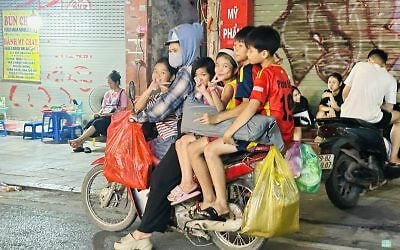
For the first few days, I was alone in Hanoi, still recovering from being sick, in a country where I didn’t speak the language and knew very little about my surroundings. I was outside my comfort zone.
Each morning, I began walking to the lake, where elderly Vietnamese men and women gathered to practice tai chi. I joined them.
We didn’t speak the same language. They moved, and I followed. They smiled, and I smiled back.
There were no explanations, no introductions, no conversations about who we were or where we came from. Just our bodies moving together in the morning air.
I began walking through Hanoi, sometimes without knowing exactly where I was going. Even at night, in unfamiliar streets, I noticed a sense of calm that surprised me.
At times, I felt more relaxed than I do walking through my own neighborhood in Israel. This realization was both beautiful and painful.
Because I love Israel. I love our people, our warmth, our generosity, our extraordinary ability to show up for one another in moments of crisis.
The kindness of strangers
A stranger grabbing my hand when I slipped in the rain. A woman sharing her umbrella as we crossed the street. People patiently helping me count Vietnamese currency when I couldn’t figure out how much money I was holding. The smiles of women selling fruit on the streets. The warmth of people serving food, opening their shops, sharing their stories, and simply going about their lives.
Vietnam has its own painful history, and its people have endured tremendous suffering. Perhaps that made these small gestures even more meaningful.
In Singapore, Mary had a habit of constantly thanking people. “Thank you. Thank you. Thank you.”
At one point, I remember feeling almost irritated. Does she really need to thank everyone for everything?
Then I caught myself. What was wrong with saying thank you, offering a smile, or acknowledging another human being?
I began doing it myself. I smiled more. I thanked people more. I made eye contact. And people smiled back.
I could feel the difference in my body: softer, less guarded, more open.
A Vietnamese teacher of peace
Before leaving Singapore, Mary gave me a book by the Vietnamese Buddhist monk and peace activist Thich Nhat Hanh.
I was already familiar with his teachings. Years ago, when I lived in San Diego, I would visit a mindfulness center in Escondido and participate in mindful walks. Yet somehow, I hadn’t fully connected his teachings with the history of Vietnam.
As I read about his life, I was reminded that he had lived through war, advocated for peace, and spent decades in exile from his homeland. He went on to establish Plum Village in France and inspired mindfulness communities throughout the world.
As I read his words while traveling through Vietnam, they began to take on a different meaning. I was no longer simply reading about mindfulness. I was trying to live it.
And perhaps most importantly, to recognize that peace is not only something we wait for governments or leaders to create. It is also something we practice in the way we live.
What war can take from us
We speak about the obvious consequences of war: the lives lost, the wounded, the displaced, the families torn apart, the grief that seems endless.
But there is another consequence that is less visible. The gradual erosion of our sense of safety.
Fear can shape how we see strangers, respond to frustrations, and begin to expect the worst from others—and sometimes from ourselves.
I am not suggesting we ignore danger, abandon the need to protect our families, or imagine kindness alone can end a war.
But I am asking something else. What happens if we allow fear to determine who we become?
I refuse to believe that this is the only way to live. I refuse to let war take away my capacity to love. I refuse to become a prisoner of fear.
We can be strong and still be gentle. We can protect ourselves and still remain compassionate. We can recognize evil without losing our belief in goodness. And we can acknowledge our pain without allowing it to define every part of who we are.
Kindness begins with me
During my travels, I also began thinking about something that is perhaps even harder than being kind to strangers. Being kind to myself.
How often do we criticize our bodies, tell ourselves we aren’t enough, or fill our minds with endless worries?
Kindness begins with how I speak to myself, care for my body, and respond to my own exhaustion, grief, and vulnerability. How could I nourish myself through what I consume—not only food, but the stories, images, and thoughts I allow into my life?
Coming home with a different intention
Now I am back in Israel. Back to my family, my clinic, my work, and the reality of a country still carrying so much pain.
I will sit with clients struggling with grief, trauma, and uncertainty. I know there will be moments when I become tense, impatient, or afraid again.
I am human. But I have made a promise to myself.
I want to practice kindness more intentionally. Not in grand gestures. In small, ordinary moments.
Returning a shopping cart instead of leaving it for someone else. Leaving a place a little cleaner than I found it. Letting someone take the parking space instead of fighting over it. Thanking the person serving my coffee. Smiling at a stranger. Choosing not to speak badly about someone. Pausing before reacting in anger. Listening a little more carefully. Being gentle with myself when I am tired. Remembering to breathe.
As an expressive arts therapist, I work with people who have endured extraordinary pain, helping them reconnect with their resources, creativity, and capacity for meaning.
But this journey reminded me that resilience is not only about surviving what happens to us. It is also about choosing how we want to live afterward.
One small mark of kindness
I don’t know how to bring peace to the Middle East. I don’t know how to heal the grief of an entire country. And I certainly don’t have answers to the enormous political and human challenges we face.
But I do know this.
I don’t want to live the rest of my life in a state of war within myself. I don’t want my body to remain braced for danger every moment. I don’t want fear to take away my ability to see beauty in the world. And I don’t want to lose my belief that most human beings, wherever they come from, are capable of love and kindness.
Perhaps someone will call this naïve. Perhaps it is. But I would rather hold on to the possibility of goodness than surrender completely to fear.
My journey began with an international conference on expressive arts and trauma. It continued through conversations with strangers, walks in the rain, morning movement with elderly Vietnamese people, the teachings of a Buddhist monk, and precious moments with my son.
And somewhere along the way, I discovered something I hadn’t realized I was missing: the feeling of peace within myself.
I cannot promise I will carry that feeling every day. But I can practice returning to it, one breath, one smile, one small gesture at a time.
Perhaps I cannot change the whole world. But I can leave one tiny mark of kindness upon it.
And kindness begins with me.