George Clooney defended a right nobody threatened
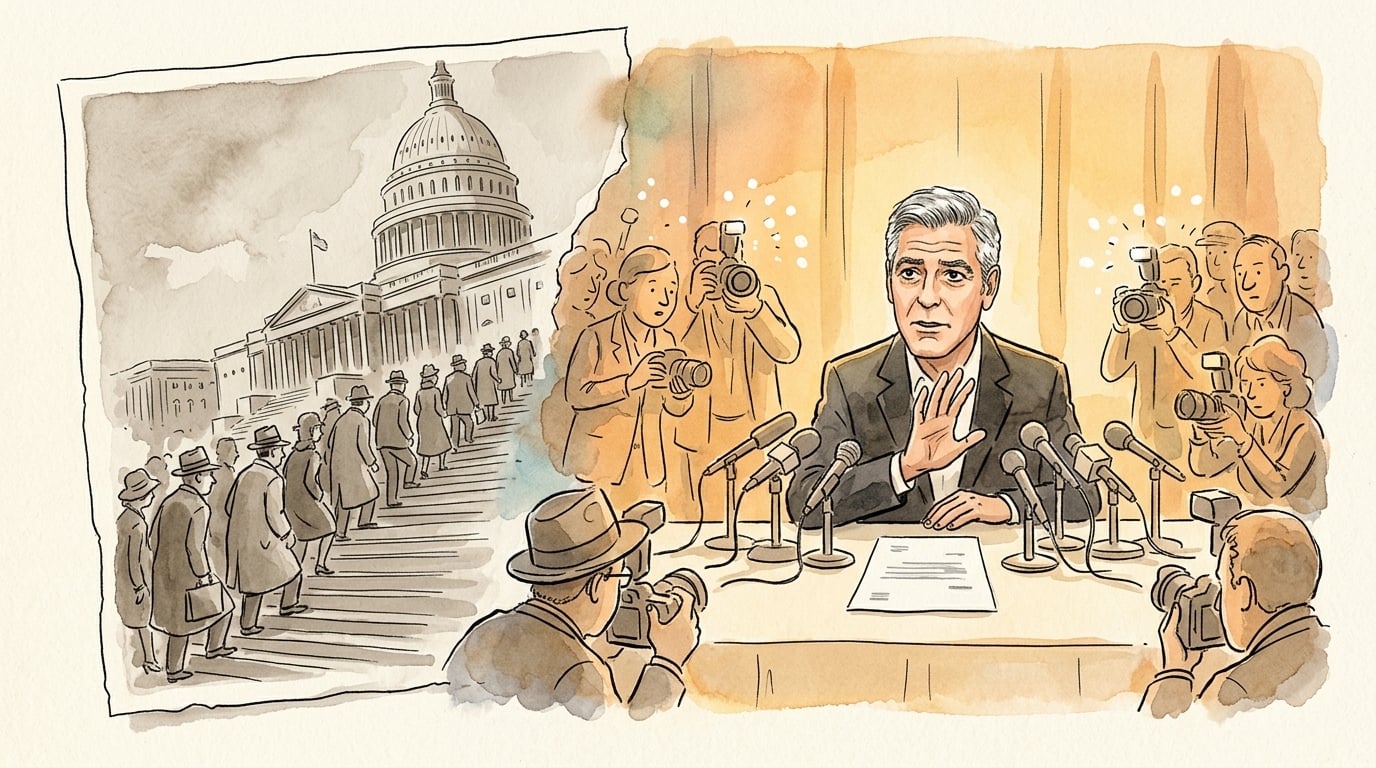
On Tuesday at the Venice Film Festival, a reporter asked George Clooney about Mark Ruffalo, and Clooney said this: “I support Mark Ruffalo’s ability to speak freely. It’s ridiculous. We’re not going to ban speech.”
Nobody had proposed a ban on speech.
I know what a real attempt to punish speech looks like, because I spent the past thirteen months defending two people from one. A Jewish couple from Pennsylvania left two comments on an Instagram post that flagged a Miami lawyer’s writing about Israel. One comment said where she worked. The other wondered how her Jewish clients would feel about her posts. She sued them. Last week, a federal judge in Miami threw out the whole case, and the sentence she used to do it is the one I want everyone in this story to read.
Count the Government Officials
I have written about Ruffalo twice already, so here’s the short version. On August 21, he posted that Larry Ellison is a “classic Oligarch” and that Oracle’s Safra Catz revels in “what we now have come to see as a genocide,” all of it somehow inside a media merger. Paramount answered within a day that it was “troubled when antisemitic tropes are invoked in purported service of a business dispute.” Days later, nearly a thousand industry people signed a statement calling the post antisemitic. Ruffalo called the accusation “appalling and fundamentally dishonest.”
Then the defense arrived. Jane Fonda, through the Committee for the First Amendment she revived last fall, issued a memo: “Mark Ruffalo has a First Amendment right to speak out about politics, powerful corporations and this dangerous merger—full stop.” Ilana Glazer said calling him antisemitic is “a dangerous way to shut down legitimate criticism.” A hundred and seventy-seven Jewish artists signed a letter calling it a smear. And Clooney, in Venice: “I believe in free speech even when I completely disagree with it.”
So do I. Now count the government officials in this story.
There aren’t any. A movie studio wrote a press release. A trade group wrote a statement. Jewish organizations wrote condemnations. The full case against him: private people with opinions, saying them out loud. The First Amendment is a leash on government, on a governor, on a public university with a discipline code. It has nothing to say to a movie studio.
The Committee Her Father Joined
Fonda’s committee has a real history. The original Committee for the First Amendment formed in 1947 to oppose congressional hearings into Hollywood’s alleged communists. Henry Fonda was a member. So were Humphrey Bogart, John Huston and Lucille Ball. The men those hearings targeted, the Hollywood Ten, went to prison for refusing to cooperate with Congress and were blacklisted for a decade after. That is a committee with a purpose: a legislature with subpoena power on one side, screenwriters on the other.
When Fonda relaunched it last October with more than five hundred and fifty signatures, the founding statement named the same enemy: “The federal government is once again engaged in a coordinated campaign to silence critics.” Whatever you think of that claim, it is the right kind for that committee to make. Ten months later, its first memo in this fight is aimed at a movie studio. Nobody subpoenaed Mark Ruffalo. Nobody cited him for contempt. A corporation he attacked said it found his post antisemitic, and the committee her father joined to fight Congress answered with a memo.
Erez Levin wrote earlier this week that the free speech line is a straw man, a way of skipping the harder job of saying what you think of the speech. He is right. I want to add the half of it I can prove. I have a court order.
What the Judge Said
Back to Miami. The lawyer’s theory was that wondering aloud what her Jewish clients would think, next to a link to her firm profile, implied she was “a virulent and irredeemable antisemite” unfit to represent them, and that the implication, not the words, was defamation. Judge Jacqueline Becerra disagreed, and her reason matters more than her result. Whether the lawyer’s posts were antisemitic, the judge wrote, is “a subjective characterization of her publicly available posts, not a verifiable assertion of fact.” The lawyer read her own posts as criticism of a government. My client read them as something else. Neither reading, the judge wrote, “can be proven true or false.” And then the line: “one person’s ‘subjective assessment’ is not rendered false by another person’s ‘different conclusion.’”
That sentence is not new and it is not ours. Judge Becerra was quoting the Eleventh Circuit, which had said it about a football coach accused of homophobic taunting and, last year, about Donald Trump and the phrase “Big Lie.” The New Jersey Supreme Court got there thirty years ago, when a man at a condo board meeting shouted that two of his neighbors “hate Jews” and the court held that was opinion too—then closed with a sentence everyone defending Ruffalo should tape to the mirror: “As a society we have made a determination that the best way to combat bias and prejudice is through the exchange of ideas and speech, not through lawsuits.”
In legal terms, an accusation of antisemitism drawn from a person’s own public words is opinion. In English: nobody can prove Paramount right, nobody can prove Paramount wrong, and the law is at peace with that, because you can read the post yourself.
Take that rule to Venice. Paramount’s statement is opinion. The thousand signatures are opinion. Fonda’s “smear” is opinion. Ruffalo’s “fundamentally dishonest” is opinion. Every one of them is protected, every one of them is unprovable, and not one of them is censorship. There is exactly one thing you can do with an opinion you don’t like. Answer it. Which, to be fair, is what all of them have been doing for two weeks. They just keep calling it something else.
Who Actually Reached for the Government
The only person in this story who reached for state power against speech was the plaintiff in Miami. She wanted a federal court to declare an opinion false and make my clients pay for holding it. For thirteen months, two people who had written two sentences on the internet were defendants in federal court: two rounds of motions, a hearing, legal fees. The Committee for the First Amendment did not send a memo about that.
Right Principle, Wrong Room
Clooney, again: “I believe in free speech even when I completely disagree with it. That’s important. In fact, it’s part of how democracy works.” Every word is right. It is why the answer to Mark Ruffalo was more speech, not a lawsuit. It is why Paramount wrote a statement instead of calling a senator, why a thousand people signed a letter instead of a complaint, why my clients’ case ended in a dismissal and not a verdict. The system Clooney described worked exactly the way he says it should. He just didn’t recognize it, because this time the speech he disagreed with was aimed at his friend.
Nobody banned anything. Somebody answered. From a microphone in Venice, the two apparently look the same.