Strategist and Diplomat Analyzing Somaliland and Horn Affairs
Greater Somalia: The Unity Test
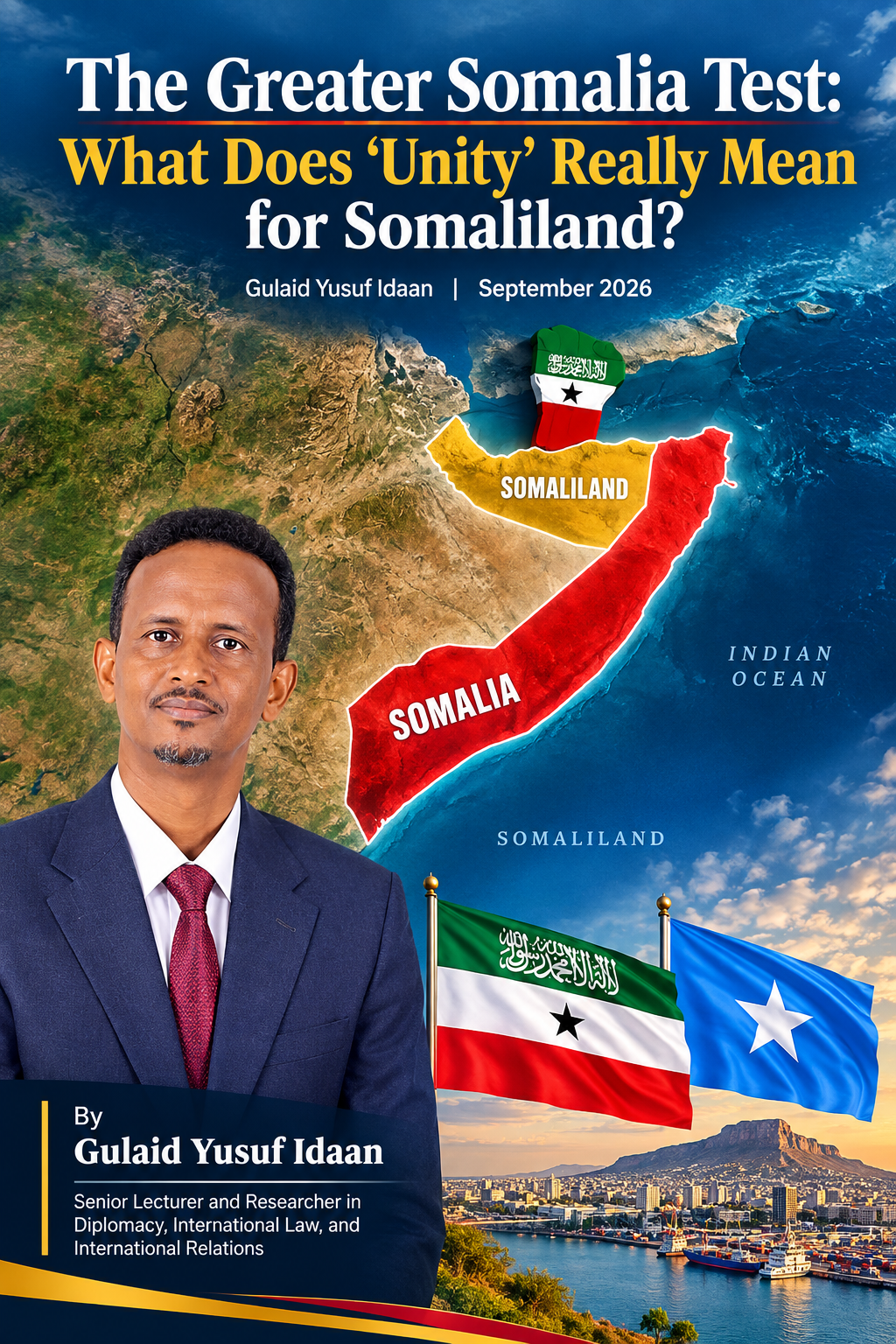
Somaliland pursued Soomaaliweyn. The union failed. Today, the question is: What does “unity” really mean? — The Greater Somalia Test
What Does Somalia Mean by Unity?
For years, I have argued that Somaliland should make an argument that is both historical and deeply political: if Somalia invokes “unity” as the basis for demanding Somaliland’s reintegration, then Somaliland should ask what Somalia actually means by unity.
This is not merely a semantic question. It goes to the heart of the historical relationship between Somaliland and Somalia and to the credibility of the narrative now presented to the international community.
Somaliland did not begin its modern political history by rejecting Somali unity. It did almost the opposite. It was among the strongest advocates of a broader Somali national project: Soomaaliweyn, or Greater Somalia. That history directly challenges a central assumption underlying Somalia’s contemporary narrative: that Somaliland is the party that abandoned Somali unity and thereby created the division that exists today.
The real story is one of an unrealized Greater Somalia project, a subsequently failed Somaliland-Somalia union, and a political relationship whose collapse eventually produced Somaliland’s restoration of independence in 1991.
This is why the question today should not simply be whether Somaliland believes in unity. The more important question is: what kind of unity does Somalia mean?
Somaliland and the Original Project of Soomaaliweyn
Somaliland and Somalia entered the twentieth century under different colonial administrations — Britain in the Somaliland Protectorate, Italy (and later the United Nations) in the Trust Territory of Somalia — and developed distinct political, social, and institutional experiences.
Yet colonial separation did not prevent Somali nationalists from imagining a common political future. On 26 June 1960, Somaliland achieved independence from Britain as the State of Somaliland. Five days later, on 1 July 1960, it united with the former Trust Territory to form the Somali Republic.
This sequence is frequently remembered as evidence that the two territories were naturally destined to become one state. That interpretation is incomplete. The political aspiration behind Somaliland’s decision was not simply to combine two territories. It was connected to a much larger Somali nationalist vision: a Greater Somali State encompassing the five principal Somali-inhabited territories divided by colonial boundaries — British Somaliland, the former Italian Somaliland, French Somaliland (now Djibouti), the Somali-inhabited territories under Ethiopian administration, and the Northern Frontier District of Kenya.
The distinction is crucial. The objective was not merely Somaliland plus Somalia. The aspiration was Soomaaliweyn, and Somaliland’s participation in the 1960 union must be understood within that wider nationalist context — not as an act of political surrender to another Somali territory, but as one step toward a much larger project of Somali political unity.
That broader project never materialized. Djibouti remained outside the Somali Republic. Somali-inhabited territories remained within Ethiopia and Kenya. What actually emerged in 1960 was a state composed of two territories. That difference between the aspiration and the political outcome is essential to the debate today.
Egal‘s Testimony: When Somaliland Went Looking for Unity
Most of the testimonies demonstrate Somaliland’s original commitment to Somali unity more clearly than that of Mohamed Haji Ibrahim Egal (1928-2002). Egal was not a peripheral observer: he became Prime Minister of the independent State of Somaliland on 26 June 1960, later served as Prime Minister of the Somali Republic from 1967 to 1969, and, after Somaliland’s restoration of independence, became its second President in 1993, remaining in office until his death in 2002.
His testimony is particularly powerful because it captures an earlier Egal — one who believed deeply in Soomaaliweyn. He recalled that in 1957, the Somali National League conference in Burao raised the question of whether Somalis in Djibouti, Ethiopia, Kenya, and the south shared Somaliland’s desire for Greater Somali unity. Somaliland’s leaders agreed to send a delegation to Mogadishu to seek the organization of a Pan-Somali conference. The delegation travelled to Mogadishu, met political leaders, and returned the following year with representatives from Somaliland and Djibouti, while questions remained over the representation of Somalis from Ethiopia and Kenya. The conference began, the Somaliland and Djibouti delegations spoke strongly for unity, and it was ultimately closed by government order.
Egal later described that experience as the moment when he personally lost hope in any future Somali unity.
The importance of this testimony extends beyond the details of one conference. It demonstrates that Somaliland’s political leadership did not passively inherit the idea of Somali unity — it actively pursued it. The question was raised in Burao, delegates were selected, representatives travelled to Mogadishu, a Pan-Somali conference was sought and convened, and it was shut down. This is not the historical record of a society indifferent to Somali unity. It is the record of a society that went looking for it.
The significance of Egal‘s account becomes even clearer alongside the later trajectory of his life. The same man who eventually became President of Somaliland had once been deeply committed to Soomaaliweyn; his political evolution cannot simply be explained as an ideological rejection of Somali identity. His account suggests that the crisis of Somali unity did not begin in 1991. The tensions surrounding the meaning, scope, representation, and political practice of Somali unity were already visible before independence and before the 1960 union.
The historical question, therefore, is not simply why Somaliland abandoned unity. It is why the larger conception of Somali unity failed to produce the political settlement its advocates had imagined.
The Failure of Greater Somalia — and Then the Failure of the Union
The broader Soomaaliweyn project never achieved its territorial objective. Somaliland united with the former Italian Somaliland, while the other Somali-inhabited territories remained under the sovereignty of Ethiopia, Kenya, and France. But the two-territory union that did emerge in 1960 subsequently faced its own internal problems. The promise of unity did not automatically produce political equality, institutional stability, or a shared sense of state ownership.
Over subsequent decades, the relationship deteriorated amid political tensions, authoritarianism, conflict, and repression. During the 1980s, Hargeisa and Burao were bombed and extensively destroyed. Civilians were killed and displaced, with widespread reports of detention, torture, unfair trials, confiscation of property, and other abuses. These conditions produced deep political alienation, and in 1981 the Somali National Movement (SNM) emerged as a major political and armed movement rooted in resistance to the repression experienced by communities in the former British Somaliland.
In 1991, the SNM helped overthrow Mohamed Siad Barre’s regime, and the collapse of that regime created a political opening. The people and communities of the former British Somaliland subsequently decided to restore the independence that had existed on 26 June 1960.
The historical sequence matters: Somaliland first pursued Greater Somali unity. The broader project failed. The 1960 union followed, and it too failed to provide the political settlement its advocates expected. Repression and conflict deepened the rupture, the SNM emerged, the Barre regime collapsed, and Somaliland restored its independence. Somaliland’s contemporary position emerged after a much longer historical process — it was not the starting point of Somali disunity.
The Selective Politics of “Unity”
This brings the argument directly into the present. Somalia continues to invoke the language of national unity when discussing Somaliland. That is understandable as a political objective. But historical legitimacy cannot be established simply by repeating the word “unity” — the meaning of unity must also be examined.
This is where Somalia’s contemporary narrative becomes selective. Somaliland is frequently portrayed as the party that abandoned unity and therefore as the principal obstacle to restoring it. But such a narrative overlooks an inconvenient historical fact: Somaliland was itself an active participant in the original project of Somali unity — and its political leaders sought a unity broader than the two-territory state that ultimately emerged. They pursued Soomaaliweyn, attempted to bring the five Somali territories together, and went to Mogadishu to pursue that objective.
The historical record therefore creates a problem for the contemporary narrative. If Somalia invokes the history of Somali unity to argue that Somaliland must return, why is the historical meaning of that unity narrowed to Somaliland and Somalia alone? Why is the broader Soomaaliweyn project absent? Why does the argument remember the union but forget the political aspiration that preceded it? And why is Somaliland expected to surrender its restored sovereignty in the name of “unity” when the wider unity project that originally inspired its participation was never achieved?
These are not rhetorical questions without political consequence. They expose a fundamental distinction between Somali unity as a historical nationalist ideal and Somaliland’s incorporation into the present-day Somali state as a contemporary political demand. The two propositions should not automatically be treated as identical.
The Greater Somalia Test
This is where Somaliland can turn history into a political test. Somaliland should not be required to choose between being portrayed as “pro-unity” and defending its sovereignty. It can do both — provided the meaning of unity is defined honestly.
The argument is simple. If Somalia genuinely means Somali unity, then Somalia should be prepared to discuss the broader historical conception of Somali unity that Somaliland itself once embraced: Soomaaliweyn, encompassing the five Somali-inhabited territories divided by colonial boundaries. Any such project today must, of course, be peaceful, lawful, voluntary, and based on the consent of the peoples and territories concerned. Somaliland is not advocating the forcible dismantling of existing states or violent territorial revision. The point is to expose the inconsistency in using “unity” selectively.
Therefore, Somaliland can put the question directly: does Somalia genuinely mean unity, or does it mean only Somaliland’s return to Somalia?
If it means a broader and voluntary Somali unity, Somaliland has historical grounds to discuss the principle. But that must not be confused with a return to the 1960 union. The union between Somaliland and Somalia belongs to history, and Somaliland does not regard reunification with the present-day Somali state as an open political option. At the same time, Somaliland’s rejection of a second bilateral union should not be confused with a rejection of the broader historical idea of Soomaaliweyn that it once pursued.
The distinction is the difference between returning to a failed bilateral union and discussing, in principle, the broader Somali unity that Somaliland once pursued.
What the International Community Should Ask
The international community should not be asked to choose between two competing national narratives without examining the historical evidence behind them. It should ask a more basic question: what did Somali unity originally mean, and what happened to the political project that Somaliland originally embraced?
The answer cannot be derived from contemporary diplomatic slogans alone. It requires examining the historical record — which shows Somaliland’s early commitment to Soomaaliweyn, its organized efforts to bring the five Somali territories together, its Pan-Somali political initiative, and one of the most prominent Somali statesmen of the period later recalling the experience as the moment when he personally lost hope in future Somali unity.
This evidence does not settle every political interpretation of the period. But it makes one claim difficult to sustain: that Somaliland simply rejected Somali unity first. The historical sequence — Somaliland pursued unity, the larger project failed, the union that followed also failed, and Somaliland eventually restored its sovereignty — is what should inform the contemporary debate.
Somaliland’s Position: Unity Without Historical Amnesia
Somaliland should defend its position without allowing the word “unity” to become a political instrument against it. There is no contradiction in acknowledging a shared Somali history while defending separate political sovereignty, or in recognizing that Somaliland once fought for Soomaaliweyn while arguing that the political circumstances of today are fundamentally different.
The distinction is between unity by consent and unity by political prescription. The former is a principle that can be discussed; the latter is a demand. If Somalia now invokes “unity,” it must explain what it means. If it means the genuine, voluntary, peaceful, and comprehensive pursuit of Somali unity, Somaliland can discuss the historical principle. If it means only Somaliland’s reincorporation into Somalia, Somaliland is entitled to reject that demand.
This is not a rejection of Somali identity, of Somali history, or of the fact that Somaliland once pursued a broader Somali political project. It is a rejection of the proposition that a historical commitment to unity creates a permanent obligation to repeat a political arrangement that has already failed.
Conclusion: The Question Somalia Must Answer
The debate over Somaliland should not be reduced to whether Somaliland is “for” or “against” unity. That framing is historically inadequate. The more important issue is whether the word unity is being used consistently.
Somaliland was not born out of an original rejection of Somali nationalism. Its political history began with an intense commitment to Somali nationalism and to the aspiration of Soomaaliweyn. Its leaders did not merely speak about unity — they pursued it, and the fact that this effort ultimately failed does not diminish its historical significance. On the contrary, it provides crucial evidence for understanding why the later trajectory of Somaliland cannot be explained simply as a rejection of unity.
The broader Greater Somalia project failed to materialize. The two-territory union that emerged in 1960 subsequently failed. The political relationship deteriorated into authoritarianism, conflict, repression, and ultimately state collapse, and Somaliland restored its independence in 1991. That history cannot simply be removed from the contemporary debate because Somalia now invokes “unity.”
If Somalia genuinely believes that unity is the answer, then it must confront the history of the unity Somaliland originally pursued. It cannot invoke the principle selectively. It cannot remember the union while forgetting Soomaaliweyn. And it cannot assume that the historical word “unity” automatically settles the contemporary question of sovereignty.
The international community should therefore ask Somalia one question: when you say “unity,” do you mean genuine Somali unity — or do you mean only Somaliland’s return to Somalia?
That is the Greater Somalia Test.
If the answer is genuine, voluntary Somali unity, then Somaliland can defend its historical commitment to that principle and discuss it peacefully and lawfully. If the answer is simply the reincorporation of Somaliland into the present-day Somali state, then that should be described honestly for what it is: a contemporary political demand, not the inevitable fulfillment of the broader Somali unity project that originally inspired Somaliland in 1960.
And that history leads to the final position. The Somaliland-Somalia union is permanently over. The restoration of independence in 1991 was not a temporary withdrawal or a pause before another bilateral negotiation; it was the final political separation from the 1960 union. There is no future return to the 1960 arrangement. Somaliland’s historical commitment to Somali unity does not constitute a present commitment to political reunification with Somalia; its history explains why Somaliland once pursued union, but it does not impose an obligation to repeat it. The failed bilateral union of 1960 and the much broader five-territory concept of Somali unity that originally inspired its nationalist leadership are fundamentally different propositions — and if the broader principle were ever raised as a genuine political question, it could only arise through peaceful, lawful, voluntary political processes and the consent of the peoples and territories concerned.
Somaliland does not need to deny its history to defend its sovereignty. It needs to explain its history, and that history begins with a fact that can no longer be conveniently overlooked: Somaliland did not abandon Somali unity first. Somaliland struggled for it.
The question now is whether Somalia is prepared to acknowledge the unity that Somaliland actually struggled to achieve — or whether “unity” has become merely another name for demanding Somaliland’s return. The international community should stop treating reunification as an automatic or inevitable outcome. Somaliland has made its choice: the union is history, sovereignty is its present, and independence is its future
Related Topics
Related Posts