Strategist and Diplomat Analyzing Somaliland and Horn Affairs
Israel–Somaliland: Ambassadorial Appointment
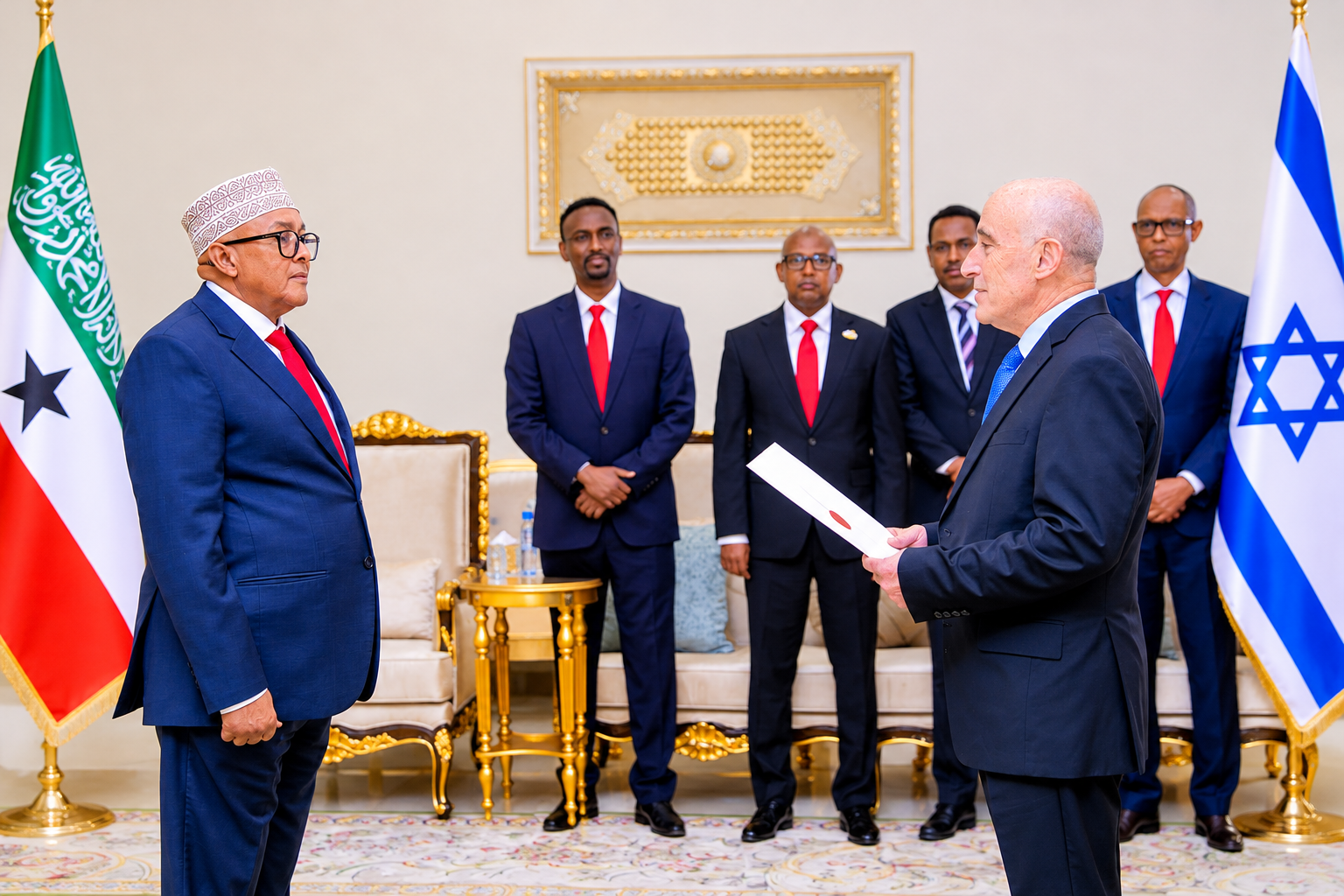
The President of the Republic of Somaliland receives the Israeli Ambassador during an official diplomatic ceremony in Hargeisa. Image source: AI-generated illustration created with ChatGPT (OpenAI), 1 November 2026.
The appointment of Israel’s ambassador to Somaliland and the establishment of permanent diplomatic missions in Hargeisa and Jerusalem mark a new phase in a relationship whose historical foundations date back to Somaliland’s independence in 1960.
The presentation of diplomatic credentials by Israel’s Ambassador to Somaliland, Michael Lotem, to President Abdirahman Mohamed Abdullahi (Cirro) at the Presidential Palace in Hargeisa marks another important milestone in the evolving relationship between Somaliland and Israel. The ceremony represents more than a routine diplomatic procedure. It reflects the gradual institutionalization of bilateral relations following Israel’s formal recognition of Somaliland on 26 December 2025 and the subsequent commitment by both governments to establish permanent diplomatic representation.
The occasion carries considerable historical significance. Relations between Israel and Somaliland did not originate with the December 2025 recognition announcement. Their historical foundations extend to Somaliland’s brief period of independence in June 1960, when Israel was among the countries reported to have recognized the newly independent state. More than six decades later, the relationship has entered a new phase, moving from historical diplomatic recognition and intermittent contacts towards formal representation, political engagement and the development of a bilateral framework. This historical connection was also acknowledged during the presentation of Somaliland’s first ambassador to Israel to President Isaac Herzog.
Understanding the significance of the current diplomatic developments requires examining the historical relationship, the circumstances surrounding Somaliland’s restoration of independence in 1991, the evolution of diplomatic contacts over subsequent decades and the changing geopolitical environment of the Horn of Africa and the Red Sea.
Historical Foundations: The 1960 Independence and Recognition
On 26 June 1960, the former British Somaliland Protectorate achieved independence and became the independent State of Somaliland. Its independence followed the termination of British colonial administration and was recognized by a number of countries, including Israel. During its five days of independence, before entering into union with the former Italian-administered territory on 1 July 1960, Somaliland established the foundations of its own statehood and international diplomatic identity. The historical sequence of independence and union is documented in the United States Department of State’s Foreign Relations of the United States, 1958–1960.
The subsequent union with the south created the Somali Republic, driven by the political aspiration of uniting the Somali territories. However, the constitutional and legal arrangements governing the union later became a subject of considerable controversy. Questions surrounding the harmonisation and ratification of the respective Acts of Union would eventually become central to Somaliland’s legal and political arguments concerning its restored sovereignty.
The collapse of the Somali Republic in 1991 fundamentally altered the political landscape. On 18 May 1991, following the collapse of the central government and the devastation of the civil war, Somaliland restored its independence within the territorial boundaries of the former British Somaliland Protectorate. The decision, adopted at the Burao National Conference, initiated a separate process of political reconstruction, institution-building and international engagement.
For Somaliland, the restoration of independence represented the recovery of the sovereignty it had exercised in June 1960. This historical and legal position has remained central to its diplomatic argument that its claim is based on the restoration of an internationally recognized independent state rather than the creation of a new political entity through territorial separation.
Diplomatic Contacts After 1991
Although formal diplomatic relations between Israel and Somaliland were not immediately re-established following 1991, contacts and expressions of interest in bilateral engagement continued over the following decades.
During the presidency of Mohamed Haji Ibrahim Egal, Somaliland explored opportunities to expand its international diplomatic relationships, including possible engagement with Israel. Historical accounts refer to a reported diplomatic overture to Israeli Prime Minister Yitzhak Rabin in 1995. Subsequent political developments also reflected Somaliland’s willingness to consider relations with Israel as part of its broader international diplomatic strategy. These developments are discussed in The Evolution of Israel–Somaliland Diplomatic Contacts.
During the administration of President Dahir Riyale Kahin, the possibility of establishing relations with Israel remained within Somaliland’s diplomatic discourse. In 2005, Riyale publicly indicated Somaliland’s openness to pursuing such relations. In 2010, an Israeli Foreign Ministry spokesperson was also reported to have expressed Israel’s openness to renewed recognition, referring to the historical precedent of 1960. These earlier contacts are discussed in the same historical account of Israel–Somaliland diplomatic engagement.
These contacts did not immediately produce formal diplomatic relations. Nevertheless, they demonstrated the continuing relevance of the historical relationship and the willingness of both sides, at different moments, to consider closer engagement.
The regional environment subsequently underwent significant transformation. The Abraham Accords, signed in 2020, changed the diplomatic landscape by facilitating normalization between Israel and several Arab countries. Although Somaliland was not a party to these agreements, the wider process created additional diplomatic space for engagement between Israel and Muslim-majority societies and reinforced the importance of economic and strategic partnerships beyond traditional political alignments.
For Somaliland, the changing environment offered opportunities to pursue relationships based on mutual interests, economic cooperation and its geographical significance. For Israel, engagement with Somaliland presented the prospect of developing relations with a strategically positioned partner overlooking the Gulf of Aden and the approaches to the Red Sea.
26 December 2025: The Restoration of Formal Diplomatic Relations
The decisive turning point came on 26 December 2025, when Israel formally recognized the Republic of Somaliland as an independent and sovereign state. The declaration, announced by Israeli Prime Minister Benjamin Netanyahu and Foreign Minister Gideon Sa’ar alongside President Abdirahman Mohamed Abdullahi, established a new foundation for bilateral relations. The announcement and its international implications were reported by Reuters.
Israel thereby became the first United Nations member state to formally recognise Somaliland’s restored independence since 1991. The recognition was accompanied by an understanding to establish full diplomatic relations, exchange ambassadors and open diplomatic missions. Both sides also expressed interest in developing cooperation in economic development, agriculture, technology and other areas of mutual interest.
In international relations, diplomatic recognition creates opportunities for formal engagement, but its practical value depends on the institutions, agreements and sustained cooperation established afterwards. The subsequent developments in 2026 have therefore been particularly important in demonstrating how the initial declaration is being translated into an operational bilateral relationship.
From Recognition to Diplomatic Institutionalization in 2026
The first major development following recognition was the historic visit of Israeli Foreign Minister Gideon Sa’ar to Somaliland in January 2026. The visit represented a significant advancement in high-level political engagement and provided an opportunity to discuss the future direction of bilateral relations.
It also demonstrated the importance both governments attached to moving beyond the initial recognition announcement towards practical diplomatic cooperation. Areas of potential engagement included agriculture, water management, technology, economic development and regional security.
The diplomatic relationship subsequently developed through the appointment of Somaliland’s first ambassador to Israel, Dr. Mohamed Hagi. On 18 May 2026, Israeli President Isaac Herzog received his credentials at the President’s Residence in Jerusalem, formally establishing Somaliland’s diplomatic representation at the highest level in Israel. The ceremony was also confirmed by the Israeli President’s Office.
The development was followed by President Abdirahman Mohamed Abdullahi’s official visit to Israel in June 2026. During the visit, Somaliland opened its embassy in Jerusalem, establishing a permanent diplomatic presence in Israel. The opening ceremony was attended by the Somaliland President and Israeli Foreign Minister Gideon Sa’ar, as reported by The Times of Israel.
The establishment of the mission represented an important institutional commitment, providing a permanent platform for diplomatic communication, political coordination and the promotion of Somaliland’s interests in Israel.
The latest development, the presentation of Ambassador Michael Lotem’s credentials in Hargeisa, completes another important stage in the exchange of diplomatic representation. It demonstrates that the relationship is increasingly being conducted through established diplomatic institutions rather than relying exclusively on high-level visits and political declarations.
Michael Lotem’s Appointment and Israel’s Diplomatic Presence in Hargeisa
Michael Lotem’s appointment as Israel’s ambassador to Somaliland brings additional diplomatic experience to the relationship. Lotem has previously served as Israel’s ambassador to Kenya, Azerbaijan and Kazakhstan and has experience in economic diplomacy across Africa. His appointment was reported by The Times of Israel.
His presentation of credentials to President Abdirahman Mohamed Abdullahi at the Presidential Palace in Hargeisa formally marks his assumption of diplomatic responsibilities in Somaliland.
Following the ceremony, a cornerstone-laying event was held for Israel’s new embassy in Hargeisa. The planned diplomatic mission represents a further step towards establishing a permanent Israeli institutional presence in Somaliland.
The significance of the embassy extends beyond its administrative function. Permanent diplomatic missions provide mechanisms for regular government-to-government communication, the coordination of bilateral initiatives, consular engagement and the development of economic and cultural relationships. They also create opportunities for sustained dialogue on regional and international issues.
Commenting on the appointment, Israeli Foreign Minister Gideon Sa’ar reaffirmed his government’s commitment to the relationship, stating:
“Israel is determined to develop and strengthen its relations with Somaliland.
“The appointment of ambassadors, in accordance with the agreement reached when our countries established mutual recognition, is another important step in deepening the ties between us.”
The statement reflects the Israeli government’s intention to consolidate the relationship through permanent diplomatic representation and continued institutional engagement.
The Strategic Geography of Somaliland and Israel’s Regional Interests
The emerging relationship also needs to be understood within the wider geopolitical transformation of the Horn of Africa and the Red Sea. Somaliland occupies a strategically important position along the Gulf of Aden, close to the Bab-el-Mandeb Strait, through which international maritime traffic moves between the Indian Ocean, the Red Sea and the Suez Canal.
The security of this maritime corridor has become increasingly important amid regional conflicts, attacks on commercial shipping and competition among international and regional powers. The Red Sea is not simply a commercial passage; it is also a strategic environment connecting the Middle East, East Africa, Europe and Asia.
For Israel, maritime security in the Red Sea has direct implications for international trade, national security and regional connectivity. The development of relations with Somaliland therefore offers an opportunity to establish closer diplomatic engagement in a region of considerable strategic importance. This dimension was highlighted by President Isaac Herzog during his meeting with President Abdirahman Mohamed Abdullahi in June 2026, when he identified maritime freedom, regional stability and security in the Horn of Africa as shared concerns.
For Somaliland, the relationship provides an additional channel through which to pursue international partnerships, expand economic cooperation and strengthen its diplomatic presence. The Port of Berbera, its associated infrastructure and its geographical position offer potential areas for cooperation in maritime logistics, trade, investment and regional connectivity.
Nevertheless, the strategic importance of geography should not be confused with the automatic existence of military or security agreements. The extent of future cooperation will depend on the specific arrangements negotiated by the two governments, their implementation and the broader regional political environment.
The relationship also has implications for the wider Horn of Africa. Ethiopia’s interest in securing diversified access to maritime trade routes, the role of the United Arab Emirates in regional infrastructure and port development, and the continuing strategic interests of international actors in the Gulf of Aden all contribute to the significance of Somaliland’s diplomatic engagement with Israel.
This creates opportunities for cooperation, but also places the bilateral relationship within a complex regional environment involving competing political interests and diplomatic sensitivities.
Beyond Recognition: The Future of Bilateral Cooperation
The exchange of ambassadors and the establishment of diplomatic missions provide an institutional foundation, but the long-term significance of the relationship will ultimately be determined by the substance of cooperation.
Several areas offer potential for practical engagement. Agricultural technology and irrigation could contribute to improving agricultural productivity and addressing water-related challenges. Cooperation in healthcare, innovation, education and technological development could create opportunities for institutional partnerships and professional exchanges. Economic relations could also expand through trade, investment and private-sector engagement. These areas were among those discussed during the Somaliland President’s official meetings with Israeli economic and government officials in June 2026.
Maritime connectivity and regional security represent another important dimension. Given Somaliland’s geographical position and the strategic importance of Berbera, discussions concerning maritime safety, port development and regional economic integration could become significant components of the bilateral agenda.
However, the development of these opportunities will require clear agreements, sustainable investment, institutional capacity and careful diplomatic coordination. The relationship’s long-term success will depend not simply on the number of diplomatic ceremonies or official visits, but on measurable cooperation and tangible outcomes.
The Strategic Implications of a New Diplomatic Partnership
The appointment of Michael Lotem and the establishment of Israel’s diplomatic mission in Hargeisa represent the transition of Israel–Somaliland relations into a more structured institutional phase. The immediate significance lies in the creation of permanent channels for political dialogue, diplomatic coordination and bilateral engagement.
For Somaliland, the relationship provides an additional avenue for expanding its international diplomatic presence and developing partnerships in areas that support its economic and institutional priorities. Its challenge will be to ensure that the relationship contributes to a broader and diversified foreign policy rather than becoming concentrated in a single diplomatic direction.
For Israel, the partnership offers an opportunity to strengthen its engagement with the Horn of Africa and develop relations with a partner situated along an important international maritime corridor. Its future development will nevertheless depend on the regional political environment and the practical agreements reached between the two governments.
Ultimately, the value of this diplomatic relationship will be measured by its ability to produce tangible outcomes in trade, investment, technology, development and regional cooperation. The presentation of credentials at the Presidential Palace in Hargeisa and the cornerstone-laying ceremony for Israel’s embassy are important institutional developments, but they also mark the beginning of a new phase in which diplomatic commitments must be translated into sustained bilateral results.
Related Topics
Related Posts