
Hidden Chapter of UNESCO Site: Pannonhalma Abbey
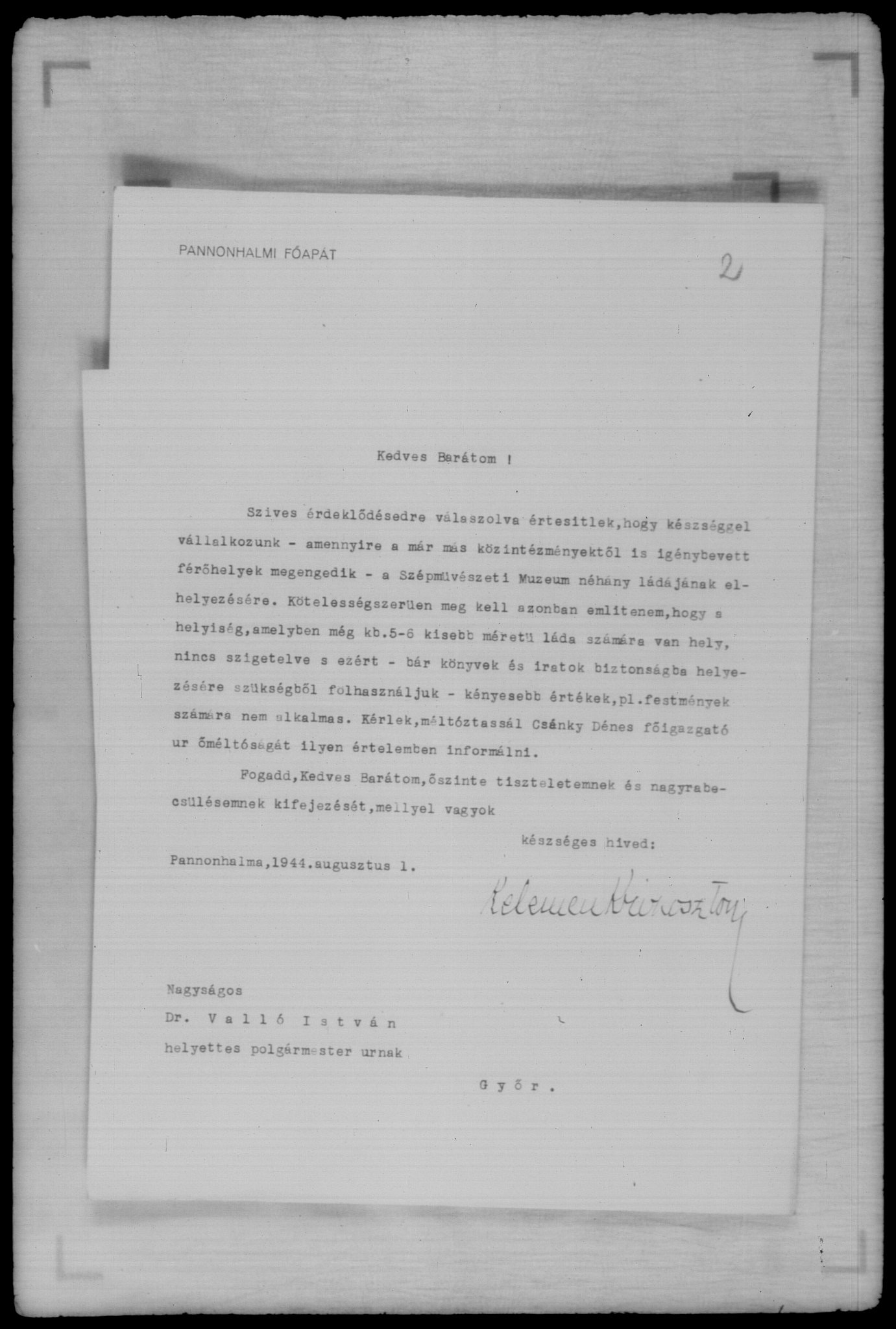
In the summer of 1944, as Hungary deported hundreds of thousands of Jews to Auschwitz, a quieter chapter of the Holocaust unfolded atop a forested hill in western Hungary. There, at Pannonhalma Archabbey—a Benedictine monastery now celebrated as a UNESCO World Heritage Site—new evidence reveals discussions and conditional agreements regarding limited wartime storage of selected museum artworks.
Documents from Hungarian wartime archives, preserved on microfilm and reviewed by our research team at the Holocaust Art Recovery Initiative, confirm that Pannonhalma was considered a potential storage site for valuables seized from Hungary’s Jewish population. In correspondence dated August 1, 1944, Abbot Kelemen Krizosztom offered limited and conditional storage space for artworks from the Szépművészeti Múzeum, citing a lack of insulation and space limitations as concerns (Hungarian archival microfilm, Reel 144, Slide 769).
Museum administrators communicated with the monastery regarding the logistical and practical limitations of transferring artworks. The available records document cautious dialogue rather than outright acceptance of bulk shipments. The items discussed included selected artworks and cultural valuables potentially vulnerable to wartime destruction in urban areas (Hungarian archival microfilm, Reel 144, Slide 761-780).
While the records do not indicate explicit Church objections to storing Jewish cultural property, the monastery’s conditional responses highlighted practical limitations rather than moral or political concerns. Correspondence from Abbot Krizosztom emphasizes limitations such as insulation, storage security, and environmental conditions, reflecting careful administrative negotiations during a volatile wartime period (Hungarian archival microfilm, Reel 144, Slide 769).
Today, Pannonhalma Archabbey is known for its Evangelistarium, Baroque refectory frescoes, medieval manuscripts, and ancient cloisters. Yet, the historical record now raises important questions about this overlooked chapter: What exactly was agreed upon? What was ultimately stored, if anything? Where did these items go afterward? Has any acknowledgment or disclosure ever been provided?
These are not abstract questions. In reviewing the microfilm records housed at the Zekelman Holocaust Center and digitized by the U.S. Holocaust Memorial Museum and the Claims Conference, we found explicit documentation of wartime discussions and conditions communicated by Pannonhalma Abbey concerning the temporary housing of cultural assets.
The role of the Church, government officials, and museum administrators during the Holocaust remains a subject of moral and legal significance. International law and basic historical justice demand clarity. At minimum, UNESCO and Hungarian authorities must publicly acknowledge and fully disclose archival records of these wartime discussions and arrangements.
As the world increasingly confronts Holocaust-era looting and restitution issues, it is time for complete transparency—not just quiet reverence for ancient stones and sacred spaces, but accountability for the human lives connected to these cultural treasures.
Jonathan H. Schwartz is an attorney based in Detroit, co-founder of the Jewish Bar Association of Michigan, and a council member of the Arts Section of the State Bar of Michigan. He leads the Holocaust Art Recovery Initiative and is co-author, with Clara Garbon-Radnoti, of recent findings on Holocaust-era looted art in Hungary based on digitized archives housed at the Zekelman Holocaust Center.
Endnotes:
- Hungarian archival microfilm, Reel 144, Slide 769. Letter from Abbot Kelemen Krizosztom of Pannonhalma Abbey explicitly offering limited and conditional storage for selected artworks from Szépművészeti Múzeum, noting concerns about inadequate insulation and unsuitable storage conditions for sensitive objects (paintings), dated August 1, 1944.
- Hungarian archival microfilm, Reel 144, Slide 761-780. Official correspondence involving museum administrators and local government authorities discussing conditions and limitations communicated by Abbot Krizosztom regarding potential wartime storage at Pannonhalma Abbey.
- UNESCO, World Heritage List Nomination File for Pannonhalma Abbey, 1996. Accessible version omits references to wartime storage discussions.
- Holocaust Art Recovery Initiative, Evidence Research Notes (July 2025), citing Hungarian archival microfilm Reel 144, detailing wartime involvement and conditional agreements concerning storage of art from Szépművészeti Múzeum.
- Zekelman Holocaust Center Digital Archive, Hungarian archival microfilm collection, digitized in collaboration with USHMM and Claims Conference. Available online at: https://hfilms.holocaustcenter.org.