Former Jewish Prison Chaplain / Co-Founder: L’chaim
Historical and Modern Voices of Reason Against Israel’s Death Penalty Bill: Pt.2
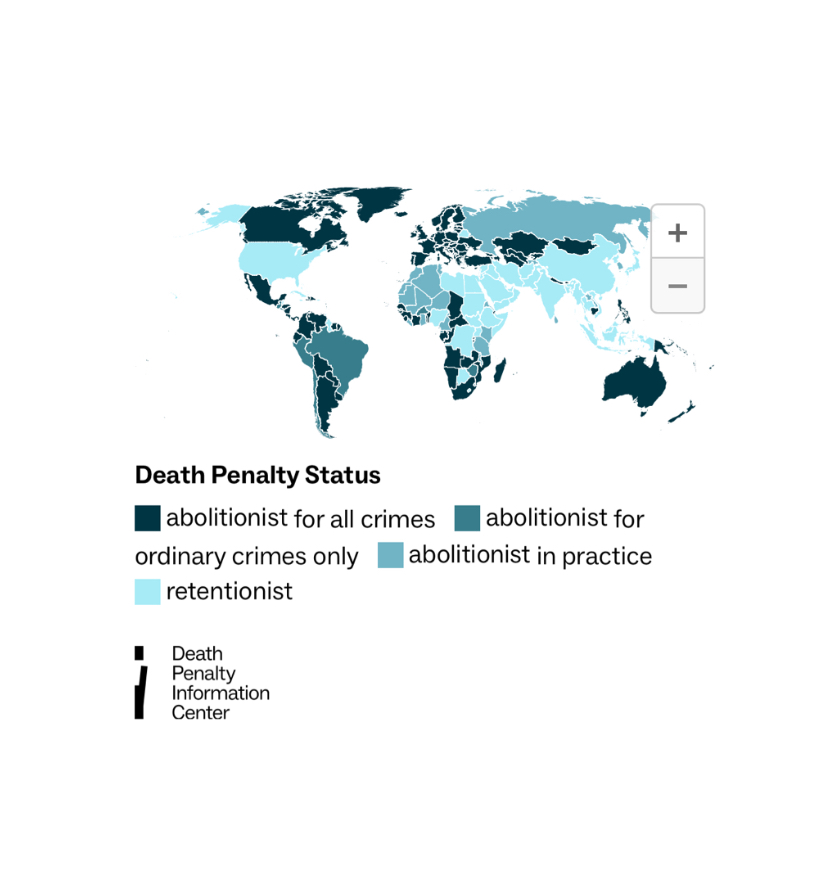
Source: Graphic from the Penalty Information Center - https://deathpenaltyinfo.org/policy-issues/policy/international/abolitionist-and-retentionist-countries
(Note: This post is Part 2 of the two-part series “Historical and Modern Voices of Reason Against Israel’s Death Penalty Bill.” Please see Part 1 for the first installment.)
Thailand: His Holiness The Dalai Lama
His Holiness the Dalai Lama of Thailand also agrees with this point. “My overriding belief,” he has said, “is that it is always possible for criminals to improve and that by its very finality the death penalty contradicts this.” And on another occasion, he firmly stated: “I wholeheartedly support an appeal to those countries who at present employ the death penalty to employ an unconditional moratorium. We need to explain the importance of the practice of love and compassion for our own survival and to try to minimize those conditions which foster murderous tendencies.”
South Africa: Nelson Mandela and Archbishop Desmond Tutu
In South Africa, Nelson Mandela’s African National Congress applauded his overseeing of the abolition of the death penalty at the start of his administration in 1995, saying, “never, never and never again must citizens of our country be subjected to the barbaric practice of capital punishment.” Mandela himself stated: “The death sentence is a barbaric act . . . It is a reflection of the animal instinct still in human beings.” Archbishop Desmond Tutu of South Africa also emphasized that “the abolition of the death penalty is making us a civilized society. It shows we actually do mean business when we say we have reverence for life.” Tutu also said: “There is no justice in killing in the name of justice.”
Russia: Fyodor Dostoevsky and Leo Tolstoy
In Russia, famed author Fyodor Dostoevsky, who himself was an execution survivor, wrote, “the degree of civilization in a society can be judged by entering its prisons.” Similarly, he realized that “a society should be judged not by how it treats its outstanding citizens but by how it treats its criminals.” In his fictional work The Idiot, Dostoevsky wrote: “Murder by legal sentence is immeasurably more terrible than murder by brigands.” Fellow Russian literary giant Leo Tolstoy was more vivid in his position on the matter, writing:
“During my stay in Paris, the sight of an execution revealed to me the instability of my superstitious belief in progress. When I saw the head part from the body and how they thumped separately into the box, I understood, not with my mind but with my whole being, that no theory of the reasonableness of our present progress could justify this deed; and that though everybody from the creation of the world had held it to be necessary, on whatever theory, I knew it to be unnecessary and bad; and therefore the arbiter of what is good and evil is not what people say and do, nor is it progress, but it is my heart and I.”
Poland: Halina Bortnowska
Staying for the moment in Eastern Europe, let us reflect on the words of Polish author Halina Bortnowska, a professor of philosophy and theology, an anti-Communist fighter, and a human rights activist. “Criminals are human beings, too,” writes Bornowska. “They continue to be human beings. No one has the power to dehumanize someone. We punish people, but they remain our neighbors. Our own dignity and conscience require moderate punishment – it cannot be cruel, it cannot be offensive to humanity – because it is wicked and always happens at the expense of the humanity of those who impose and execute the punishment.”
United Kingdom: Oscar Wilde, George Bernard Shaw, Albert Pierrepoint, Richard Branson, J.R.R. Tolkien
Turning our attention to the British Isles, consider the words of the Irish playwright Oscar Wilde: “One is absolutely sickened,” he wrote, “not by the crimes that the wicked have committed but by the punishments that the good have inflicted.” Or, George Bernard Shaw: “Murder and capital punishment are not opposites that cancel one another, but similars that breed their kind. It is the deed that teaches, not the name we give it.” Better yet, ponder the hard-learned lesson of Albert Pierrepoint, an English hangman who executed between 435 and 600 people in a 25-year career that ended in 1956. As he stated, “Capital punishment in my view achieved nothing except revenge.” Contemporary British icons such as billionaire Richard Branson have continued the charge toward global abolition. “The death penalty, writes Branson, “is broken beyond repair and plainly fails to deliver justice by every reasonable measure. It is marred by cruelty, waste, ineffectiveness, discrimination, and an unacceptable risk of error.”
Fans of British literature also will want to learn that J.R.R. Tolkien – author of The Lord of the Rings trilogy – himself was likely a death penalty abolitionist. Read his thoughts through the voice of Gandalf the Grey as he reprimands Frodo Baggins for believing that Gollum deserved punishment: “‘Deserves death!’ explained Gandalf, ‘I daresay he does. Many that live deserve death. And some that die deserve life. Can you give that to them? Then be not too eager to deal out death in the name of justice, fearing for your own safety. Even the wise cannot see all ends.’”
France: Jean-Jacques Rousseau, Voltaire, Baron de Montesquieu, Albert Camus, Robert Badinter, Christiane Taubira,
Moving across the Channel to France, let us recall the prophetic words of some of the Age of Enlightenment’s leading figures. Eighteenth-century philosopher Jean-Jacques Rousseau argued, “No man should be put to death, even as an example, if he can be left to live without danger to society.” Note as well the abolitionist writings of Voltaire (François-Marie Arouet) – Rousseau’s contemporary, who wrote sarcastically: “It is forbidden to kill; therefore all murderers are punished unless they kill in large numbers and to the sound of trumpets.” Voltaire also wrote: “Let the punishments of criminals be useful. A hanged man is good for nothing; a man condemned to public works still serves the country, and is a living lesson.” And again, consider French philosophe Baron de Montesquieu’s well-known quip: “This punishment of death is the remedy, as it were, of a sick society.”
Post-Enlightenment France did not stop shedding light on this man-made darkness. Two centuries after Rousseau, Voltaire, and Montesquieu, author and philosopher Albert Camus of France had the following epiphany:
“But what then is capital punishment but the most premeditated of murders, to which no criminal’s deed, however calculated it may be, can be compared? For there to be equivalence, the death penalty would have to punish a criminal who had warned his victim of the date at which he would inflict a horrible death on him and who, from that moment onward, had confined him at his mercy for months. Such a monster is not encountered in private life.”
One eminent French – and Jewish – figure who rightfully received global attention upon his passing in 2024 was the former French Minister of Justice, Robert Badinter, of blessed memory. The Holocaust experience of Badinter’s family was punctuated by the unfathomable murder of his father, Simon Badinter, in the Sobibor concentration camp in 1943. Emboldened by this killing and the lessons of the unparalleled conflagration of the Shoah, Badinter went on in his illustrious legal and political career to successfully advocate for the ultimate abolition of the death penalty in France in 1981. A tribute celebrating his accomplishments poignantly described that when Badinter was confronted with Klaus Barbie, the Nazi who had arrested and sent his father to his death, he proudly “stood by his opposition to the death penalty and did not wish nor seek to have his father’s killer executed. He thereby demonstrated a rare willingness to place principle over the powerful personal desire to avenge the brutal death of a beloved parent. This abolitionist tradition continues in France today, where former French Minister of Justice Christiane Taubira notably concluded: “Capital punishment is a denial of human dignity.”
Italy: Cesare Bonesana di Beccaria
As our gaze shifts to Italy, we learn of Cesare Bonesana di Beccaria, Marquis of Gualdrasco and Villareggio, an 18th-century criminologist, jurist, philosopher, economist, and politician widely considered one of the greatest thinkers of the Enlightenment. “The punishment of death,” wrote Beccaria, “is the war of a nation against a citizen whose destruction it judges to be necessary or useful.”
The Vatican: All 21st-century Popes
From Italy, we can turn to the Vatican, where all twenty-first-century popes have preached in favor of abolishing the death penalty. Pope John Paul II (1978-2005) significantly moved the Church’s position by urging global abolition, calling executions “cruel and unnecessary.” Pope Benedict XVI (2005-2013) continued this trend, advocating for abolition and emphasizing mercy. The previous head of the Catholic Church, Pope Francis (2013-2025), made the definitive shift, revising the Catechism (2018) to declare the death penalty “inadmissible” in all circumstances, attacking the “inviolability and dignity of the person,” and working for its global abolition. Finally, the current pontiff, Pope Leo XIV, reiterated his own longstanding abolitionist stance once he was elected to the papacy, stating that support for the death penalty is “not really pro-life.” As a result of these papal directives, organizations such as the Catholic Mobilizing Network and the Community of Sant’Egidio devote significant resources to advocating for global abolition.
United States: Cultural, Moral, Religious, Intellectual, and Political Figures and Organizations
Rounding out our abridged list, let us return to the United States for other quotes from renowned abolitionists from across the political spectrum. Take Mr. Fred Rogers, a card-carrying Republican, who was known to have said that the death penalty “just sends a horribly wrong message to children” and asked, “What are our children learning from us when we model that this is an appropriate way of responding to societal problems?” Take, as well, President Jimmy Carter, an avowed Democrat, who wrote in an op-ed, “[T]here has never been any evidence that the death penalty reduces capital crimes or that crimes increased when executions stopped. Tragic mistakes are prevalent.” Carter later added: “Perhaps the strongest argument against the death penalty is extreme bias against the poor, minorities, or those with diminished mental capacity. Although homicide victims are six times more likely to be black rather than white, 77 percent of death penalty cases involve white victims. Also, it is hard to imagine a rich white person going to the death chamber after being defended by expensive lawyers. This demonstrates a higher value placed on the lives of white Americans.”
Also on the political Left was former US Attorney General Ramsey Clark, who is on record saying: “A humane and generous concern for every individual, his health and his fulfilment, will do more to soothe the savage heart than the fear of state-inflicted death, which chiefly serves to remind us how close we remain to the jungle.” Politicians such as Bernie Sanders, Cori Bush, Ayanna Pressley, and Jamie Raskin – among many others – all have made similar statements in support of abolition. Many lawmakers now indeed echo US Supreme Court Justice Harry A. Blackmun’s famous promise that “From this day forward, I shall no longer tinker with the machinery of death.”
It should come as no surprise that many renowned Catholic Americans like Sister Helen Prejean have spoken out vociferously against the death penalty, even appearing jointly with L’chaim members. “If we believe that murder is wrong,” Sister Helen has written, “and not admissible in our society, then it has to be wrong for everyone, not just individuals but governments as well.” Her famed book Dead Man Walking and its graphic novel, film, stage, and opera adaptations have gone on to inspire the likes of pop icons Tim Robbins and Susan Sarandon to become anti-death penalty activists. Other Protestant religious leaders and organizations, such as the Rev. Dr. Jeff Hood, Shane Claiborne, and the evangelical group Equal Justice USA, continue to gain a growing following across the United States.
Numerous social influencers and celebrities are opposed to the death penalty across the USA. American celebrities such as Joan Baez, Steve Earle, and Kim Kardashian have joined the abolitionist ranks. Sports icons such as the late Dean Smith, former Nebraska football coach Tom Osborne, and former LSU Basketball coach Dale Brown have also joined the cause.
Among American abolitionist intellectuals, Noam Chomsky is a notable figure on the Left. “The death penalty can be tolerated,” wrote Chomsky, “only by extreme statist reactionaries who demand a state that is so powerful that it has the right to kill.” Conservative intellectuals who lend their voices to abolition include George Will, Col. Oliver North, Richard Vigurie, Drew Johnson, and Jay Sekulow. Others can be found on the website of Conservatives Concerned About the Death Penalty.
Grassroots NGOs dedicated to the abolition of the death penalty in the United States, such as Death Penalty Action and Death Penalty Focus, among others, alongside multiple state-specific groups, employ all these voices in seeking to end American executions.
American Medical Professionals
Countless medical professionals are forbidden from participating in executions on ethical grounds, including the members of the American Medical Association and the American Nursing Association. One of these is Dr. Deepak Chopra, who wrote: “Under what possible moral scheme can a civilized country consider this anything but barbaric? Our prisons are called penitentiaries (from the root word ‘penance’) because, over two hundred years ago, it was felt that an enlightened society must move beyond Old Testament revenge for wrongdoing. Now we have slipped back across that moral boundary, and the saddest thing, in this boom time for building more prisons, locking away more non-violent criminals, and handing down maximum sentences, is that we have learned to condone cruelty almost as if it didn’t exist. As if it was a good thing.”
Of particular note is the view of Dr. Joel Zivot, a practicing anesthesiologist and intensive care physician and a senior fellow in ethics at Emory University in Atlanta, Georgia. Zivot, who also holds a legal master’s degree, is a recognized expert who advocates against the use of lethal injection in the death penalty and against the use of the tools of medicine as an arm of state power. In a poignant essay for the Jurist entitled “Israel’s death penalty bill will bring darkness, not deterrence,” Zivot argued that “Israel’s proposed death penalty legislation for convicted terrorists is legally unenforceable under existing Israeli law, medically untenable without physician cooperation, and morally corrosive to the democratic values Israel seeks to uphold.”
American Founding Fathers: Thomas Jefferson, Benjamin Rush, James Madison, Benjamin Franklin
Those who rationalize their pro-death position by arguing that Israel should have the death penalty option simply because of the example of the United States should consider the many Founding Fathers who opposed capital punishment. Thomas Jefferson wrote, “Beccaria and other writers on crimes and punishments had satisfied the reasonable world of the unrightfulness and inefficacy of the punishment of crimes by death.” As Paul Jacob has shared, “I agree with Thomas Jefferson, who once wrote that he would support the death penalty only when the infallibility of human judgement had been demonstrated.”
Dr. Benjamin Rush, in his 1792 piece “Punishing Murder by Death,” unequivocally wrote that “The punishment of murder by death is contrary to reason, and to the order and happiness of society…It lessens the horror of taking away human life, and thereby tends to multiply murders.” James Madison, the father of the Constitution, was one of several founding fathers who sought to reduce the number of executions, saying, “I should not regret a fair and full trial of the entire abolition of capital punishments by any State willing to make it.” Finally, for Benjamin Franklin, abolition was also very clearly the path forward. “The punishment of murder by death,” he wrote, “is contrary to reason, and to the order and happiness of society, and contrary to divine revelation. As historian John Bessler has concluded, “the Founding Fathers were deeply ambivalent about capital punishment…[T]hey embraced the principle of Montesquieu and Beccaria that any punishment that goes beyond what is ‘absolutely necessary’ is ‘tyrannical.’ In an era of maximum-security prisons and life-without-parole sentences, the death penalty can no longer be considered necessary.”
The Death Penalty Morally Condemns any Executing Nation
Many of the American Founding Fathers, like many of the luminaries who have led America and the world in thought and progress in each generation since the Enlightenment, doubtless would support the idea of Israel and the United States joining the more than seventy percent of countries worldwide that have now abolished the death penalty. They stand with us in our sacred mission to bring this to fruition, just as we stand in their shadow and on their shoulders in solidarity. Those who are with us are with them; those who stand against us oppose them. They align themselves with executing nations, the likes of Iran, which put to death over 2,200 human beings in 2025, Saudi Arabia, which hit a record 356 in the same year, as well as the executing regimes of Hamas and Yemen, among others.
History has demonstrated and will continue to reveal that the death penalty not only condemns individuals to death, but it also morally condemns any civilization that enacts it. May Israel not follow this ill-fated path.
Cantor Michael Zoosman, MSM, Board Certified Chaplain, Neshama: Association of Jewish Chaplains
Co-Founder: “L’chaim: Jews Against the Death Penalty”
Advisory Board Member: Death Penalty Action
Related Topics
Related Posts