Hormuz: Trump’s Achilles’ heel
Contrary to popular belief, chess was not invented in Persia but in India. Yet the modern game we know today – with its rules and strategic depth – was refined and popularized in Persia after arriving from India in the 7th century. In Hebrew, chess is called shahmat, derived from the Persian shah mat – “the king is helpless” or “the king is defeated”. From this comes the English “checkmate”.
The Iranian people have long been masters of strategy and commerce. As a central hub on the Silk Road, Persia linked China to the Mediterranean, with key routes passing through Merv, Mashhad, Teheran, and Hamadan to Bagdad. Persian rugs were prized as far back as the 5th century BCE, mentioned by the Greek author Xenophon as objects of great value. Iranians have honed the art of negotiation and haggling for millennia. They excel at it – often securing exactly what they want.
This brings us to the present. As of May 24, 2026, it appears a deal is nearing completion between President Donald Trump and the Islamic Republic of Iran: the US would ease military pressure and sanctions in exchange for Iran reopening the Strait of Hormuz and surrendering its stockpile of over 440kg of 60% enriched uranium.
Ignore, if you can, the thousands of anti-regime Iranians slaughtered in the streets in January by the very regime Trump seeks to bargain with. The real question remains: Does Iran truly intends to part with its most valuable asset? And if it has no choice, why does it seems to be dictating the terms?
The answer lies in the Strait of Hormuz.
Many claim Trump is playing “4D chess”, always several moves ahead. Yet we should remember: Iranians have been playing – and perfecting – this game for centuries.
Evidence that Iran is shaping the deal appears in Lebanon. Following the US-Iran temporary ceasefire agreed in early April (still holding), Tehran insisted on linking it to restrictions on Israeli operations, particularly in Beirut. While Trump has permitted limited Israeli responses to attacks south of the Litani River, Israel’s hands are largely tied. Hezbollah exploits this daily with advanced drones guided via fiber-optic cables – difficult to detect and counter. Israeli casualties mount, yet escalation is restrained under American pressure.
This episode reveals Iran’s strategy: by leveraging global antisemitism and tendency to scapegoat Israel, Teheran has convinced the world that the Lebanese front is the main obstacle to the Gulf stability. Trump, desperate for a deal and to reopen Hormuz, has pressured Israel to show restraint – effectively shielding Iran’s key proxy in its campaign against the Jewish state.
The lesson for Iran is clear: control of the Strait of Hormuz is nearly as powerful as nuclear weapons.
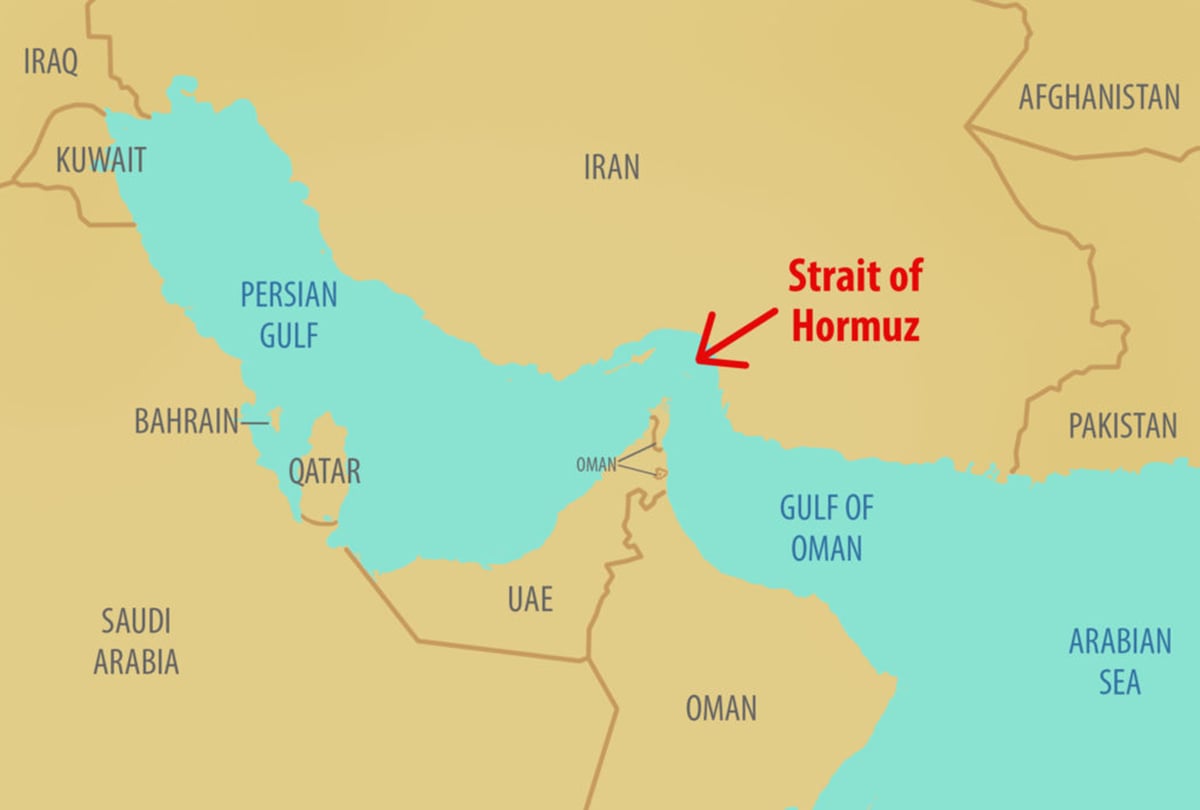
The Strait of Hormuz is a narrow chokepoint between Iran and the Arabian Peninsula. It serves as the only maritime outlet for much of the Gulf’s oil and gas exports – carrying roughly 25% of the world’s oil and 20% of its liquefied natural gas. While the US, is less dependant on these supplies, Europe and Asia are not. Disruptions send global energy prices soaring. With midterm elections approaching, Trump – a businessman at heart – understands this vulnerability. Iran has seized upon it, holding the strait like a sword of Damocles over the negotiations.
The second issue is the 440kg of 60% enriched uranium. There is no credible civilian justification for this material. Civilian nuclear needs rarely exceed 3.5-5% enrichment and never require 60%. The sole purpose of enriching to this level is to enable rapid further enrichment to the 90% weapons-grade threshold. This stockpile alone could yield roughly a dozen nuclear bombs.
Iran’s actions speak louder than any supposed fatwa against nuclear weapons. As with all regimes, judge intentions by deeds, not words. Unlike the flawed intelligence preceding the Iraq war, here the evidence is undeniable and publicly acknowledged by Iran itself.
For Israel, a nuclear Iran is existential. The regime has spent nearly 50 years vowing to wipe us off the map. We already see how Hormuz leverage forces concessions in Lebanon. A nuclear Teheran would paralyze responses to future attacks, with the world likely urging restraint as Israelis count our dead. Backed into a corner, Israel would have no choice but to act decisively – with catastrophic consequences for the entire region.
Countries like Saudi Arabia play a dangerous double game: quietly terrified of a nuclear Iran armed with ballistic missiles and drones, yet publicly pressing for a deal. This only convinces Teheran that Hormuz is an asset it must never relinquish.
The Islamic Republic is a religious fanatic regime, not a rational actor driven by economics or human life. Its goals – exporting the Shia revolution and destroying Israel – are ideological imperatives, not negotiable interests. Deals with such regimes buy time, not peace. The phased structure reportedly under discussion (sanctions relief and Hormuz first, uranium later) risks giving Iran exactly the window it needs to cross the nuclear threshold.
Do not think that a deal would quench the thirst of Iran for the control of the Strait of Hormuz now that they’ve seen the value of it. They had no problem attacking neighbors like the UAE or Kuwait. Even bombing countries that are less hostile to it like Oman and Qatar. Iran knows that if it goes nuclear they can in the future use the threat of closing the Strait of Hormuz again and this time, no one would do anything against it. Iran has learned from the North Korea case.
Mr. Trump, you rightly abandoned the JCPOA. Do not replace it with something worse. insist on tangible, verifiable results: immediate and unconditional reopening of Hormuz, full surrender and removal of the enriched uranium, and ironclad enforcement mechanisms. Do not underestimate your counterparts. Negotiation is in their blood.
A short-term drop in fuel prices may feel like victory, but the long-term cost could be measured in millions of lives and a nuclear Middle East. There are many good, freedom-loving Iranians who deserve better than this regime. Let us not betray them – or ourselves – for temporary relief at the pump.