
How a war 3,000 km away became a French protest symbol
In Jerusalem, history is easily visible everywhere you look, especially in the stones. Many have said that you cannot dig anywhere in Israel without stumbling upon some artifact or stone from 3000 years ago. Therefore, when looking at Jerusalem’s pavements, walls, churches, mosques, gates, and archaeological layers such as Roman rule, Byzantine Christianity, Islamic conquest, Crusader warfare, Ottoman administration, British imperial control, Jewish return, Arab nationalism, Palestinian identity, war, terrorism, and unresolved land claims, it’s difficult to understand how a French culture 3,000km away, believes it can summarize all of this history through a Palestinian flag.
Jerusalem and Israel, as a whole, have now been weaponized by anti-Israel propaganda, nonetheless, no single slogan carries all of its history.
And since history cannot be summarized to a single slogan, then the images coming from the streets of Paris and all over France are worrisome!
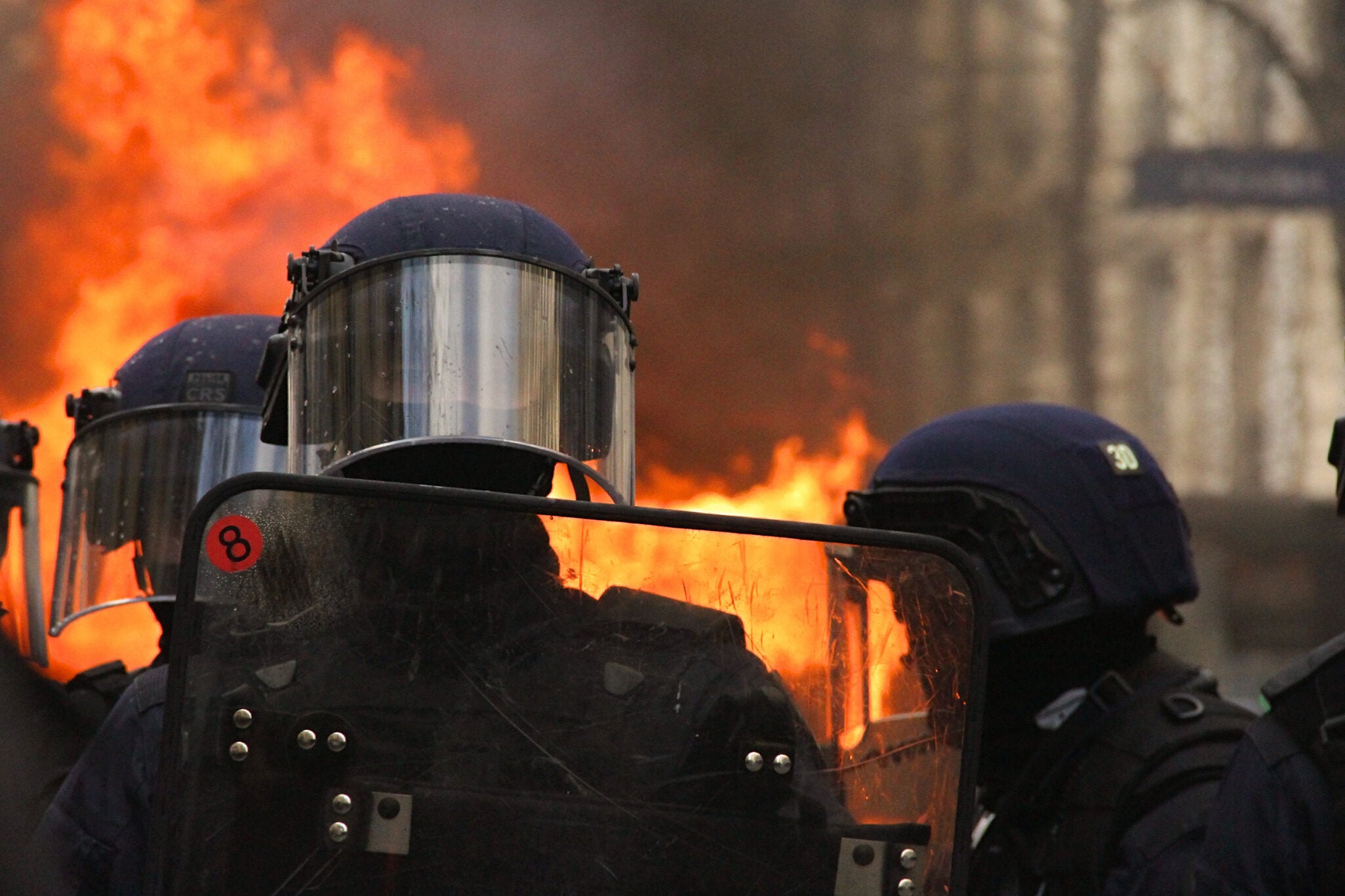
French students, from both high-schools and universities, have taken to the streets over real grievances: deteriorating schools, teacher shortages, overcrowded classrooms, inequality, and the rising cost of living. The protests, which are widely visible on social media, have been large, disruptive, and many times extremely violent. Yet alongside banners about protesting education budgets and social justice, Palestinian flags and keffiyehs have appeared regularly.
Not long after October 7, 2023, the Palestinian flag has quickly become more than a symbol of solidarity and support for the Palestinians. In parts of France’s streets, it has become a type of portable emblem of resistance itself: against the government, against capitalism, against policing, against authority, alongside proud symbols of anarchy. In today’s society, it seems that the Palestinian flag can be attached to almost any grievance.
While this doesn’t explicitly mean that someone who displays it is ignorant or insincere, the unfortunate ease with which a distant Middle Eastern conflict has been absorbed into France’s anger reveals a deeper problem: when history is reduced to a slogan, a flag can become a mantel, and a complex war can become a moral performance.
The bigger question should in reality be: “what does a Palestinian flag have to do with what is happening France right now?”
Initial reports seemed to suggest that the protestors began with concrete and legitimate demands connected to the condition of French schools and the pressures young people are facing in France. As a result, the unrest has spread across the entire country, has drawn in university students, and has produced thousands of arrests, injuries, and episodes of violence.
As history has shown, France has a long tradition of taking political gripes into the street. From the Revolution in 1789 to the protests of 1968, and on to the Yellow Vests movement, French politics have been made in the public squares as much as in the parliament. The current protests are therefore not something new, rather a continuation of what has grown from deep French soil.
Yet, something dangerous and toxic has been added to that soil. The Palestinian flag now prominently appears at all kinds of demonstrations. Any grievance is a good pretext to wave the Palestinian flag beside French union banners and radical-left symbols. In this setting, “Palestine” often functions less as a specific historical and political reality and more like a universal sign of resistance.
This is not entirely new, May 1968 remains the most obvious comparison. That revolt began among students at Nanterre and the Sorbonne, then expanded into a general strike involving millions of workers. It challenged Charles de Gaulle, capitalism, hierarchy, and the authority of the French state as the students of 1968 also looked outside of their country. Vietnam, Algeria, Cuba, and the “Third World” supplied a powerful moral vocabulary for young French radicals of the time. Distant liberation struggles became mirrors in which French students could interpret their own rebellion against authority.
Today, Gaza and Palestine occupy a comparable symbolic position albeit with a difference – the speed and shallowness of the medium. In 1968, radical ideas circulated through newspapers, pamphlets, lectures, and long political debates, while today, a fifteen-second video, a slogan, or a photograph can create the impression of moral clarity without requiring historical knowledge.
The result is a “wiki-style” understanding of the Middle East – Israel is the oppressor, Palestinians are the oppressed, and anyone who waves the right flag has chosen the correct side.
While that narrative is emotionally powerful, it is also historically utterly inadequate.
What the stones say
Anyone willing to look past 15-second videos and the pseudo-moral clarity of online influencers will quickly reach a simple realization – a shallow dive into history is all it takes. The stones of Jerusalem and Israel are an eloquent resistance to such oversimplification.
Israel’s situation is summarized by emotionally charged slogans and videos which encourage people to look at the Israel/Palestine conflict merely as a tale of two peoples and one land, whereas the land and its stones tell a more complicated story.
Nevertheless, none of this erases either side’s suffering, quite the opposite! A serious encounter with the land should deepen compassion for Palestinian civilians, including those in Gaza who have endured war, displacement, and loss without forasmuch allowing the conflict to be reduced to a children’s story portraying one villain and one victim.
The Jewish people’s historical, religious, and cultural connection to the land of Israel did not begin in 1948, the Jewish people did not return to an empty land. The Ottoman Empire, the British Mandate for Palestine, the Arab rejection of the 1947 partition, the numerous wars, the unending terrorism, the Palestinian people’s statehood aspirations, the dreadful Hamas rule in Gaza, and the Palestinian Authority’s failures all belong to the story.
In fact, historical documents from the British Mandate reveal a reality often ignored in order to solidify a modern, singular narrative – at the time, both Jews and Arabs held a “Palestinian” identity. This shared administrative history is plain to see in archived videos, pictures, articles, from David Ben-Gurion’s legal documents to a television interview of Golda Meir displaying her Palestinian passport while denouncing the nascent post 1967 Palestinian Arab identity. Although a flag can express solidarity, however skewed or mistaken, it cannot carry the weight of that history faithfully.
The danger of borrowed causes
This is the worrisome reason, mentioned earlier, that there is a particular irony in seeing Palestinian flags waved during protests initially connected to French schools and overcrowding.
Many of the immediate issues are localized to France – classroom conditions, public investment, social mobility, and trust in the state, yet the most emotionally charged symbol on the street may come from a conflict thousands of kilometers away, which many protesters know little to nothing about beyond viral images and ready-made slogans spread online through propaganda.
This is not unique to France; western activism has often borrowed distant struggles to give its local anger a grander meaning. The Middle East, however, carries a special danger since for Jews in France, it is not merely a distant cause.
When Israel is portrayed as the embodiment of colonial evil rather than as a state with policies that one is allowed to criticize, Jews can quickly become stand-ins for Israel and its politics. A French Jew walking to synagogue, a Jewish student on campus, or a Jewish shopkeeper in Paris should not have to answer for the decisions of the Israeli government whether the government was justified or not in its decision.
That distinction matters, as admittedly, criticism of Israeli policy and government is not antisemitism. Many Israelis themselves criticize their parliament every day. Likewise, Arab citizens of Israel may fiercely oppose Israeli policy without being antisemites. Conversely, when Jews are collectively blamed for Israel’s actions, when Jewish institutions are targeted because of the war in Gaza, or when “Zionist” becomes a slur applied to any Jew who supports Israel or refuses to disavow it, the line has been crossed. Although, one should count himself fortunate if the worse that happens to him is to be the victim of slurs.
The International Holocaust Remembrance Alliance’s working definition recognizes precisely this danger – antisemitism can include targeting Israel as a Jewish collectivity, and holding Jews responsible for actions of the State of Israel.
France has seen the direct consequences of the numerous antisemitic acts committed on its soil. French Jewish communities have faced a sharp rise in incidents since October 7, and the numbers have remained dangerously high with French Interior Ministry reporting 1,320 antisemitic acts recorded in France in 2025, underlining that approximately 67% targeted people rather than property.
A foreign conflict cannot create French antisemitism from thin air, sadly, antisemitism has deep roots in Europe and an oversimplified Israel-Palestine narrative can give old hatred a new, politically fashionable vocabulary.
The current uprisings and protests are rooted in real French sufferings, regrettably, the Palestinian flag gives them a different emotional center. It allows a protest about French schools to feel connected to a wider global struggle against oppression – good vs. evil. It gives participants a ready-made identity – they are not merely students demanding better conditions, but heirs of a worldwide resistance movement. That feeling can be intoxicating, alas intellectually lazy. By making the “Jews” the cause and symbol of oppression, France is swiftly moving toward sentiments similar to those of the 1940’s.
For protestors, it is easier to shout “Free Palestine” rather than to explain or even understand the differences between Hamas and the Palestinian Authority. It is easier to condemn Israel rather than to ask what a secure and dignified future for both Israelis and Palestinians would require, conveniently overlooking the history the stones of Jerusalem and Israel are trying to scream out to anyone willing to take the time to learn and understand. Slogans can unite a crowd but they rarely, if ever, build peace, certainly not lasting peace.
History is not a costume
None of this should serve as an argument to propose that Palestinians should be silent, or that their suffering should be minimized. Any honest account must reckon with the human cost of war, displacement, fear, and grief on both sides. Be that as it may, solidarity that begins with a slogan and ends with a slogan is not solidarity. It is theatrics.
If French students want to stand with Palestinians, they must first and foremost learn history, seek to discover the internal political divisions and the difficult questions of governance, corruption, extremism, and statehood within the Palestinian leaders themselves. Nevertheless, they cannot claim to want to understand history without trying to understand Israel. Therefore, they should learn Jewish history, including the centuries of exile, persecutions, pogroms, genocide, and the return to its ancestral land which shaped Israeli society. If protesters want peace, they should resist narratives that require one people to disappear or be eradicated, as the chant “from the river to the sea” claims.
History is not a costume which is simply worn for a play in a theater. A flag is not an argument, nor is a slogan an education!
From Jerusalem’s stones to Paris’s streets, the contrast is clear, France’s young protesters have real complaints, at the same time, if their anger is to mean something, it must do what serious political movements have always had to do – put down the slogans, review history, and confront the world as it is!