
Russian-American-Israeli Palestinian. Palestine is Israel.
How Israel’s Calendar Protects against Holiday Hijacking
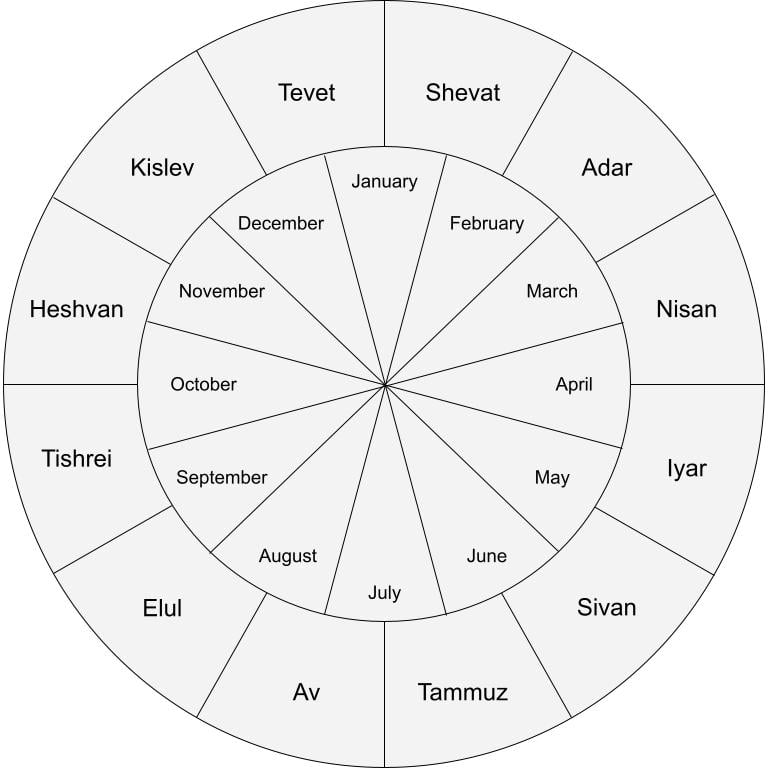
Hebrew (Jewish) calendar with approximate alignments to the Gregorian calendar. Image © Eden Aviv, 2023. Licensed under CC0 (public domain dedication). Source: Wikimedia Commons.
Floating Hebrew Dates, a Surprising and Clever Shield for National Identity
Commemorative days — whether holidays or solemn observances — are more than days off. They serve as powerful markers of identity, memory, and narrative. Around the world, rivals sometimes create counter-commemorations—deliberate observances designed to invert or challenge the meaning of an existing date. This phenomenon can also be referred to as holiday hijacking and shows how even a single day on the calendar can become a battleground for collective memory.
In the United States, for example, Columbus Day, observed on the second Monday in October, celebrates the arrival of Europeans in the Americas. Many communities, however, observe Indigenous Peoples’ Day on the same date, reframing the story to honor Native American history and resilience.
Similarly, Thanksgiving, celebrated on the fourth Thursday of November, is traditionally remembered as a day of national unity, but it is also countered by the National Day of Mourning or Unthanksgiving Day, highlighting the suffering and displacement experienced by Native Americans.
Other countries have similar cases. In Australia, Australia Day on January 26 marks the arrival of the First Fleet, but Indigenous Australians commemorate the same day as Day of Mourning, Invasion Day, or Survival Day, emphasizing colonization and resistance.
In Japan, August 15 is the day of Japan’s surrender at the end of World War II. The Allies commemorate it as Victory over Japan Day, while in Japan it is observed as Shūsen-kinenbi (“Day for Mourning of War Dead”), reflecting contrasting national narratives of defeat and peace.
These examples show how symbolic dates are not neutral—they are contested. Establishing a commemoration on a particular day allows a group to assert its version of history and challenge others.
* * *
Israel faces a similar dynamic, but it has a clever safeguard. The vast majority of Israeli national commemorations are anchored in the Hebrew calendar, not the Gregorian calendar we use in daily life. Observances such as Yom HaZikaron (Memorial Day for fallen soldiers and victims of terror) on 4 Iyar, Yom HaAtzmaut (Independence Day) on 5 Iyar, Yom HaShoah (Holocaust Remembrance Day) on 27 Nisan, Yom Yerushalayim (Jerusalem Day) on 28 Iyar, and Yom HaAliyah (Aliyah Day) on 10 Nisan shift every year relative to the Western calendar.
Naturally, ancient cultural milestones like Tu BiShvat (15 Shevat), the New Year for Trees, which has been celebrated for centuries and is now observed with Zionist tree-planting traditions, are also Hebrew-calendar–based.
Anchoring national commemorations in the Hebrew calendar was a deliberate decision by early Zionist leaders, including David Ben-Gurion and cultural planners of the Jewish Agency. Their goal was to root Israel’s civic memory in Jewish historical continuity, strengthen a shared collective identity, and assert temporal independence from Western norms.
Interestingly, this decision also had a side benefit: it makes it extremely difficult for rivals to hijack Israeli dates. If Israel’s commemorations were fixed to the Gregorian calendar, adversaries could create counter-commemorations on exactly the same day, directly contesting the narrative. Because the Hebrew calendar shifts each year, rivals would either have to adopt the Hebrew system (which they would never do) or approximate the dates.
* * *
This is why the Gregorian date of Yom HaAtzmaut changes each year, while adversaries observe the so-called “Arab Nakba Day” on the fixed Gregorian date of May 15. The date was deliberately chosen as the day after Israel’s Declaration of Independence on May 14, 1948. They would like nothing more than to shackle it permanently to Yom HaAtzmaut—always “the day after”—but because Yom HaAtzmaut follows the Hebrew calendar, the effort leaves them grinding their teeth year after year.
Notably, the real Nakba Day is Jewish Refugee Day, commemorating the Jewish expulsion and flight from Arab lands—effectively ethnic cleansing—and is observed on November 30, the day after the UN Partition Plan vote on November 29, 1947. That vote triggered widespread violence across the Arab world and set in motion the forced displacement of roughly one million Jews from their homes (see November 30 — Nakba Day: The Jewish Expulsion and Flight from Arab Lands).
In fact, Jewish Refugee Day (Yom HaPlitim) on November 30 is the only major Israeli state-recognized national commemoration set on a fixed Gregorian date. All other core Israeli civic and national commemorations are anchored in the Hebrew calendar.
Precisely because it is fixed to a Gregorian date, this commemoration is far more vulnerable to counter-commemoration. Rivals can simply choose the same date and attach their own narratives to it. The date was adopted by the Knesset in 2014, and it is striking that—unlike nearly every other national commemoration—it was not anchored to the Hebrew calendar.
Interestingly, there appears to have been no documented public debate or formal discussion in Israel about why Jewish Refugee Day (Yom HaPlitim) was fixed to the Gregorian calendar rather than the Hebrew calendar. Presumably, the goal was to ensure global visibility, while the risk of counter-commemoration was not fully considered.
* * *
A more coherent solution already exists in Israel’s own commemorative framework: dual remembrance days, one national and one international.
Consider Holocaust remembrance. International Holocaust Remembrance Day, observed on January 27, marks the liberation of Auschwitz by the Red Army in 1945 and is commemorated worldwide. It is distinct from Yom HaShoah (27 Nisan), Israel’s national Holocaust Remembrance Day, anchored in the Hebrew calendar.
Importantly, although International Holocaust Remembrance Day is widely observed by Israeli institutions, it is not an Israeli state commemoration per se — it is an international observance designated by the UN General Assembly in 2005.
By the same logic, the current Yom HaPlitim on November 30 is, in effect, an international commemoration. Unlike International Holocaust Remembrance Day, however, Yom HaPlitim was established by the Knesset.
It would be more accurate to call it International Jewish Refugee Remembrance Day—a role it already increasingly plays, as recognition expands globally, including in the United States. A bipartisan U.S. House resolution, H.Res. 904, for example, formally acknowledges the forced displacement of Jews from Arab lands and Iran.
But for consistency with Israel’s founding vision—and, critically, to guard against counter‑commemoration—the Knesset should establish a National Yom HaPlitim, anchored in the Hebrew calendar. As with other Israeli civic commemorations, this would preserve national memory within Jewish historical time, while allowing the international observance to continue serving its global role.
* * *
So, the next time someone asks why Israel bases most of its civic holidays on the Hebrew calendar, the answer is both practical and strategic. Beyond connecting modern Israel to millennia of Jewish history, it protects the state’s narrative by making it very hard for rivals to directly hijack the dates. What started as a cultural and historical choice became an unexpected yet powerful defense of memory.
Without this, every major Israeli holiday could be mirrored or inverted on the exact same day. The Hebrew calendar creates a subtle but highly effective buffer, ensuring Israel retains temporal control over its own story.
Importantly, this protection is not limited to Jewish citizens. By anchoring civic holidays in the Hebrew calendar, Israel has created a surprisingly clever safeguard that preserves the national memory and identity of all its citizens—Jews and non-Jews alike—against rival attempts to hijack these commemorations.
In a world where even a single date can become a battleground, Israel’s calendar strategy demonstrates how history, identity, and timekeeping can work together to safeguard collective memory. It also serves as a reminder that, for any future national commemorations, anchoring dates in the Hebrew calendar would continue this tradition—strengthening national identity while minimizing the risk of counter-commemoration or holiday hijacking.
—
See Also
Related Topics
Related Posts