Somaliland
How Somaliland’s Greatest Victory of Recognition by Israel Becomes Somalia’s Biggest Problem Ever
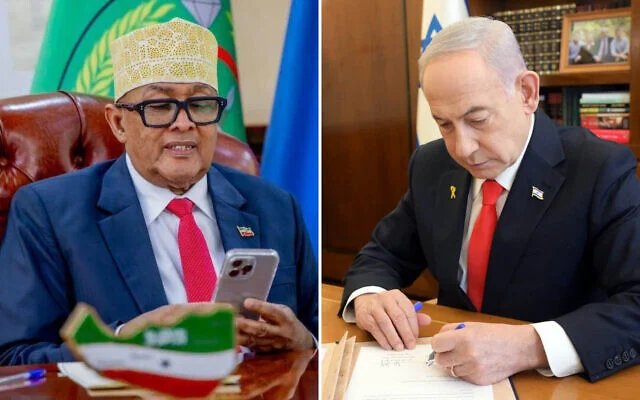
Somaliland's President Abdirahman Mohamed Abdullahi (left) speaks to Prime Minister Benjamin Netanyahu in a photo released on December 26, 2025, by the Israel Government Press Office; Prime Minister Benjamin Netanyahu (right) signs Israel's declaration to recognize the Republic of Somaliland as an independent state, December 26, 2025. (Amos Ben Gershom/GPO)
A History of Violence and Unfinished Hostility
Somalia’s defense minister, seemingly intoxicated by political ambition, requested to Saudi Arabia in January to carry out a military intervention against Somaliland, mirroring operations Somalia once supported in Yemen against the Southern Transitional Council (STC). This was not merely irresponsible rhetoric. It echoed a history that Somaliland’s people know all too well.
In 1988, warplanes taking off from Mogadishu bombed Hargeisa and Burao cities filled with unarmed civilians, the very population the state was obligated to protect. The destruction was immense: tens of thousands killed or displaced, cities reduced to rubble, and trust in the Somali state irreparably shattered. That legacy remains central to why Somaliland rebuilt itself outside Mogadishu’s authority.
Today, Somalia lacks the military capacity to repeat such actions, but the intent appears unchanged. The Defense Minister’s call illustrates the persistence of hostility and the readiness to externalize violence when political leverage is absent. It is a reminder that Somaliland’s caution toward Mogadishu is not ideological, it is historical.
A Failed State’s Obsession with What It Does Not Control
For more than 15 years, hostility toward Somaliland has been embedded in Somalia’s failed state apparatus. Despite having exercised no governance, legal authority, or territorial control over Somaliland since 1991, Mogadishu continues to portray the issue as one of legality and national unity. Much of the international community has passively accepted this narrative, ignoring the empirical realities on the ground.
Since Israel officially recognized Somaliland becoming the first UN member state to do so—this hostility has intensified. The move revived a historical truth often forgotten: in 1960, more than 30 countries, including Israel, recognized Somaliland as an independent state. Rather than engage with this precedent or reflect on Somaliland’s 34-year record of peace and self-governance, Mogadishu has sought to undermine the diplomatic breakthrough.
This reaction exposes two failures. The first is Somalia’s own governance, long distracted from addressing terrorism, corruption, and institutional collapse within its borders. The second is global hypocrisy: legitimate steps taken by Somaliland are ignored or downplayed, while Somalia is treated as if it represents authority and unity despite decades of dysfunction.
Recognition, Visibility, and the Fear of Comparison
This leads to the central question: how did Somaliland’s greatest diplomatic victory recognition by Israel become Somalia’s biggest political problem?
The answer lies not in diplomacy alone, but in visibility. For 34 years, Somalia has been widely recognized as a failed state among the world’s most corrupt, one of the most terrorism-ridden, and a hub for groups such as Al-Shabaab, Al-Qaeda, and ISIS. Piracy, internal conflict, and aid dependency have defined its global image. For decades, instability itself became a political economy, managed, funded, and normalized. This raises a deeper and more uncomfortable question: how does a society remain in such a condition for more than forty years? What went fundamentally wrongand why has it not been corrected?
Yet history offers counterexamples. Rwanda emerged from genocide in 1994 and is now among Africa’s most stable and rapidly developing states. The difference was not time, but leadership, accountability, and a decisive break from political decay.
Somalia’s greatest anxiety today is not terrorism or collapse; those crises have become routine. It is comparison. Somaliland’s recognition has forced the world to look at two Somali realities side by side. One is Mogadishu: chronic dysfunction, coerced protests, and symbolic outrage including demonstrations since December 26, 2025, in which impoverished civilians were pressured to burn Israeli flags amid anti-Semitic rhetoric. The other is Somaliland: peace, competitive elections, multiparty politics, civil liberties, and a society seeking engagement with the world through partnership rather than perpetual aid appeals. Unlike Somalia’s aid-dependent political economy, Somaliland has pursued collaboration with Taiwan, the United Arab Emirates, and now Israel seeking integration as a responsible global actor.
This model restores dignity and credibility to a Somali polity whose name has too often been associated with collapse. For decades, Somalia’s political elite monetized the symbolism of statehood while presiding over failure. Somaliland’s trajectory threatens that narrative.
It is this contrast, rather than recognition alone, that has transformed Somaliland’s diplomatic progress into a source of deep political concern for Somalia. The question now confronting the international community is not whether Somaliland functions as a state, but whether global actors are prepared to align their policies with the realities on the ground, supporting stability and effective governance rather than continuing to manage prolonged institutional failure.
Related Topics