
Consultant and writer exploring policy, society, and identity
How the US Midterms Could Affect US Jewish Communities and Israel
Shalom, everyone! I am delighted to start this blog on the Times of Israel platform and to address topics of interest including Jewish community, identity, Israel, and the Middle East. I was born in Belgium and have lived in the United States for more than 40 years, giving me an American perspective and a European point of comparison. My professional and academic interest is studying complex systems: the people and institutions within them, the forces that move them, and consequences that appear elsewhere. I will start with a few posts on the 2026 US midterm elections and their possible consequences for American Jewish communities and Israel. This is an analytical project, not an argument for a party or candidate.
The elections on November 3rd will decide every seat in the House of Representatives and a third of the Senate—the two chambers of the US Congress. The results may change which party controls either chamber, affecting legislation, federal spending, investigations, committee leadership and the limits Congress places on the president. Yet an election result does not automatically become a policy result. Between the voter and the final decision lies a system of candidates, parties, donors, committees, courts, federal departments and political pressures.
From evidence to consequence
I developed a model to analyze public-opinion reports, surveys, and primary-election news, distinguish isolated events from meaningful trends, and trace how those trends could affect competitive races, control of Congress, American Jewish communities, and Israel. The model identifies forces that may change behavior, collects evidence, tests whether a trend is developing, and asks whether that trend could affect competitive races or control of Congress.

For each major development, I will test this chain: Evidence → trend → voter group or competitive race → control of the House or Senate → US institutional decision → possible effect on American Jewish communities → possible effect on Israel. Israel and Jewish-community issues will not determine how most Americans vote. They may nevertheless matter within certain communities, party nomination contests, close races, congressional committees and later policy decisions.
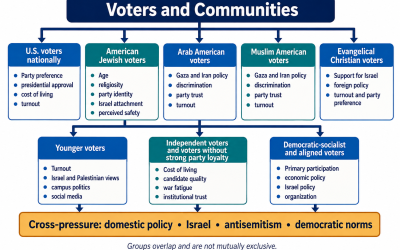
The model will not consider “the Jewish vote” as uniform. American Jewish voters differ by age, religious practice, political affiliation, attachment to Israel and perceptions of safety. Effects on American Jewish communities will be assessed separately from effects on Israel.
What the model will track
Some drivers are familiar: the cost of living, confidence in the economy, presidential approval, candidate quality, political spending and voter enthusiasm. Others may enter suddenly, including war, energy shocks, antisemitic violence, court decisions or election disputes. A development becomes important only a credible mechanism connects it to political behavior. A Middle East conflict, for example, might affect US politics through fuel prices, war fatigue, presidential approval, community mobilization or disagreement within a party. Extensive news coverage alone does not prove an electoral effect. Each assessment will draw on official records, complete public-opinion surveys, campaign-finance reports, nonpartisan evaluations of competitive races, established news organizations, and academic and policy research. Campaign statements will show positions and actions.
From political power to policy
Both Congress chambers pass laws and approve federal spending. The Senate also confirms many senior officials and judges. Committees in both chambers determine which issues receive hearings, investigations and legislative attention. The posts before and after the mid-term elections will examine pathways involving security assistance to Israel, arms transfers, Iran policy, regional diplomacy, protection for Jewish institutions, hate-crime enforcement, and federal civil-rights policy in schools and universities. This is a directional model, not a prediction machine. It is designed to identify movement, exposure and possible consequences—and show what evidence would change the assessment.
The next article will present the first model run. Later updates will compare new evidence with earlier findings before and after Election Day. Each will answer three questions:
- What changed?
- Why might it matter to control of Congress?
- What could it eventually mean for American Jewish communities and Israel?
Related Topics