


Thought Leader, Keynote Speaker and Best Selling Author on Reputational Security
If We Won the War, Why Don’t We Feel the Sweet Taste of Victory?
I often listen to podcasts while driving, a habit that turns traffic into thinking time. On one of those drives recently, I listened to Dan Senor interview Dr. Micah Goodman on the excellent Call Me Back show about whether Israel had won the war.
I cannot recommend Call Me Back enough. I listen to it religiously. Here’s the episode I’m referring to, it’s shorter than the usual full hour episodes and of course hearing these two giants converse is always thought-provoking and of tremendous value for anyone who wants to make sense of what we’re all going through:
As with many of the topics covered on the popular podcast, this conversation stayed with me long after the episode ended. But this time – it was not only for what they said, but also for what didn’t get nearly as much airtime as I think it deserves.
Allow me to elaborate…
How We Talk About Victory
When Dan asked Micah whether Israel had won the war, Micah answered by reframing the entire premise: you cannot declare victory or defeat unless you define which war you mean. Israel, Micah said, fought three distinct wars: the one against Hamas in Gaza, the broader confrontation with Iran and its proxies, and Hamas’ effort to break Israeli resilience.
On all three fronts, Micah argued, and most of us would agree – Israel prevailed: Hamas’ military capability was sharply reduced; Iran’s hoped-for coordinated collapse of Israeli defenses never materialized; and Israeli society, despite years of internal division, held together. Viewed through these lenses, Israel did not lose. It may even have emerged stronger.
I listened intently, agreeing with the analysis, but I couldn’t help but wonder: Do we truly feel a sense of victory?
In this climate (putting aside the fragility of the ceasefire and the future of this region feeling shakier than ever), with anti-Semitism still on the rise, ‘Zionism’ becoming a dirty word on the extreme Left and the extreme Right, and a volatile, exploitable Next Gen ushering in new kinds of leaders such as Zohran Mamdani, most Israelis and Jews around the world would say – no, victory is not what we feel.
I think we all owe it to ourselves to ask – why? That’s what I want to unpack here.
You see, we talk about victory as if it is a fixed, measurable metric. Israel’s prime minister even branded the war with the slogan “Total Victory,” framing expectations in absolute terms that were never realistic.
But as Simon Sinek writes in The Infinite Game, there are no winners or losers in games that never end; the real measure is your capacity to stay in the game. Geopolitics is exactly that, an infinite game.
In fact, Sinek uses the example of the Vietnam War to make his point:
The United States operated as if the game were finite instead of fighting against a player that was playing with the right mindset for the Infinite Game they were actually in. While America was fighting to ‘win,’ the North Vietnamese were fighting for their lives!”
Source: Simon Sinek, The Infinite Game (Portfolio/Penguin, 2019), Chapter 1: “Finite and Infinite Games”
Annoying as it may be to draw a comparison, clearly Hamas is playing an Infinite Game, while Israel is not. So perhaps the question isn’t whether Israel won or lost, but whether this war strengthened or weakened its ability to keep playing?
The Missing Front: National Reputation
I think that Dan and Micah were discussing an important question, but in doing so, a new, 21st Century front of war was overlooked or at least minimized. A front that could lead to a better strategic path if Israel were willing to take it, invest in it and lean into it without abandoning the other essential fronts.
I’m talking about the reputational front: the arena in which Israel’s narrative, legitimacy and global standing are contested. Micah mentions legitimacy later, when he talks about normalization (more on that below), but the reputational front is not limited just to legitimacy, because there are countries out there whose legitimacy isn’t contested, and yet their global reputation isn’t something we should aspire to emulate – such as Russia or North Korea.
Some call it the “eighth front,” and I have written about it in those terms myself. But the “eighth front” framing ties it too closely to the seven physical fronts Israel has faced over the past two years (Gaza, the West Bank, Iran, Iraq, Syria, Lebanon and Yemen). The reality is broader: This is not a front specific to this war or this moment. It is a strategic arena that exists in every war, between wars and across generations.
The reputational front is what determines a country’s long term ability not just to survive, but to thrive. For that to happen – just like with companies, people and organizations – a country needs to work hard on its global reputation. Israel’s adversaries recognized decades ago that reputation is a battleground in its own right (and Israel’s Achilles heel). Iran and Russia use it. China uses it. Hamas with Qatar as its benefactor built entire capacities around it. Israel, by contrast, arrived late to the game. Very late.
Even as Israel advanced militarily in the October 7 War, it lost enormous ground reputationally. Legitimacy in the last two years has fully eroded in the West. Every battlefield gain carried international reputational cost.
And yet – while Israel and the Jewish people at large are arguably now aware of this front that our adversaries have cultivated for decades, a front that can be shaped, influenced and even won, we’re still treating it as peripheral.
Normalization Is Key, But Is It Enough?
In the podcast, after laying out the military and regional fronts, Micah argued that normalization with Saudi Arabia is the missing ingredient for true strategic victory. Such a diplomatic breakthrough, he said, could reset Israel’s regional position, rebuild legitimacy and counter reputational losses.
It is a compelling argument. Normalization would reduce isolation, weaken extremist ideologies and create a more stable regional architecture.
But normalization cannot be the prerequisite for Israel’s reputational recovery.
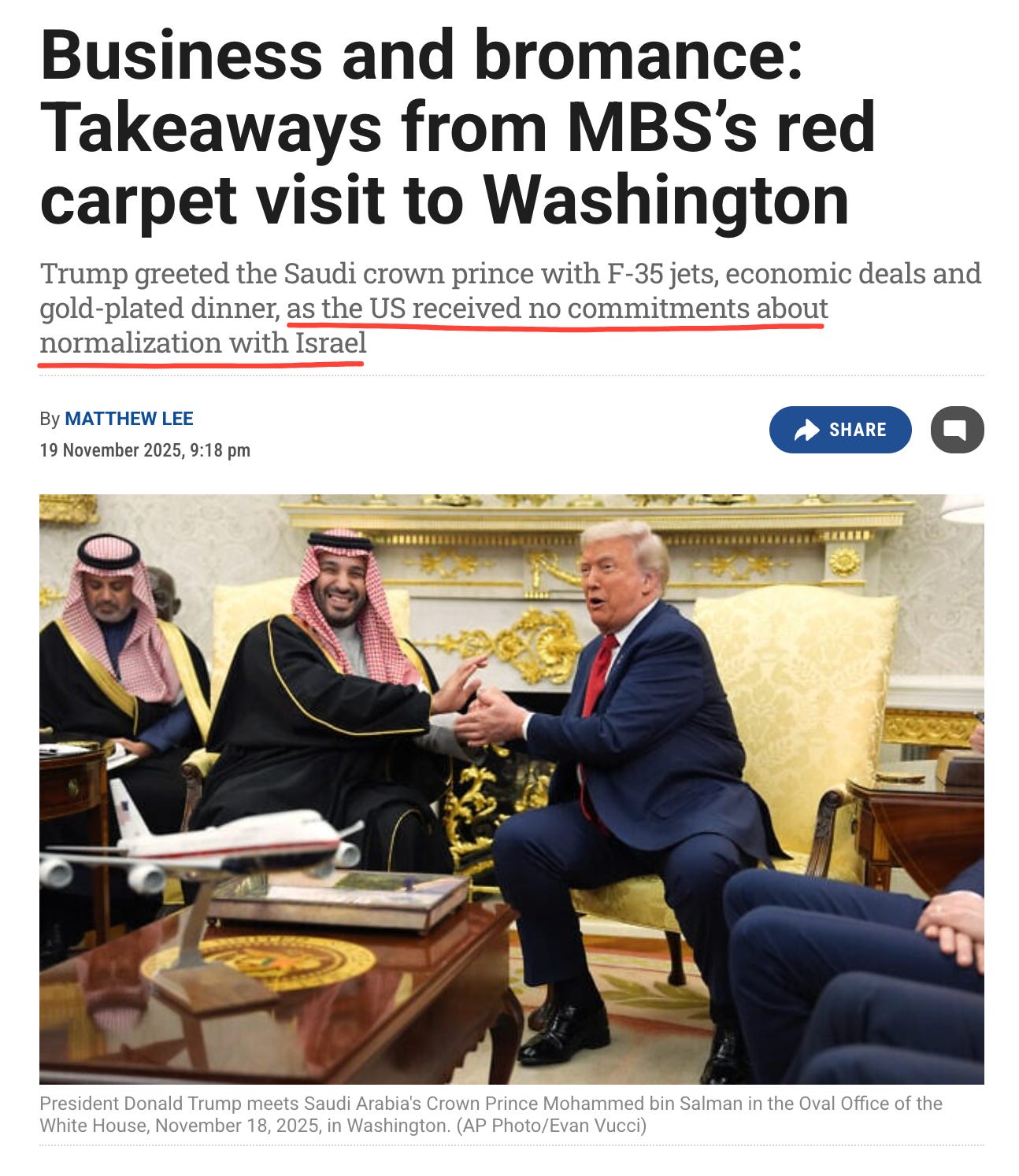
Why? Because the path to achieving normalization with Saudi Arabia is not fully in Israel’s control, and, as recent events show, it may not happen on the timeline Israel needs. With MBS’ visit to the White House and Trump decoupling Saudi demands from normalization, this process could take years – or stall entirely.
 Source: Times of Israel
So what happens in the meantime? Do we sit still? Hope? Wait for the perfect geopolitical moment?
We cannot afford to wait. Israel cannot pause reputational repair until normalization becomes convenient. The reputational front is being contested aggressively now, we’ve got to get in the game!
Reclaiming Agency on the Reputational Front
One of our most self-defeating assumptions is that reputation is something that happens to us, as if we have no agency over what people say about us. That it is the product of geopolitical weather, antisemitism, the strength of the Muslim Brotherhood, the wealth of Qatar or the biases of Western media rather than something that we can proactively shape.
That mindset removes agency from Israelis and from Jews around the world. And it’s why we will never really feel the sweet taste of victory unless we change our attitude. The path forward becomes clearer when we stop treating reputation as an afterthought and start seeing it as a strategic front in its own right.
Dan Senor knows this better than most. He and his co-author, Saul Singer, handed Israel and the Jewish people a reputational win on a silver platter back in 2009 when they launched what became their bestselling book, Start-Up Nation.
Supported by philanthropists and embraced across government and civil society, that story became the lens through which the world understood Israel’s contribution, what it can offer them and why it matters. Its impact lasted for more than a decade. It’s high time a new story is written for Israel. It should have been written well before October 7, but… better late than never.
And yet, I’ll be the first to admit that an updated, relevant and similarly compelling story is only one piece of what Israel needs now. Winning on the reputational front requires what winning on any front requires: strategy, infrastructure and coordination. We need mechanisms that connect government ministries with civil society actors. We need distribution platforms that move credible narratives faster than disinformation spreads. We need a digital Iron Dome. We need centralized training, tremendous resources and capacity, and shared doctrine.
In other words, we need to treat the reputational front as seriously as we treat all the others.
Do that, and a new story will have the force it needs to take hold. Do that, and Israelis and Jews abroad will no longer be playing defense in a fight our adversaries prepared for decades. Do that, and normalization – if and when it comes – will be a booster, not a prerequisite we cannot control.
This post is reprinted from REPUTATION NATION, my Substack newsletter, which you can subscribe to by clicking here.