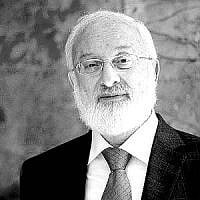
Interview of Dr David Gerbi, a Jew from Libya
Interview of David Gerbi – Tel Aviv July 15th, 2026
Laurent Cudkowicz: Hello, Doctor Gerbi. Thank you very much for this interview.
Doctor David Gerbi: Hello. It’s a pleasure to be here.
LC: Is there an inventory of the Jewish remains in Libya?
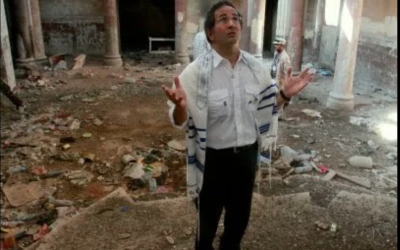
Dr DG: According to my information, there are some things remaining in the old Jewish neighborhood of Tripoli. There is also a “documentation center” inside the former Dar Yeroussi Yeshiva. This center holds numerous documents, Torah scrolls, ketubot (marriage contracts), etc. The Libyan authorities collected and gathered everything they found in the synagogues and in other Jewish sites in the “documentation center”.
There is also marble that has been recovered from cemeteries that they destroyed.
I also learned from the Italian Ambassador that the city hall’s underground is full of registration documents related to Jews: birth certificates, death certificates, ownership certificates… Some of these documents are also located at the Italian Embassy in Tripoli. As Libya is a former Italian colony, Italy holds some of these documents. Some of these documents are secret.
LC: Are you the only one to have been able to see some of these items?
Dr DG: Yes, I am the only one to know their location and who has seen them. When Gaddafi offered me the deal [INT: David Gerbi’s aunt was to be freed after having been the last Jew to remain in Libya until 2002, in exchange for allowing the normalization of relations between the US and Libya][1], he wanted me to see many of these Jewish remains with the goal of manipulating me and increasing my motivation to fulfill my part of the deal. I could see all the items; I was the only one, and many are asking me about them.
LC: Is there a difference between the way these items are kept in the Tripoli part of Libya and in Benghazi?
Dr DG: Yes, there is. In Benghazi, the only remains I could see were the bones of Libyan Jews, which are kept in a warehouse, some tombstones, and an old synagogue turned into a church. By the way, in Tripoli, I have also seen synagogues that were turned into mosques.
LC: What is the situation currently in Libya, particularly as far as Jews are concerned?
Dr DG: The play is well known. According to the statements, Jews are considered like all other Libyans. But in reality, a Jew cannot travel to Libya. He would be jailed right away. A Jew who would request an entry visa would face questions going back to Gaddafi’s Libya narrative: “Considering what Israel did to the Palestinians! We took your goods because of what Israel took from the Palestinians.” But Gaddafi didn’t take the Jews’ goods to give them to the Palestinians. He kept them for himself.
LC: The Jew-hatred goes back to King Idris’s time [INT: King Idris ruled over Libya from 1951 to 1969 and was overthrown by Gaddafi’s coup.] Pogroms took place under his rule.
Dr DG: Yes, pogroms took place in 1945, in 1948, and in 1967. In 1942, the regime was Nazi-fascist. It deported 712 Libyans, of whom 562 died in the Libyan concentration camp of Giado. Jew-hatred was steadily increasing. During the 1945 pogrom, 133 Jews were killed. It had been fostered by the British authorities, who wanted this violence to show that the Libyan population was too “barbaric” to be able to become independent. The 1948 pogrom caused the killing of 13 Jews. It was followed by a huge wave of Aliyah to Israel. Nevertheless, Israel was one of the countries that voted at the UN in favor of Libya’s independence in 1951. King Idris was quite good for the Jews. I had the opportunity to work with his grandson, who was also a refugee [INT: like the Libyan Jews]. My uncle, Elyahu Journo z”l, was an advisor to the King regarding the appointment of Ministers of the Government.
After 1948, the conditions became horrific for the Jews. Many of them left Libya [around 30,000]. Some of them emigrated to Israel even though the conditions were not so good there. Only a handful of Jews remained, for whom, financially, things were good. Problems started to appear with the Suez crisis, the Six-Day War in 1967, and particularly because of Nasser’s influence on all of North Africa. Jews from Tunisia, Algeria, and Egypt fled to Israel and other countries. King Idris gave us the possibility to flee but limited the amount of assets we could bring to 20 Libyan pounds per family.
At the beginning of the Six-Day War in 1967, with the start of the anti-Jewish riots, King Idris requested that the population “not soil their hands with Jewish blood”. This warning helped because the riots stopped. But during the 1967 pogrom, 17 Jews were killed.
LC: Was this a trick? [To prevent the population from attacking Jews?]
Dr DG: For some, he really meant it. Afterwards, he said to Jews that he could not guarantee their safety anymore. “Come and ask me to help you flee,” he declared, as if he was saying: “I will do you the favor of helping you flee and allowing you to take with you 20 Libyan pounds.”
Between 1967 and 1969, some Jews came back secretly to sell their goods for a tenth of their real value. After Gaddafi’s coup on September 1st, 1969, all the goods of the absentees “became the property of the Libyans who were in the country”. As of March 1970, a campaign to destroy the Jewish cemeteries was launched. Jews mainly remained in Rome instead of making Aliyah because they remained hopeful that they would recover their goods in Libya: shops, properties, etc.…
LC: Is the Jew-hatred deeply rooted inside the Libyan population? Depending on the period, this hatred increased or decreased. After October 7th, it increased in Arab countries where it had decreased before.
Dr DG: The Amazigh part of the population [INT: the Berbers] is on the side of Israel. They feel like Jews. They constitute a minority in the general population. Things are more complicated with the Muslim Sunni population, which identifies with the Muslim Brotherhood. Whereas the Shiites are supported and funded by Iran. The Minister of Interior went as far as trying to make the hijab compulsory for women, but it has not been accepted.
Sunnis, especially those who were educated abroad, are more open towards Jews. But the rest of the population will always make a connection between Jews and Israel. They want to be on the side of their “brothers in Palestine” but do not accept going as far as welcoming the Gaza refugees, as Netanyahu had suggested. In Misrata, the third-largest town, there is only business, without any consideration for each other’s identity.
LC: Is it true that the western part of Libya is under the influence of Turkey, whereas the eastern part is under the influence of the UAE—the United Arab Emirates? What are both countries looking for in Libya?
Dr DG: In 2019, as Marshal Haftar [INT: the Commander of the Libyan National Army who controls the country’s eastern part] tried to take over Tripoli, Turkey intervened. Haftar was supported by Russia at the beginning. Hydrocarbon resources raise interest. Now, he is supported by the UAE.
LC: What is Italy’s attitude in all this business? How is your struggle considered?
Dr DG: In 1970, Gaddafi sent back all Italians, even those who were born in Libya, in retaliation for colonial times. Relations became very complicated. Prime Minister Andreotti had tried to resume relations, and his successor Berlusconi invited him to Rome in 2009. Gaddafi demanded from Italy an apology to the Libyan people for having caused harm to them during the colonial times. But Libyans, apart from the Shiites, love Italy; they want to be under its influence and to trade with it. They admire its fashion and its culture and largely speak its language. Italian is still spoken by elderly people aged 70 and over. Italian courses are still given by the Italian Cultural Center in Tripoli. On a political level, Libya puts pressure on Italy using the number of African migrants it allows to cross towards the transit island of Lampedusa, an entry point to the European Union.
LC: How do Italian non-Jews react to your struggle to recover Jewish remains in Libya?
Dr DG: Unconcerned. It was 60 years ago; it’s old. But on the political level, there are some voices who say that they don’t want to open some old wounds in a context of complicated relations with Libya.
LC: But as far as the transfer of bones from destroyed Jewish cemeteries is concerned, it is difficult not to approve such an operation?
Dr DG: Yes, and still, my contacts with Italian authorities were not successful. Most of the time, people don’t want to appear to have been “in contact with Jews”. For them, I represent an “unresolved historic problem”.
LC: There is an exception, though?
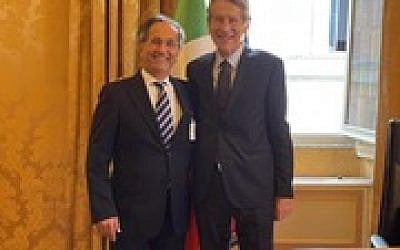
Dr DG: Yes, Senator Giulio Terzi di Sant’Agata, former Italian Ambassador to Israel, and later to Washington and to the United Nations in New York. He was also Minister for Foreign Affairs in Mario Monti’s Government. He is currently a Senator of the Italian Republic. He helps me in my struggle.
LC: I would like now to touch on your own personal history. When did your struggle start?
Dr DG: On September 11, 2001. I had just come out of a medical appointment and was drinking an espresso in Rome. I saw TV screens that were showing the Twin Towers disappearing in smoke. Seeing this smoke had a devastating effect on me. Instantly, the 1967 trauma surfaced. I was about to faint and had to sit down because I was about to lose consciousness.
This trauma was provoked by the fear I had experienced during the anti-Jewish pogrom in 1967 in Tripoli, when I was 12 years old. Seeing this smoke re-opened the wound I had kept buried for decades. Smoke acted like a trigger that reactivated my traumatic memory.
I only remember pieces of these moments: the furious crowd shouting, “Slaughter the Jews!”, the smoke coming out of the fires that had been lit under our windows and that was filling up our first-floor apartment.
I also remember the extraordinary bravery my mother showed by walking down to the ground floor to lock the main entrance to the building, which would prevent the rioters from going up.
I also did not forget our Libyan lady housekeeper, who was Black and Muslim. She saved us by warning us against leaving the house because the riots were approaching.
All these years, these memories remained buried. The September 11th pictures brought them all back to the surface of my consciousness, together with their emotional intensity.
So, I said to myself: enough with this terror, with this violence, the First Intifada, the Second Intifada, the Gulf War. Enough! What did we do to deserve this?
Jews like us have been driven out of their homes and have lost everything apart from the 20 Libyan pounds. And we didn’t become terrorists! We just started over again from scratch.
I was young at the time [in 2001], I was an idealist. I thought that peace was possible. I remembered my childhood in Libya, our good relations with the local population. I thought that the source of the problems was Israel. So, I promised myself that I would be back in Tripoli within a year [by 2002], so that I could show that living together was possible—Jews, Muslims, Christians, like during my childhood. I was used then to hearing the “Allah Akbar” on Fridays, to going to the synagogue on Saturdays, and to hearing the bells from churches on Sundays. There were examples of living together in the past, like in Spain, for example. So, I wondered: Why not in Libya, now?
God heard me. I succeeded in travelling back to Libya exactly from December 5th to December 12th, 2002. During that year [since September 11th, 2001], many strange events happened which allowed this journey to take place: an issue with my mother’s passport renewal, learning about my aunt being the last Jew remaining in Libya, etc.… and Gaddafi granting me a visa on humanitarian grounds so that I could do him this favor [INT: allowing Libya to normalize its diplomatic relations with the US, in exchange for my aunt’s freedom]. I thought, at that time, that the story would end after my aunt’s liberation, but in fact it is still going on today.
LC: How did you eventually understand that it was impossible for you to live in Libya?
Dr DG: First, there were many assassination attempts on me, in Tripoli as well as in Benghazi. Second, I saw hatred in the eyes of people, a hatred which prevented trust. During my 2002 and 2010, in spite of staying all the time in a hotel for security reasons, the Consul from Italy made me realize that I was still in danger: the food I was served, the [Libyan] secret service surveillance, all of this could be a danger. In these conditions, how could it have been possible for me to live there? Moreover, there were no Jews left, no synagogue; even the cemeteries had been destroyed. From all the signs a child could remember, none had survived. An entire world had disappeared.
Nostalgia can cause the psychologically dangerous feeling of having remained young.
So, limited visits, yes, why not? To visit Jewish remains, for a religious memorial ceremony, yes. But to live there? No.
And even if we succeed in going further, if there is a peace agreement and if trade can develop, this might be possible as well, but not more than that.
Hoping for compensation for goods from which Jews have been plundered is illusory. Sixty years after the facts, it will not happen.
LC: Rebuilding what had existed is impossible. But building something new, maybe based on the Abraham Accords, is possible, you think?
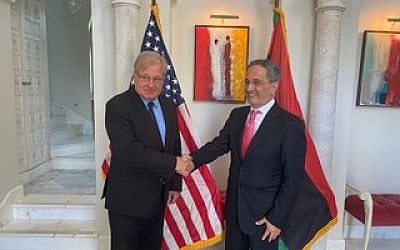
Dr DG: Yes, on this basis, things could be based on trade, like it happened with the United Arab Emirates. But bringing back all Libyan Jews to the country where they were born is impossible. It is completely finished.
LC: Is it the same for the 835,000 Jews who had to flee the other Arab and Muslim countries?
Dr DG: Yes, it is the same. It’s impossible. But building something new based on the Abraham Accords is possible. Libyans, as well as Jews, would benefit from it.
LC: What is your dream for the future?
Dr DG: I would like to conclude with a personal reflection.
After more than twenty years of working to preserve the heritage of the Jews of Libya, I have come to believe that the future cannot be built by attempting to recreate the past, but by creating new relationships founded on mutual respect.
For this reason, I look with great admiration at the experience of the Kingdom of Morocco.
I believe that Morocco today represents one of the most significant examples of the preservation of Jewish heritage in the Arab world. This is not the result of a recent policy, but the expression of a historical tradition that has been carried forward by successive generations of the Moroccan monarchy.
I wish to pay tribute to His Majesty Mohammed V, who protected Morocco’s Jewish population from the discriminatory laws of the Vichy regime during the Second World War; to His Majesty Hassan II, who maintained dialogue with the Jewish diaspora and encouraged important contacts between the Arab world, Israel, and the West; and to His Majesty King Mohammed VI, who continues this tradition through the restoration of synagogues, cemeteries, and historic Jewish quarters, while recognizing the Jewish component as an integral part of Morocco’s national identity.
I have also greatly appreciated the decision to restore the historic Jewish quarter of Marrakesh to its traditional name, El Mellah, together with its historic street names. These are powerful gestures demonstrating that memory can become an instrument of reconciliation and hope.
For these reasons, I regard Morocco as an important model for advancing the spirit of the Abraham Accords throughout North Africa and the Mediterranean.
I am also honored to begin a collaboration with the Adam Foundation for Human Fraternity, led by Mohammed Aabidou, whom I consider an outstanding promoter of dialogue among cultures and religions and a living example of the values of inclusion, mutual respect, and fraternity.
Looking ahead, I hope that all Libyan authorities committed to dialogue will contribute to safeguarding the historical and religious heritage of the Jews of Libya and to building new relationships of peace with Israel.
I hope that an international mission dedicated to preserving Libya’s Jewish heritage may one day be authorized. Such a mission could include the digitization of Jewish archives, the documentation of surviving historical sites, the recovery of the Jewish cemeteries of Giado and Homs, and the preservation of the Dar Bishi Synagogue and other sites connected with the Jewish presence in Libya.
I also hope that this mission may extend to Cyrenaica, including the remains of the Jewish heritage of Benghazi. In particular, I hope it will be possible to document and identify the human remains recovered from destroyed Jewish cemeteries so that they may receive a dignified burial in accordance with Jewish tradition. I also hope that any surviving historical archives relating to the Jewish presence in Benghazi and Cyrenaica can be identified, preserved, and studied.
My dream also includes one day returning to Benghazi to pay my respects, in prayer and remembrance, at the site of the former Jewish cemetery, as a tribute to the generations buried there and to a history that must never be forgotten. I would also like to honor the memory of Selwa Bugaighis, whom I had the privilege of knowing and who gave her life for a Libya founded upon dialogue, the rule of law, and human dignity. For me, remembering the Jews of Libya and remembering Selwa Bugaighis express the same principle: that every human life deserves respect and that reconciliation can only grow from memory, justice, and dignity for all victims of violence.
I hope that the authorities of eastern Libya will also embrace this spirit of cooperation and contribute to preserving this historical and human heritage for the benefit of memory, reconciliation, and future generations.
I also hope that an international delegation, including the Alliance of Rabbis in Islamic States, led by Rabbi Mendy Chitrik, may one day officially visit Libya to pray at Jewish cemeteries and holy sites, honor those who are buried there, and work together with the local authorities to preserve a heritage that belongs not only to the Jews of Libya but to the history of the entire Mediterranean.
I also hope that, in the future, I will have the opportunity to engage personally with all Libyan authorities committed to reconciliation and normalization, so that Jewish heritage may become a bridge of cooperation rather than a source of division.
My dream is not to bring history back. History cannot be reversed. My dream is that the memory of the Jews of Libya will finally be recognized and respected, and that it may contribute to building a future of peace, cooperation, and friendship among Israel, Libya, Morocco, and all the peoples of the Mediterranean.
LC: Thank you very much, Doctor David Gerbi. Thank you for your extraordinary work. Keep going.
–
[1] See the previous article on this subject: https://blogs.timesofisrael.com/libyan-jews-refuse-to-die/