
Iran and the Mechanics of Media Caution
When Freedom Does Not Fit the Template: Iran and the Mechanics of Media Caution
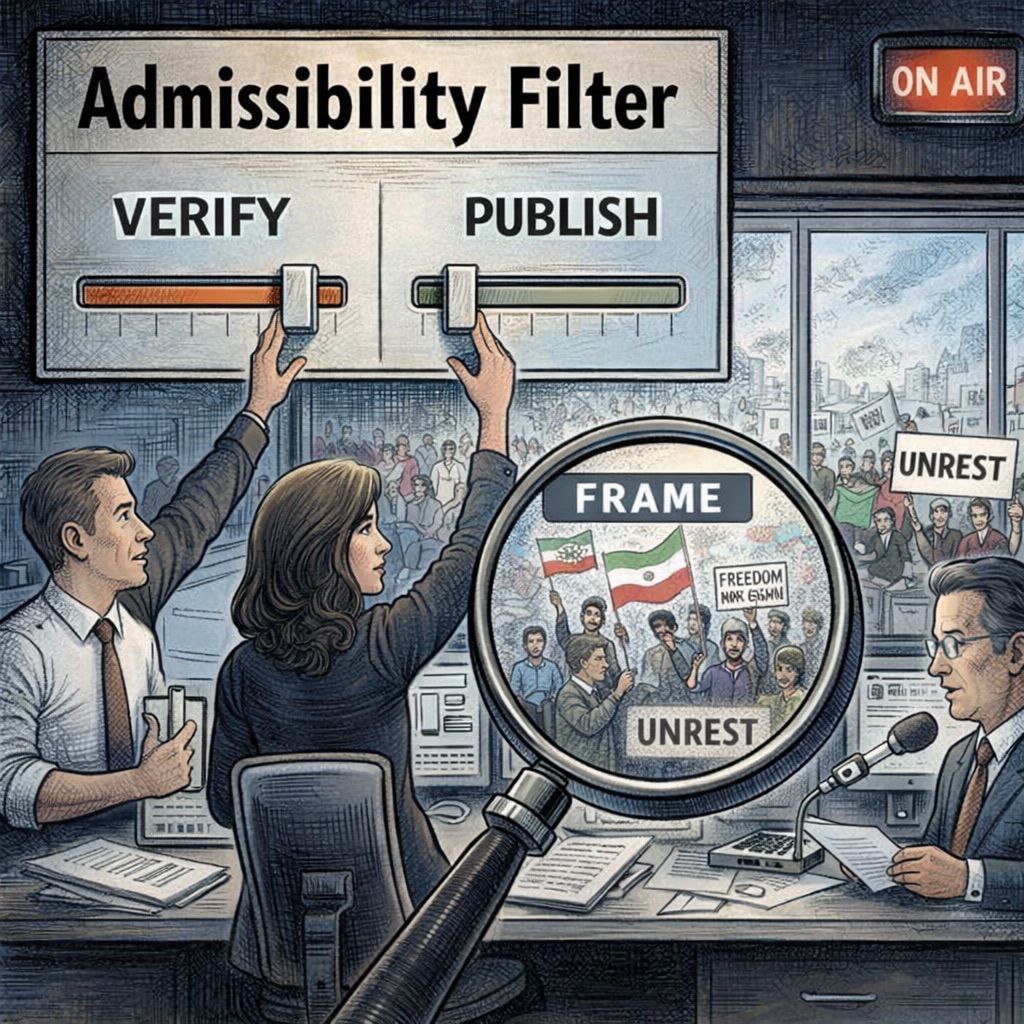 This post is not a referendum on which outlet is “good” or “bad,” and it is not a recycled opinion about someone else’s opinion. It is a technical note about how public intelligibility is produced or blocked when an event is fast, decentralized, and politically high-stakes. The current unrest in Iran is a clean case study because the observable trigger is economic while much of the street language is explicitly anti-regime, and that forces editors to choose a frame that is not merely descriptive but operational.
Here is the operational switch. Calling something “economic protest” implies correction: policy adjustment, price relief, a return to the same political architecture. Calling it “political protest” implies structural stress: legitimacy failure, possible rupture, uncertain succession. That is why the category matters more than the adjective. It decides what kind of reality the audience is allowed to imagine as plausible before the dust settles.
On the ground, multiple sources report that protests and strikes were sparked by the rial’s fall and inflation pressures, including the Tehran Grand Bazaar and other cities, and that the situation has produced deaths and large numbers of arrests, with figures varying across state media, rights groups, and wire services. The Algemeiner piece that prompted this post emphasizes a further point: alongside “cost-of-living” anger, slogans and targeting of regime symbols indicate that the movement is not limited to technocratic grievance but includes overt rejection of clerical rule. You do not need to accept every rhetorical flourish in that article to take the analytical lesson: when anti-regime demands are present, reducing the whole thing to prices is not neutral compression; it is a public reclassification of what the event is allowed to be.
Why do large outlets often default to that compression? Two filters do much of the work.
First filter: epistemic risk management. The standard line is “we must verify,” especially when much of the visual record is social media. In isolation, that is correct. In practice, it can become a brake on intelligibility precisely when verification is structurally difficult and the state restricts access. The new twist is that AI-manipulated images can be injected into an otherwise genuine stream, and fact-checking units then face a tempting but dangerous strategy: highlight a small number of manipulated artifacts in a way that encourages general disbelief. BBC Verify itself has publicly discussed AI-manipulated or AI-generated imagery circulating alongside real protest footage. The technical point is simple: “some items are fake” does not logically entail “the field is unreliable.” But in audience psychology, it often functions that way, and editorial choices can unintentionally (or conveniently) turn verification into a solvent.
Second filter: reputational and institutional risk. Naming the event as a potential legitimacy crisis forces uncomfortable revisions of prior explanatory comfort: claims about stability, reformability, or the efficacy of engagement. It is cheaper to keep the story in the safe box of “economic unrest,” where the implied policy response remains incremental and the larger narrative does not need to be re-audited. Reuters reporting even noted an official “dialogue” posture early on, which fits neatly into an “economic grievance” storyline, regardless of whether that storyline captures the whole meaning of the street.
This is why “media silence” is often not silence. It is minimal-mode transmission: cautious verbs, diluted headlines, story placement that signals “background noise,” and an interpretive emphasis that keeps the reader from switching cognitive gears. You do not need to lie to neutralize. You only need to maintain a frame that makes structural change feel irresponsible to even consider.
For a Jewish reader, this topic has an additional edge because Jewish historical experience contains too many lessons about the political function of euphemism. We have repeatedly watched real danger, real violence, and real discontinuity get narrated in procedural language until it becomes tolerable to ignore. That is not a claim that “Iran equals our history.” It is a claim about vigilance: when courage and suffering are translated into safe categories like “unrest” and “incidents,” the translation is not innocent. Jewish sensitivity to how words can cancel an event before it becomes publicly shareable is, here, an intellectual asset. It trains the eye to notice when description becomes a mechanism for postponing moral and political clarity, and it starts with refusing the comfort of euphemism.
So what do we achieve with this post?
We replace punditry with a reader-usable diagnostic. Instead of “believe this outlet” versus “hate that outlet,” we isolate the switch (economic versus political), the two filters (verification as brake, and institutional risk avoidance), and the predictable outcome (minimal-mode coverage that compresses possibility). That is not rhetorical fog; it is an audit method. It lets the reader test coverage across outlets by asking one non-mystical question: what does this framing make thinkable, and what does it make unthinkable, right now?
Yochanan