
Israel Cannot Outsource the Permission to Survive
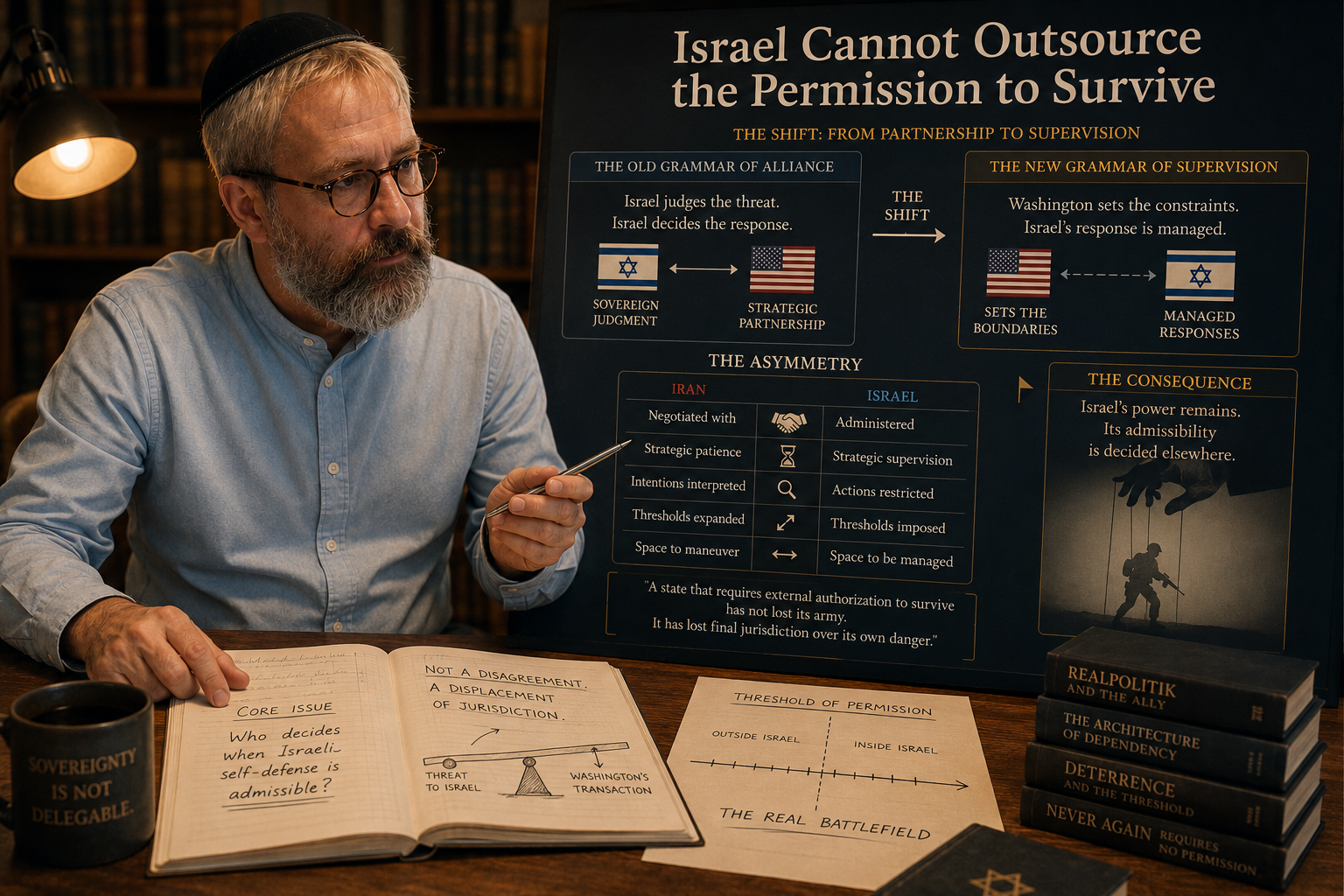
Concept and visual direction by Yochanan Schimmelpfennig.
Israel Cannot Outsource the Permission to Survive
There are moments when an alliance does not break. It simply reveals what it has become.
The latest confrontation between Donald Trump, Benjamin Netanyahu, Iran, and the fragile ceasefire architecture around the region is one of those moments. This is not an ordinary disagreement between Washington and Jerusalem over timing, diplomacy, retaliation, or de-escalation. It is a deeper dispute over jurisdiction: who ultimately decides when Israeli self-defense is admissible?
The issue is no longer abstract. When an American president tells an Israeli prime minister not to respond to Iranian attacks, warns him that Israel may soon be left “on its own,” and then presents an immediate ceasefire and final talks with Tehran as the higher priority, the matter is no longer coordination. It becomes control. Israel’s response is no longer weighed primarily against the threat it faces, but against the diplomatic transaction Washington wants to preserve.
For decades, Israel lived with a necessary fiction. The fiction was not that America would always agree with Israel. No serious person ever believed that. The fiction was subtler: even when Washington pressured, delayed, warned, armed, financed, or tried to restrain, Jerusalem retained the final right to judge its own existential danger.
That fiction is now cracking.
The current crisis exposes an asymmetry that polite diplomatic language usually hides. Iran is negotiated with; Israel is administered. Tehran’s intentions are interpreted as material for a possible agreement; Jerusalem’s actions are treated as a risk to be contained. The enemy becomes a partner in process. The ally becomes an object of management.
This is how dependency reveals itself: not through open abandonment, but through the quiet relocation of sovereign judgment into another power’s timetable.
Betrayal may be brutal, but at least it is readable. Management is more intimate. That is why it can be more destructive.
Israelis are very good at recognizing external hostility: the United Nations, European moral theater, academic accusations, media inversion, and anti-Zionist vanity disguised as ethics. That script is old and familiar. What is harder to recognize is the moment when limitation comes from inside the architecture of partnership and speaks the language of responsibility, stabilization, and shared interests.
That is why much of the Israeli debate remains one step behind the event. It continues to use the old vocabulary: deterrence, strategic alliance, qualitative military edge, American backing, shared security. These terms have not disappeared, but their function has changed.
Military superiority is not sovereignty if its use requires external permission. An alliance is not protection if it turns survival into a procedure managed by someone else’s priorities. Diplomatic support means little if it is suspended precisely when deterrence must be restored.
The brutal lesson is that Israel still possesses immense force, but the admissibility of that force is increasingly being decided elsewhere.
Trump did not create this dynamic. He merely says aloud what bureaucratic systems prefer to conceal. His style is vulgar, but that is precisely why it exposes the structure. When he says that he calls the shots, he is not simply making a gaffe. He is revealing the mechanism.
The United States wants Israel to survive, but it wants Israel to survive within a regional arrangement that Washington can control, explain, sell, and close. That may sometimes serve Israel’s interests, but it is not identical with them. Confusing those two things is the beginning of strategic infantilization.
Iran understands the difference perfectly.
Tehran does not need to defeat Israel in a classical war. It only needs to alter the conditions under which Israel may respond. It only needs to make every Israeli move pass first through Washington’s fear of escalation, Europe’s exhaustion, oil prices, media pressure, Arab capitals, electoral calculations, and the diplomatic illusion that a signature can replace deterrence.
The real battlefield, then, is not only the sky over Haifa, the Lebanese border, the tunnels, drones, missiles, proxies, or nuclear infrastructure. The real battlefield is the threshold of permission.
Once that threshold moves outside Israel, every enemy learns the same lesson: one does not only attack Israel. One attacks the arrangement that decides whether Israel is allowed to answer.
That is why the current moment is so serious. Israel is not facing Iran alone. It is facing a new political geometry in which enemies attack, allies supervise, and Jerusalem’s decision-space shrinks under the banner of responsibility.
Many Israelis reject this diagnosis because it is painful. It strikes at one of the deepest promises of the Jewish state: never again will Jewish survival depend on the permission of another power.
And yet this is where the current logic leads.
If Israel must wait for Washington to decide whether its response is proportional, useful, timely, convenient, or risky for an American agreement, then “never again” is quietly rewritten as “not without consultation.”
This is not a slogan. It is a strategic wound.
None of this means Israel should act recklessly. Sovereignty is not hysteria. Independence is not theatrical escalation. A serious state knows how to calculate, delay, remain silent, negotiate, and choose restraint.
But there is a decisive difference between chosen restraint and imposed restraint.
If Israel chooses restraint because it serves Israeli strategy, that is sovereignty. If Israel accepts restraint because Washington needs an agreement, that is supervision. If Israel delays its response because timing strengthens its position, that is prudence. If Israel delays its response because an American president does not want his diplomatic performance disturbed, that is subordination.
The Israeli political class must therefore stop pretending that this crisis is merely military or diplomatic. It is deeper. It concerns Israel’s very status as an actor.
Is Israel a sovereign state whose alliances amplify its power, or a protected object whose power is admissible only within externally defined limits?
That question lies beneath all the noise.
Answering it requires a merciless audit of dependency. American support remains indispensable. But indispensability is not innocence. Every guarantee contains a hidden command structure. Every umbrella casts a shadow. Every protection can become a leash when the protector begins to decide when the protected may defend itself.
This is the point at which sentimental pro-Americanism becomes dangerous. Gratitude is not strategy. Dependency is not friendship. Coordination is not obedience. And an alliance that cannot tolerate an ally’s independent judgment in a moment of danger is no longer merely an alliance. It is a system of supervision.
The task is not to abandon the alliance with America. That would be an infantile fantasy. Israel cannot replace the United States with slogans, resentment, or romantic dreams of total autonomy. Geography is cruel. Weapons systems are material. Diplomacy has supply chains. Power does not care about emotional purity.
But the opposite error is just as dangerous: to confuse alliance with permission.
Israel must remain allied with America without surrendering the final jurisdiction over its own danger. It must coordinate without internalizing obedience. It must listen without becoming administered. It must calculate with Washington, but not allow Washington to become the authority that decides when Israeli fear is legitimate enough to be acted upon.
This is especially important because the Iranian regime is not simply testing Israeli deterrence. It is testing the political architecture around Israeli deterrence. It wants to know whether Israeli force can be made procedurally unavailable. It wants to know whether Washington’s desire for an agreement can become Tehran’s indirect shield.
That is the deeper meaning of the present crisis.
Iran attacks. Washington negotiates. Israel is told to wait. Then the waiting is described as responsibility.
But responsibility to whom?
To the ceasefire? To the agreement? To the president’s legacy? To regional optics? To oil markets? To European fatigue? To the fantasy that Tehran can be stabilized by diplomatic choreography?
Israel cannot allow the answer to replace the question that matters most: what does Israeli survival require?
The Jewish state was not created so that Jewish danger could be processed through another empire’s calendar. It was not created so that self-defense would become an administrative file moving between Washington, Brussels, Doha, and the evening news. It was not created to ask whether its survival is convenient.
A state that requires external authorization in order to survive has not lost its army. It has lost something more fundamental: final jurisdiction over its own danger.
That is the line.
Israel is standing on it now.
Yochanan Schimmelpfennig