
Founder & Principal, Line of State
We Did Not Lose the War. We Lost Control of It
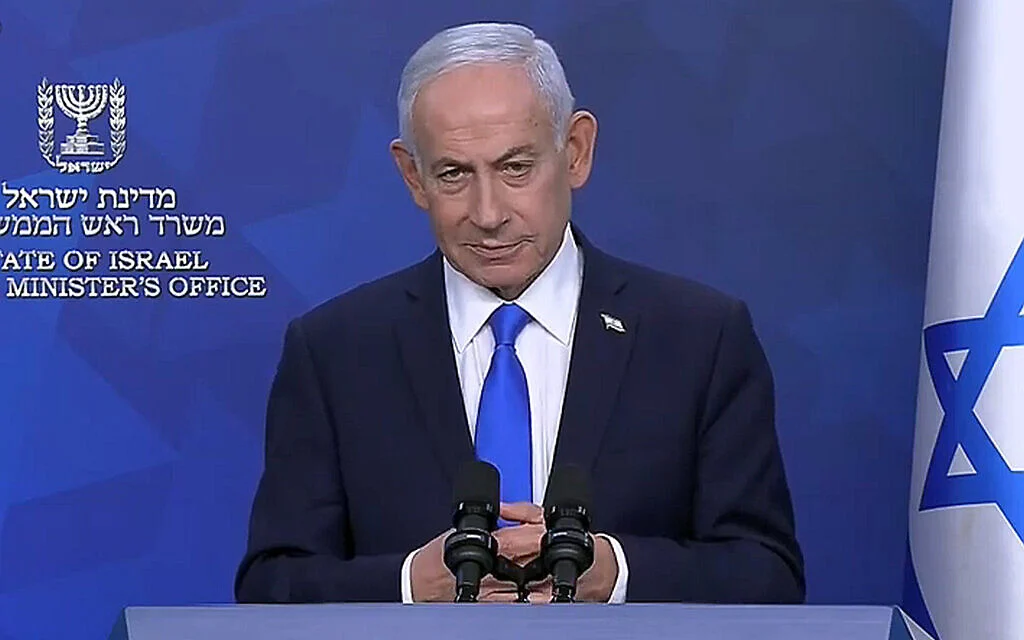
Prime Minister Benjamin Netanyahu delivers a statement, April 8, 2026. (GPO screenshot)
Israel has one condition of survival: the ability to fight, to continue, and to prevail on its own. Not with the help of others. Not in dependency. Any departure from this condition is not an advantage. It is a danger.
The danger greater than Iran itself is the moment Israel loses the ability to determine for itself when to stop, how much force to apply, and what the end state will be. Security does not rest on the goodwill of a foreign president, on a foreign electoral cycle, on fuel prices, or on an ally’s willingness to extend a war. When production, stockpiles, the timing of a halt, and the definition of the end state depend on an external actor, independence ceases to be a fact. It becomes an illusion.
The ceasefire announced this week did not reflect maturity. It reflected subordination. The President of the United States halted the bombing for two weeks not because Israel had completed its objectives, but subject to the reopening of the Strait of Hormuz. This is the decisive point: Washington acted according to Hormuz, the markets, and energy, not according to the end state required by Israel against Iran. The arrangement was American. Israel did not shape it. It was subordinated to it. The ceasefire did not close the gap between military effort and political outcome. It exposed who determined the outcome.
The fire was not halted because the war had ended. It was halted because authorization to continue had ended.
At that point, it became clear that Washington and Jerusalem were not waging the same war. At the outset, the objective was framed as regime change. It was later revised to the destruction of capabilities and the prevention of rearmament, without regime change. Two campaigns. Two objectives. One end state, and it was not set in Jerusalem. This is the difference between alliance and independence: in an alliance, the end is coordinated. In independence, it is decided.
The next stage is loss of independence and reduction to a subcontractor. Israel pressed to continue. It assessed that further gains could still be achieved by force. The decision was taken elsewhere. The ceasefire framework was managed without clarity, not over the arena of fighting, not over its scope, not over who was included and who was not. When the halt, the fighting, and the negotiations are dictated from outside, the state is using force, but it does not own it.
Independence is not a slogan. It is a system: stockpiles for a prolonged war, sovereign production lines, munitions free of foreign restrictions, defensive layers without foreign crews, and the ability to decide when to begin, continue, and end, without external dependence. Significant force was applied. Control over the pace of stockpile depletion, munitions consumption, and the end state did not exist. This is the most dangerous gap.
Trump is not an anchor. He is not an exception. He is the case in point. A shift from total threat to the language of settlement. Changes in objective, language, and tone. This is not instability. It is non-commitment as a method. Decisions change as interests change. Such a mechanism cannot serve as a security foundation.
The problem is structural. Israel’s arms imports rely on two primary sources. American aid dictates procurement lines, restricts their use, and shapes domestic industry. Deliveries are halted for external reasons. Systems are deployed with foreign crews. This is not only partnership. It is operational dependence. It is a vulnerability.
Recognition of the problem exists. It is not translated into policy. Reduction of aid is discussed while new agreements are prepared simultaneously. Recognition that does not lead to decision preserves dependence.
The 1956 Sinai Campaign is the classic warning.
Israel achieved a clear military success against Egypt, yet was forced to withdraw not because of battlefield outcomes, but due to American and international pressure. The outcome was determined by what was permitted, not by what was achieved. The same pattern appeared in Saigon during the Vietnam War, where large-scale military force was applied over years, yet the end state was fixed politically in Washington rather than operationally on the ground, and once that decision was made, the gains eroded. The pattern reappeared in Armenia against Azerbaijan, where a defence system dependent on Russia revealed in real time that external protection is not a commitment, but an option. Great powers act according to their interests. As long as interests align, they act. When interests diverge, they withdraw. A state that cannot act independently discovers this at the wrong moment.
In Europe, recognition is forming, but it is late, partial, and directed at the wrong threat. Ukraine exposed the limits of dependence. The shift toward domestic production is expanding, alongside increased stockpiles and extended endurance. Against Turkey, the gap remains. Greece and Cyprus are already acting accordingly. Front-line states do not wait for external definitions of threat. They build capability accordingly.
The implication is immediate: change in force build-up, stockpiles, definition of the end state, and allocation of resources.
There is no need to sever ties with the United States. There is a need to stop relying on it. Alliances are assets. They are not conditions of survival. The condition of survival is independence: the ability to act, continue, and prevail alone.
A state that does not control the end state of its wars does not control its security.
This war did not expose weakness. It exposed deviation from the principle.
That principle does not run through Tehran.
It runs through Jerusalem.
A sovereign Jewish state must be able to fight, continue, and prevail on its own.
–
Originally published in Hebrew in Maariv (April 9, 2026) under the title “לא איבדנו את המלחמה. איבדנו את השליטה בה”.
Related Topics
Related Posts