Former Director of Planning Ministry of Investment and Industrial development of Somaliland
Israel, Turkey, Somalia and Somaliland Recognition
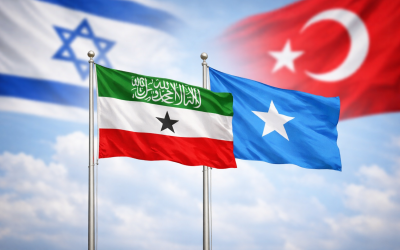
Israel surprise Dec. 26, 2025 decision to formally recognize the Republic of Somaliland has set off fireworks across the Horn of Africa. In a historic first, Jerusalem and Hargeisa signed a mutual declaration, declaring full diplomatic relations. Prime Minister Netanyahu framed this as in “the spirit of the Abraham Accords,” promising immediate cooperation in agriculture, health, technology and the economy. Somaliland’s president hailed it as “a step toward regional and global peace,” vowing partnerships to “promote stability across the Middle East and Africa”. Locally, the reaction was jubilation. Thousands of Somalilanders poured into the streets and stadiums of Hargeisa, chanting “Victory for Somaliland!” as their green-white-red flag flew beside Israel’s. The Somaliland foreign ministry spoke of “mass celebrations”. As Somaliland’s minister of the presidency put it, “the recognition and the arrival of Israel will not create violence, will not bring conflict and will never harm anyone,” promising cooperation on economy and water resources. After that Israeli Foreign Minister Gideon Saar visited Somaliland on Tuesday on a trip that was denounced by Somalia, 10 days after Israel formally recognized Somaliland.
By contrast, Mogadishu’s federal government and Ankara are incensed. Somalia’s president denounced Israel’s move as “illegal aggression” against Somali unity, and Turkey’s president Erdogan lambasted it as “illegitimate and unacceptable,” warning it could “destabilize the Horn of Africa”. Ankara called Israel’s initiative an “overt interference in Somalia’s domestic affairs”and joined Egypt and others in condemning what it portrayed as an expansionist, zero-sum plot. But beneath these postures lies a clear motive: Turkey’s own deep investment in Somalia is being challenged. Israel’s recognition “threatens Türkiye’s economic interests and presence … and poses a direct challenge to Somalia’s sovereignty”. In other words, Ankara is furious because it has poured millions into Somalia and fears losing influence if Somaliland gets official recognition.
Turkey’s Self-Serving Schemes in Somalia
Turkey’s critics argue that its “ Muslim brotherly” outreach to Somalia has often been a cloak for exploitation. Since 2011 Ankara has won no-bid, over 15-years concessions to run Mogadishu’s port and airport through its companies Albayrak and Favori. A UN report and independent Somali audits document how these contracts were awarded opaquely, ratcheting up tariffs and fees while slashing Mogadishu’s revenue share. For instance, Albayrak was officially collecting only $2.7 million monthly from the port in 2014, down from $6 million pre-2011, reducing Somalia’s port take from 55% to 16%. Equally lopsided, a massive oil exploration pact secretly granted Turkey virtually exclusive rights: no signature bonuses, just a 5% royalty, and a clause letting Turkish firms recover 90% of oil revenues before Somalia earns anything. “This is not a partnership; it’s plunder disguised as investment,” warned Somali analysts. Turkey’s trade footprint likewise exploded on Somalia’s account: Turkish exports to Somalia rose from $37.5 million in 2011 to $256 million by 2019, while Somali exports to Turkey languished under $7 million. A UN report and local unions even document labor abuses and bribery surrounding Turkey’s Mogadishu contracts.
– Turkish firms control Mogadishu Port and Airport via lucrative, opaque concessions
-Somali-Turkey oil pact grants Ankara near-total extraction rights and allows Turkey to recoup costs (up to 90%) before Somalia profits.
– Trade is heavily imbalanced: Turkey now sells dozens of times more to Somalia than vice versa.
-Millions in US dollars for interest ties have made Ankara a kingmaker in Mogadishu’s politics – a role critics say masks a geopolitical agenda
In short, rather than a benign partner, many Somalis see Turkey as an opportunist. “Turkey has evolved from friend to focused on geoeconomics and geopolitics.” Its state firms have been accused of “using state-sponsored corporations to exploit [Somalia’s] assets … as part of a development trap cloaked in the guise of religion”. These shady deals haven’t spared Turkey from scrutiny – US, French and Chinese satellites have reportedly been spying on Turkey’s planned launch zone in Somalia to see if it’s really a military gambit. turkey worried if Israeli by the same token, because Turkey’s Somalia spaceport “could eventually support advanced missile development”.
So when the Erdogan administration claims Israel’s move “undermines Somalia’s sovereignty,” it rings hollow. Turkey itself has shoved projects through Mogadishu with minimal oversight, then told Somalis it was all in their interest. The Turkey took over the Afghanistan-scale embassy in Mogadishu, military base, Hospitals, local infrastructure projects, and $300 million Mogadishu airport – once lauded as benevolence – look more like Turkey cementing a strategic foothold.
The Somalia Spaceport: A Geopolitical Gambit
An emblem of Turkey’s ambitions is its new equatorial launch complex on Somalia’s Indian Ocean coast. Announced by Erdoğan and Somali President in late 2025, this is Turkey’s first spaceport, under a bilateral accord.
The facility is reportedly being built on a 900-square-kilometer (about 30×30 km) site along Somalia’s Indian Ocean coast, specifically in the Jamaame dunes region near Kismaayo. As of January 2026, the first phase of construction has officially begun following the completion of feasibility and design studies.
The spaceport is designed to serve as an independent launch site for Turkish and commercial satellites, as well as a facility for testing long-range ballistic missiles (up to 2,000 km). While no final completion date has been disclosed, Turkey aims for a soft moon landing by 2028 using this infrastructure.
Turkish media highlight Somalia’s proximity to the equator – a technical boon for rocketry – and the sparse air/sea traffic that would make launches safer. Turkish engineers and companies like Baykar (defense drones) and Roketsan (rockets) are reportedly leading the build. Tapping this strategic location would give Ankara a rare equatorial launch site between the Red Sea and Indian Ocean – a corridor of intensifying competition.
Officially, Turkey calls it a “long-term push for technological independence” and commercial access to space, it’s a dual-use. As Turkey’s own think-tank director noted, “any launch complex can support both civilian and military applications,” and indeed he told Israelis to be “worried” about the facility’s potential for testing advanced missiles. In short, this spaceport is a geostrategic play, not a humanitarian and developmental project. By anchoring a launch base on Somalia’s coast, Turkey cements its footprint in the region – an “anchor [for] its aerospace ambitions in a strategically significant region” – while gaining a direct line to the Red Sea and beyond, that’s why Turkey continues to condemn Somaliland’ and Israel relations, and Israel has the right to build a base on the Red Sea.
Turkey’s somber ideology of Islamic brotherhood cannot conceal this reality. Its unasked-for “gifts” are really resources and privileges – a giant spaceport in Somalia, port and oil concessions, security pacts. Israel now has stark evidence of what Turkey means by “strategic depth” in Africa: a runway on the equator.
Somaliland’s Stability and Sovereignty
Somaliland’s contrasting track record deserves emphasis. Since declaring restoration in 1991, Somaliland has developed a peaceful, functioning state – entirely on its own merits. Unlike Somalia’s over three decades of civil war and Islamist insurgency, Somaliland has enjoyed relative stability and consistent governance. Multiple democratic elections have been held there, including a 2024 vote that saw a peaceful handover to an opposition party – one of only a handful of such transitions in Africa. International observers (from the US, EU and others) have monitored its polls and noted Somaliland as an “oasis” of stability in a turbulent region. Freedom House even rates Somaliland as “partly free” compared to Somalia’s “not free” status, but that was ignored by Turkey, and Israel recognized it.
All segments of Somaliland’s society have long craved international legitimacy. traditional leaders, religious leaders, youths, scholars, women’s and all the Somaliland citizens alike view ties with Israel as pragmatic and welcome. As one Somaliland citizen said, the recognition felt like vindication: “we know (Somalia and friends) are making noises, but there is nothing that will make Somaliland stop aiming high”. After three decades of requests ignored, the foreign ministry jubilantly announced that Somaliland “welcomes every country that recognizes our existence”. We must note that extremist militia’s (al-Shabab) have never gained a foothold in Somaliland, and its navy helps patrol the Red Sea approaches. In practical terms, supporting Somaliland adds a responsible ally on a crucial maritime chokepoint (the Gulf of Aden), rather than leaving it isolated or forcing it back under a corrupt, failing Mogadishu.
Israel’s Recognition and Red Sea Strategy
Israel’s diplomatic shift toward Somaliland follows logic as well as principle. Since the Abraham Accords of 2020, Jerusalem has sought new moderate partners. The Somaliland declaration explicitly ties into this framework. For Israel, a friendly Somaliland offers a front-row position on the Red Sea. Israeli strategists have noted that Somaliland could serve as a “forward base” for operations against Yemen’s Iran-backed Houthis – for intelligence, logistics and direct action. (Indeed, the UAE already runs a military base at Berbera port in Somaliland as part of its anti-Houthi campaign.) By contrast, Somalia’s coastline offers none of that stability.
American Jewish leaders hailed Israel’s recognition as a “strategic milestone” for Red Sea security. The Conference of President statement praised Somaliland’s record in counterterrorism and maritime surveillance, calling the new alliance a chance to “deepen economic partnership… and strengthen security and defense cooperation in the strategically vital Red Sea region”. In other words, Somaliland is a proven partner in fighting extremists and protecting shipping – exactly the kind of ally Israel needs on the African flank.
This contrasts sharply with Turkey’s approach: while Israel actually rewards a peaceful, Turkey has leaned on Somalia’s fractious government and extremist proxies. Ankara’s backing of various Yemeni and Libyan factions, for example, has often complicated regional security. Now Turkey accuses Israel of an “expansionist” policy just for supporting Somaliland’s right to exist. But really, Ankara’s real objection is that Somaliland’s recognition undermines Turkey’s shop in Mogadishu. As one Turkish analyst admitted, Turkey did mediate talks between Somalia and Somaliland and backed Mogadishu – all while building its own stakes. In the end, the recognition “threatens Türkiye’s economic interests and presence” in Somalia.
A New Balance of Influence
Turkey portrays itself as Somalia’s guardian of unity; in truth, it has often exploited that unity for selfish gain. With Israel now embracing Somaliland, a long-ignored but well-governed society finally has a major patron of its own. For the region, this offers a partial counterweight to Turkish dominance. Rather than depriving Somalia of aid or stability, Israel’s move diversifies who holds leverage in the Horn. Stable Somaliland can help clamp down on piracy and terrorism in adjacent waters, cooperate on Red Sea security, and encourage more balanced investment in East Africa.
Israel’s recognition of Somaliland should be seen not as an affront to Somalia or to regional powers, but as an incentive. It rewards good governance and might pressure Mogadishu to reform, rather than ceding it blindly to Turkish tutelage. Ultimately, the goal is regional stability: if Turkey’s heavy-handed, secretive projects breed corruption and dependence in Somalia, Israel’s open partnership with Somaliland can show a better path forward. As Jewish leaders noted, boosting Somaliland strengthens not only Israel’s security but that of the U.S. and its allies in the Red Sea.
The shift is a test of sincerity from all sides. If Ankara truly cared about Somali unity, its response would be to fix the flaws it has helped create – transparently renegotiating exploitative contracts and supporting reconciliation on fair terms. Instead it lashes out at Israel and Somaliland while sheltering its own gains. For Israelis and other world powers watching, the choice is stark: endorse a stable, democratic Somaliland now, or risk allowing one state (Turkey) to continue monopolizing a strategic region in the guise of aid. In this light, Israel’s bold recognition emerges as a step toward balance and peace – and a rebuke to short-sighted hegemonism.
Related Topics