
Israel-Turkey Tensions: Would Russia or America Back Erdoğan Against Israel?
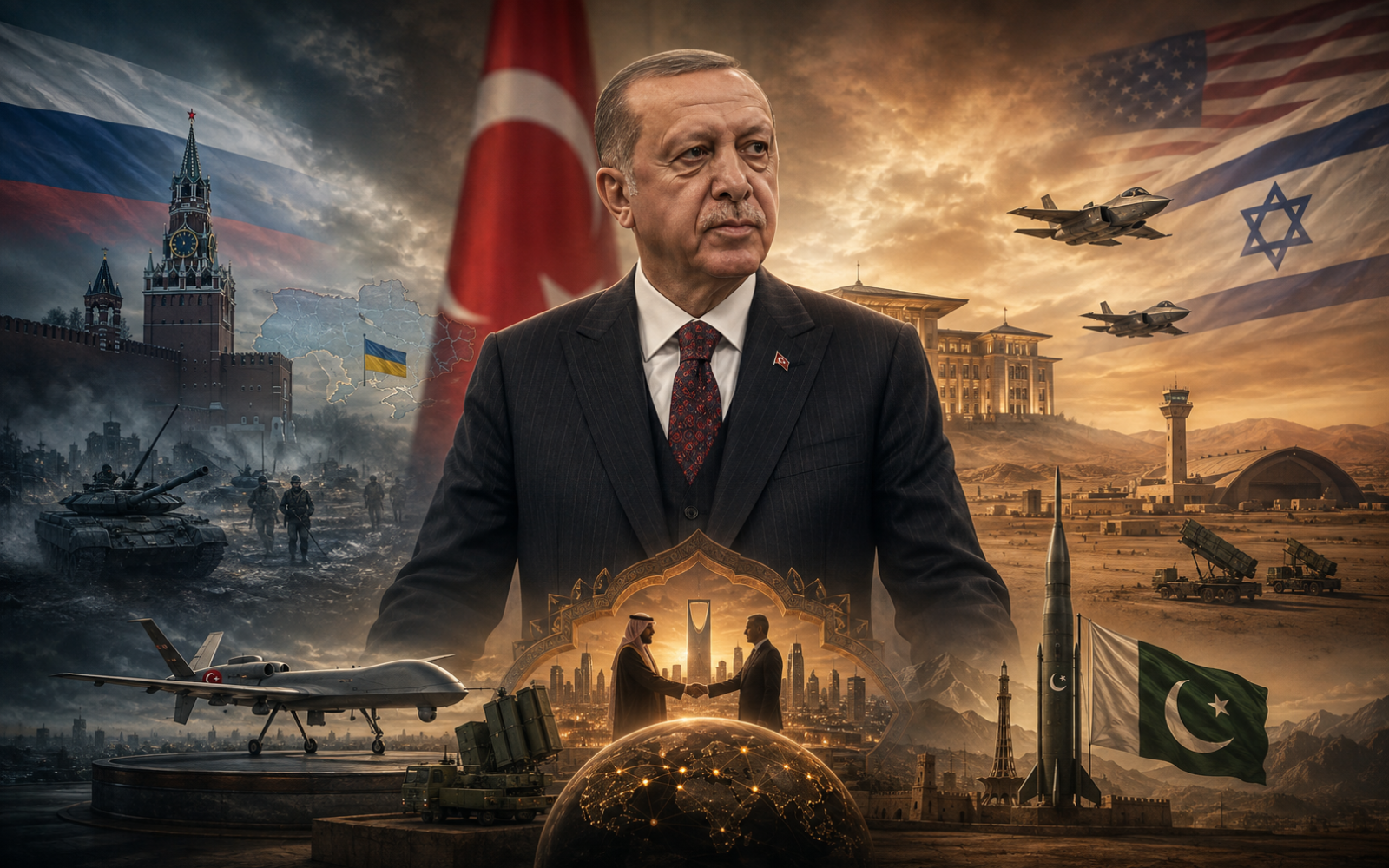
For years, Recep Tayyip Erdoğan has tried to keep Turkey close to competing powers at the same time. Turkey remains a NATO member, maintains important relations with Russia, supports Ukraine militarily, and is expanding its influence in Syria, where Israel sees some Turkish moves as a threat to its security and freedom of action.
Turkey has also joined Saudi Arabia and Pakistan in the new Makkah Joint Defence Agreement. This strategy has given Ankara considerable freedom. But rising Israel-Turkey tensions raise a harder question: if political confrontation turns military, who would actually stand behind Turkey?
Russia has no treaty obligation to defend Ankara, but Erdoğan has spent years keeping Moscow as an important strategic partner. America does have an alliance relationship with Turkey through NATO, but it is also Israel’s closest strategic partner. The Makkah Pact adds Saudi Arabia and Pakistan, but its limits have never been tested.
Turkey has many relationships. The real question is whether any of them would become serious strategic backing in a confrontation with Israel.
Ankara Arms Ukraine, Moscow Is Watching
Turkey and Russia are not enemies. They trade, cooperate on energy and continue talking even when their interests clash. Erdoğan has also tried to present Turkey as a possible mediator between Moscow and Kyiv.
But on Ukraine, Turkey is clearly not on Russia’s side. Ankara supports Ukraine’s territorial integrity and has provided military assistance to Kyiv. Erdoğan has also said Turkey will continue supporting Ukraine militarily.
The contradiction became sharper in August. Russia demanded explanations over reports that U.S.-made weapons held by Turkey could be transferred to Ukraine, including ATACMS tactical missiles, launchers and large quantities of ammunition.
On August 15, Moscow warned that such transfers could seriously damage Russian-Turkish relations. The message was clear: Russia’s willingness to tolerate Ankara’s balancing policy has limits.
This matters beyond Ukraine. If Turkey later enters a serious confrontation with Israel, why would Moscow take major strategic risks for a country that is helping arm Ukraine?
This does not mean Russia would support Israel against Turkey. Moscow has its own interests and disagreements with Jerusalem. But Turkey cannot assume that good relations with Russia would turn into Russian protection against Israel.
Cooperation with Moscow is one thing. Expecting Moscow to stand behind Ankara during a military confrontation with Israel is something very different.
NATO Ally — But America Is Israel’s Closest Friend
The United States presents Erdoğan with the opposite problem. Turkey is not simply an American partner. It is a formal NATO ally.
At the NATO summit in Ankara in July, the alliance again reaffirmed Article 5. A direct military attack on Turkish territory could therefore create a serious crisis for the entire alliance.
But there is an important distinction. NATO membership does not automatically cover every confrontation involving Turkish forces operating outside Turkey.
If Israel attacked Turkey itself, Washington would face an extraordinary NATO problem. If Israeli aircraft struck a military facility inside Syria where Turkish personnel or equipment were operating, the situation would be far less straightforward.
I examined this NATO dilemma in an earlier Times of Israel article, “Could an Israel-Turkey War Trigger NATO’s Article 5?” The central question was whether a clash involving Turkish forces outside Turkish territory would create the same collective-defence obligations as a direct attack on Turkey itself.
Then there is Israel. The United States has one of its deepest military and strategic relationships with Jerusalem. If Turkey and Israel entered a confrontation, Washington would suddenly have two important partners on opposite sides.
America’s first goal would probably be to stop the fighting rather than fight Israel on Turkey’s behalf. Recent events in Syria already show this approach.
After Israel struck Syria’s Abu al-Duhur airbase on August 18, Washington moved quickly to reduce the danger of an Israel-Turkey collision. On August 23, senior Syrian and Israeli officials held U.S.-mediated talks in Jordan, where preventing Israel-Turkey tensions from spilling further into Syria was among the issues discussed.
Washington’s response has therefore been to prevent its NATO ally Turkey and its strategic partner Israel from being forced into a confrontation in the first place.
For Erdoğan, that distinction matters. NATO remains central to Turkey’s security, but NATO membership does not mean Washington would automatically choose Turkey over Israel.
Syria: Where Words Could Turn Into War
Israel-Turkey tensions are no longer limited to Gaza, diplomatic disputes or angry speeches. Syria is becoming a place where Israeli and Turkish military interests could physically collide.
Turkey is increasing military cooperation with Syria. Israel, meanwhile, is determined to prevent military developments there that it believes could threaten its security or restrict its freedom of action.
The August 23 U.S.-mediated talks show that this danger is being taken seriously at the diplomatic level. The talks do not remove the risk; they confirm that Israel-Turkey tensions in Syria have become serious enough to require active efforts to prevent a military collision.
That creates a dangerous possibility. Turkey could eventually place personnel, drones, radar or air-defence systems at a Syrian facility. Israel could decide that those systems pose a threat and strike the site.
Turkish soldiers are killed. Ankara responds. Israel responds again.
A Syrian dispute could suddenly become a direct Israel-Turkey military confrontation even if neither government originally planned a war.
This is where Israel could gain strategic room. It would not necessarily need to attack Turkish territory to test Erdoğan’s position. A confrontation beginning inside Syria would create a much less straightforward NATO question.
Washington would probably try to stop the fighting. Moscow would have little reason to become Turkey’s military protector while Ankara continues supporting Ukraine.
The greatest danger is therefore not necessarily a planned Israel-Turkey war. It is a military miscalculation that forces both governments into decisions they had hoped to avoid.
The Makkah Pact: Powerful on Paper, Untested in War
The Makkah Joint Defence Agreement adds another layer. On August 7, Turkey, Saudi Arabia and Pakistan established a new defence framework designed to strengthen collective deterrence and military cooperation.
The attraction is easy to understand. In simple terms, Saudi Arabia brings enormous financial power, Turkey brings a large conventional military and a growing defence industry, and Pakistan brings nuclear deterrence.
Pakistan is the only declared nuclear-armed state in the pact. That sounds formidable, but nuclear weapons are not a magic shield.
Pakistan is not operating in a strategic environment where nobody else has nuclear weapons. Israel maintains its policy of nuclear ambiguity but is widely believed to possess nuclear weapons. India, Russia and the United States are also nuclear powers with major influence over the wider strategic balance.
Pakistan’s nuclear arsenal gives the Makkah Pact teeth, but it does not make the pact the biggest predator in the strategic ocean.
Nuclear weapons are mainly instruments of deterrence against extreme threats. They do not automatically solve a conventional military confrontation in Syria. The harder question is whether Islamabad would ever risk nuclear escalation because Turkish forces were struck during a confrontation that began outside Turkey.
There is also a more basic question. Would an attack on Turkish forces operating inside Syria even activate the Makkah Pact in the way Ankara might expect? The public details of how the agreement would work in such a situation remain unclear.
Saudi Arabia and Pakistan could provide diplomatic support, intelligence, weapons or other assistance. But entering a direct war with Israel would be a much larger decision, especially because both governments would have to consider the wider consequences for their relations with Washington.
The pact may strengthen Turkey politically and strategically. Erdoğan cannot yet know whether it would become a real military shield when tested.
Erdoğan’s Double Game Faces Its Hardest Test
This is the contradiction at the centre of Erdoğan’s foreign policy. Turkey wants NATO protection while keeping independence from Washington. It wants good relations with Russia while helping Ukraine. It wants greater influence in Syria while challenging Israeli security calculations. And now it has another defence arrangement with Saudi Arabia and Pakistan.
For years, this strategy has worked remarkably well. Turkey has expanded its defence industry, increased its regional influence and made itself important to both Washington and Moscow.
But diplomacy and war follow different rules. During diplomacy, Erdoğan can talk to Moscow, work with NATO, support Ukraine and challenge Israel at the same time. During a military crisis, other governments must decide how much risk they are actually willing to take.
This is where Israel may have an important advantage.
Turkey would enter such a crisis with uncertainty about external support. Israel would enter it with a more predictable strategic network. The United States remains Israel’s most important military and strategic partner, while India has also developed deep defence and strategic ties with Israel.
Russia is more complicated. Moscow is not Israel’s ally. But Turkey’s military support for Ukraine gives Russia little reason to become Ankara’s protector against Israel.
That creates an important difference. Israel cannot assume that America, India or any other partner would fight a war for it. But Jerusalem has fewer doubts about where some of its most important strategic relationships stand.
Turkey has much less certainty. Russia wants relations with Ankara, but Turkey is helping Ukraine. America values Turkey as a NATO ally, but Israel remains one of its closest strategic partners. Saudi Arabia and Pakistan have promised collective defence, but their new agreement has never faced a real military test.
Israel’s possible advantage is therefore not simply military strength. It is strategic uncertainty on the Turkish side.
That does not mean Israel would easily defeat Turkey, and it does not mean an Israel-Turkey war is about to begin. Turkey has a powerful military, a growing defence industry and major regional influence.
But uncertainty matters in military calculations. It could give Israel greater room to act, especially if a confrontation begins inside Syria rather than on Turkish territory.
Erdoğan has spent years gaining advantages by keeping Turkey between competing camps. That strategy has given Ankara remarkable freedom.
But every balancing strategy has a limit.
The deeper question behind Israel-Turkey tensions is not whether Turkey has friends. It clearly does. The question is whether those friends would take serious risks for Erdoğan in a confrontation with Israel.
Ankara cannot know the answer. Israel, meanwhile, would enter the same crisis with a clearer strategic network, a powerful military of its own, and fewer doubts about where its most important security relationships stand.
That uncertainty on the Turkish side may prove to be one of Israel’s most important strategic advantages if the rivalry in Syria ever becomes a direct confrontation.
August 24, 2026
Tokyo, Japan