Left is not a dirty word
It’s the final countdown
own work
Remember the days when the results of elections were a complete surprise? Remember waking up to find the polls had got it wrong and the results changed between midnight and 6:00 am the next day?
Oh yeah. The last elections, and the ones before that. Still, the polls seem to be returning results to the parties in the manner of AB targeted ads on social media. If we run a campaign on hate and fear, will we get more votes? Is more exposure of the candidates going to increase votes or is it better to lean back and let the other side shoot themselves in the foot?
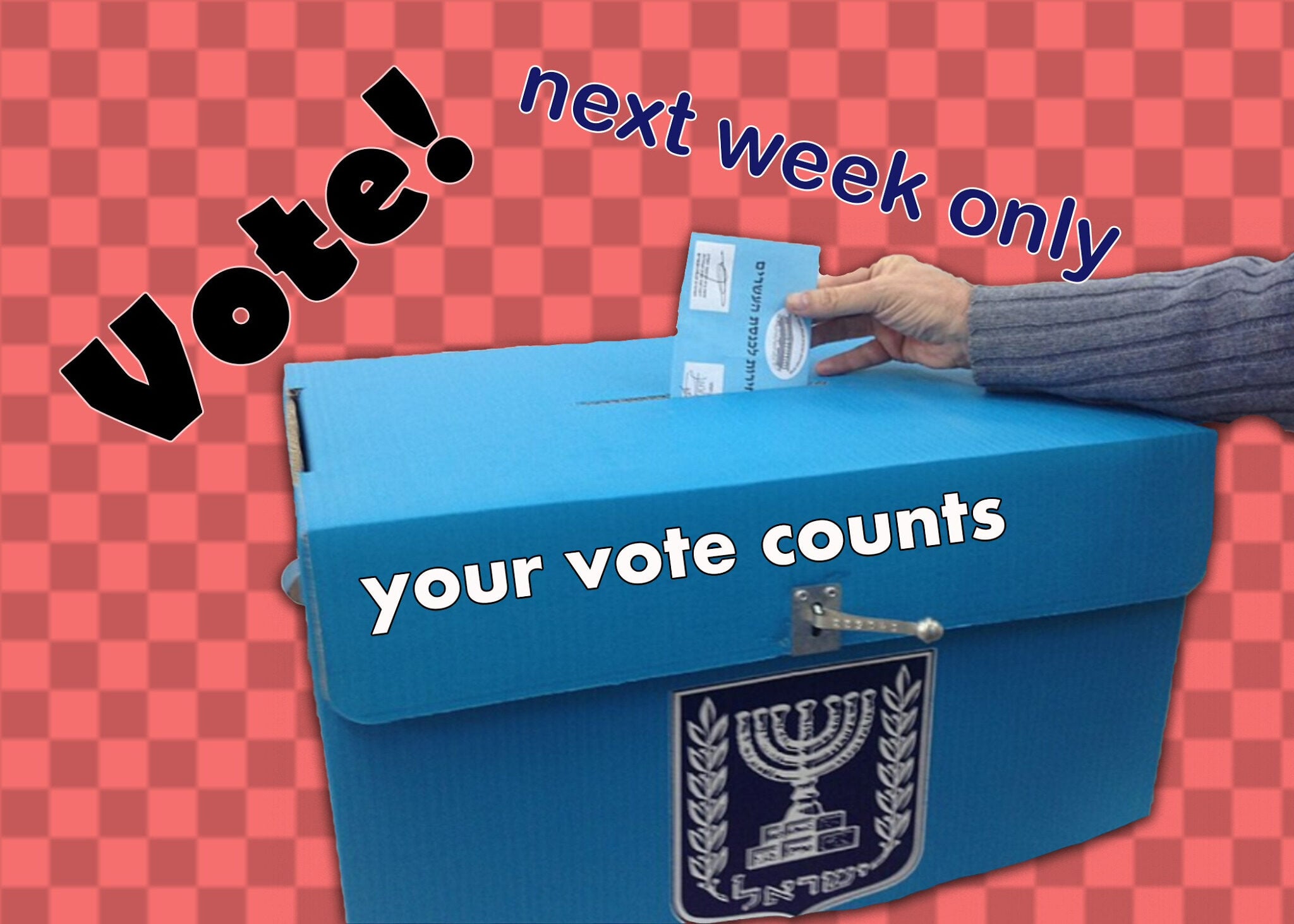
More than any election I can recall in the past, this year’s chances of victory or defeat seem to hinge on percentages – specifically percentages of voter turnout. We can expect a fair share of “gevalt!” tactics in the coming week, trying to panic one side into voting, at the same time discouraging others from getting to the polls. Most people know by now what they prefer, so the thinking goes, but they need a reminder – subtle or not so subtle – that their vote counts.
The predicted percentages go something like this: Haredim, over 85%, the rest of us Jews, around 65-70%, Arabs – 55%. Because the margins are so small in a race in which 37 parties are contending for 120 seats, the ability of a party to pass the Knesset entry threshold, the vote-sharing agreements for overflow votes and, yes, the voting percentage of supporters of the Haredim vs those supporting Arab parties can make a huge difference. Even shifts of one seat can mean the difference between the ability to form a coalition and the return to new elections in six months.
That is why Benny Gantz dropped out of the race, so that voters who might have “thrown away” their votes on him can now support one of the other “change bloc” parties. The other parties still in the running are working the numbers like poker players counting cards. They are running together or on separate lists, assured their choices will lead to greater overall support for their bloc.
This makes me believe that the way that the “change men” are lacking the slick campaign techniques of the Likud could be a fact that may ultimately work in their favor. Eisenkot stumbles on his words, making us feel that rather than reading from a script, he is speaking from the heart. Bennet looks straight at the camera and lets his emotions show just a bit, while Lieberman plays up his Russian accent and jokes with the interviewers before getting straight with them. Golan is a war hero who stands for ending the war. I assume these all play well enough in the polls.
The other parties still in the running are working the numbers like poker players counting cards
The Arab parties are starting off with more than one handicap. The war has exposed the basic personality split in this bloc. They have always been non-Zionist and pro-Palestinian statehood. But now they must grapple with the horrific ongoing war as well as with the complacency within Israel when it comes to the killing. They lost one member to a court ruling because his remarks could be construed as support for Hamas. But even those who do not support Hamas cannot support the war. Mansour Abbas was slammed for pointing out that the Zionist state was forced upon unwilling Arab citizens. For him, this is simply an obvious fact that must be recognized in going forward in a state in which Arabs are a large minority. He chose to run with a Jew, despite his Islamicist background, because the real needs that should be addressed by our government cross ethnic lines. It appears to be a gamble based on a long-term strategy.
Because the center-right Jewish parties have declared they will not form a government with Ra’am, Abbas’s party. That is, Arabs are excluded from the get-go. The one year Abbas sat in the coalition is now called an aberration rather than an experiment that was largely successful. That makes convincing Arab voters they have power in this election doubly difficult.
If you are really into the numbers, you can try to game the system. Say you want your Haredi party to continue to reap the benefits of coalition politics, including huge sums for yeshivas and free day care for families of men who do not legally work, pay taxes or serve the country. You might work out a way to split the Haredi vote so that your party is in a strong bargaining position, but the main party that is likely to cede the most to Haredim will also remain in power.
The leading parties are already working the numbers for the day after. The problem is that, if the polls are correct, the numbers do not add up, for either side.
Unfortunately, the most likely scenario, by a hair, is that Gadi Eisenkot will be asked to form a government, and he will have to rely, in some way, on parties that do not fit his parameters – Haredim, Arab parties, other right-wingers. And that will involve compromise on his tough positions on not accepting those who do not serve or those responsible for the massive f-up of Oct 7.
Right-winger Ofer Vinter, in contrast with Benny Gantz, is adding up his numbers differently. He is gambling on getting just enough votes to gain a couple of seats, thus placing himself in a position to make outrageous demands in return for joining a coalition. If he makes it, both sides will be courting. If he loses, he will take votes for a Likud coalition down with him. If you ask the pollsters, that one is too close to call.
Of course, a lot can happen in a week, including a new outbreak of war, new revelations in the Qatar-gate case, more racist slurs against Eisenkot (who was called a “Mizrachi ape, being ordered around by Ashkenazim), visits by American politician, etc.
In other words, the best strategy is still to take the time to vote, and to vote for the party that will move the country in the direction you believe in. Even if they do not lead the country, they may still have an impact on the war, on education, the environment or the flailing legal system. Forget about promises not to sit with this one or that one. Those go out the window as soon as coalition negotiations get underway. The only real question you should be asking yourself is whether you want things to continue as they are, or whether your vote can make a difference for change.
Related Topics